True Cost Per Sq Foot to Build a Deck: 2026 Maintenance Guide
Discover the true cost per sq foot to build a deck in 2026. Compare upfront material prices with 10-year maintenance expenses for wood, composite, and PVC.

The Upfront vs. Long-Term Cost Per Sq Foot to Build a Deck
When homeowners research the cost per sq foot to build a deck, they typically focus exclusively on day-one material and labor expenses. However, a deck is an exterior structure subjected to UV radiation, freeze-thaw cycles, and moisture intrusion. Evaluating the true financial impact requires calculating the Total Cost of Ownership (TCO), which factors in mandatory maintenance, sealing, cleaning, and eventual board replacement over a 10-year horizon. In 2026, material inflation and specialized labor rates have widened the gap between cheap upfront materials and expensive long-term upkeep.
According to structural durability data from the USDA Forest Products Laboratory, exterior wood degradation accelerates exponentially when protective coatings fail, meaning deferred maintenance on budget-friendly materials often results in catastrophic structural costs. This guide breaks down the real cost per square foot across major decking categories, exposing the hidden maintenance liabilities that inflate your long-term budget.
Material Breakdown: Initial Build Cost vs. 10-Year Maintenance
The table below illustrates the 2026 national averages for both the initial installation cost per sq foot to build a deck and the projected 10-year maintenance cost per square foot. Maintenance costs include professional cleaning, sealing, staining, and minor board replacements.
| Decking Material | Upfront Cost / Sq Ft (Installed) | 10-Year Maint. Cost / Sq Ft | 10-Year TCO / Sq Ft |
|---|---|---|---|
| Pressure-Treated Pine (SYP) | $18 – $26 | $12 – $18 | $30 – $44 |
| Capped Wood-Composite | $38 – $55 | $3 – $5 | $41 – $60 |
| Cellular PVC | $48 – $68 | $1 – $2 | $49 – $70 |
| Powder-Coated Aluminum | $65 – $90 | $0.50 – $1 | $65.50 – $91 |
Pressure-Treated Pine: The Maintenance-Heavy Budget Option
Pressure-treated Southern Yellow Pine (SYP) remains the most common choice for budget-conscious builds, but it carries the highest maintenance burden. Freshly treated lumber is saturated with chemical preservatives and moisture. It must weather for 6 to 12 months before accepting a penetrating stain. If you apply a film-forming acrylic sealer too early, the trapped moisture will cause the coating to blister and peel within months, requiring aggressive chemical stripping and sanding to fix.
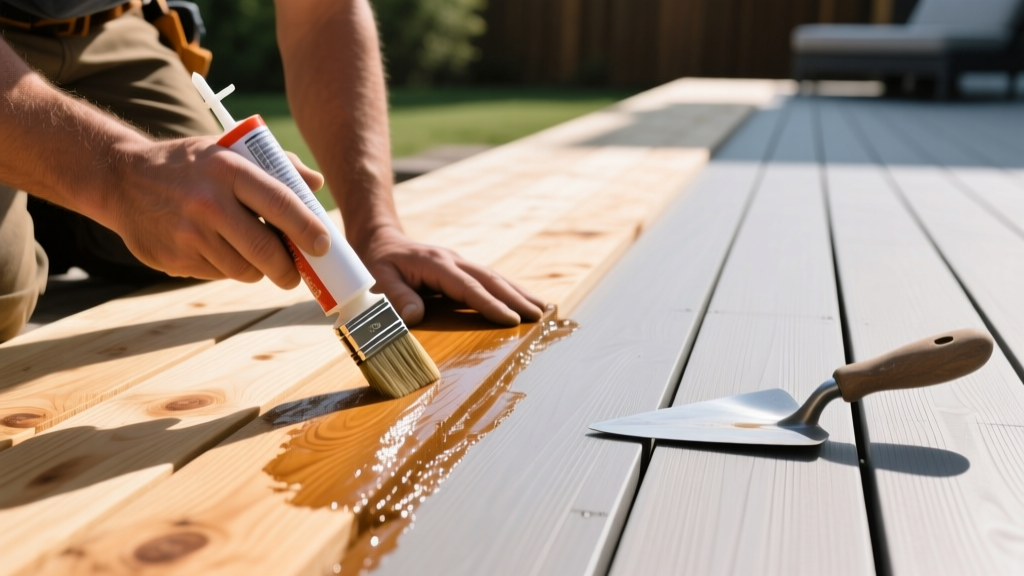
For ongoing protection, penetrating oil-based stains (such as Cabot Australian Timber Oil or Armstrong-Clark) are superior to solid acrylics. Oils soak into the wood pores and fade gradually, allowing for easy reapplication every 12 to 18 months without sanding. Hiring a professional to power-wash and re-oil a 400 sq ft deck typically costs $400 to $600 per visit, quickly eroding the initial savings of choosing wood.
Capped Composite: The Middle-Ground Compromise
First-generation uncapped composites are largely obsolete due to severe staining and fading issues. Modern capped composites, like Trex Transcend Lineage or TimberTech Legacy, feature a high-density polyethylene (HDPE) core wrapped in a polymer shell. While they never require sanding or staining, they are not entirely maintenance-free.
The primary maintenance liability for composite decking is mold and mildew growth in shaded, damp environments. While the polymer cap resists moisture, organic debris (pollen, leaves, dirt) can accumulate on the surface, providing a food source for mold spores. If the cap is deeply scratched by dragging heavy furniture, moisture can reach the wood-flour core, leading to localized swelling. Maintenance involves bi-annual washing with a composite-specific cleaner and a soft-bristle brush. Avoid high-pressure washing (>1,500 PSI), which can etch the polymer shell and void the manufacturer's warranty.
Cellular PVC & Aluminum: Premium Upfront, Minimal Upkeep
Cellular PVC boards, such as AZEK Landmark, contain no organic wood fibers, making them entirely immune to rot, insect damage, and mold penetration. The maintenance cost per sq foot is negligible, usually limited to an annual rinse with a garden hose and mild soap. However, PVC is highly susceptible to thermal expansion and contraction. Installers must strictly follow manufacturer spacing guidelines (often requiring 1/8-inch gaps per 10 degrees of temperature change) to prevent buckling or fastener pop-outs.
Aluminum decking (e.g., Wahoo Decks) represents the absolute lowest maintenance tier. It will not warp, crack, or burn. The only ongoing requirement is inspecting the powder-coated finish for deep scratches that could expose the raw aluminum to oxidation, though modern marine-grade powder coats make this a rare occurrence.
Hidden Maintenance Costs That Inflate Your Square Foot Price
When calculating the cost per sq foot to build a deck, contractors often overlook the substructure. The framing beneath your deck boards dictates the lifespan of the entire project. According to inspection guidelines from the North American Decking and Railing Association (NADRA), substructure failure is the leading cause of premature deck collapse and costly rebuilds.
- Joist Tape Application: Standard pressure-treated joists will rot from the top down where water pools beneath the deck boards. Applying a butyl-based joist tape (like Trex Protect or DeckWise WiseWrap) costs roughly $0.45 to $0.70 per linear foot. Skipping this $150-$250 upgrade on a standard deck can result in $2,500+ in joist replacement costs within 12 years.
- Hidden Fasteners vs. Face Screws: Face-screwing composite boards creates thousands of small divots where water pools, accelerating localized wear and voiding warranties. Using hidden clip systems (e.g., DeckWise Ipe Clips or manufacturer-specific grooved fasteners) adds $1.50 to $2.50 per sq ft to the initial build but eliminates the maintenance nightmare of replacing corroded surface screws and plugging holes.
- Flashing and Ledger Board Protection: The ledger board (where the deck attaches to the house) is the most critical failure point. Installing a copper or PVC ledger flashing cap prevents water from wicking behind the house's weather barrier. Replacing a rotted ledger board and repairing adjacent home siding can easily exceed $3,000.
The 5-Year Deck Maintenance Calendar
To protect your investment and keep your actual cost of ownership aligned with projections, follow this strict maintenance timeline based on your material choice.
Year 1: The Curing and Settling Phase
- Wood: Allow 6-12 months for moisture to equalize. Apply a penetrating oil-based sealer before the first winter or intense summer UV season.
- Composite/PVC: Inspect all hidden fasteners after the first freeze-thaw cycle. Thermal movement may require tightening of specific tension clips.
Years 2-3: The Surface Protection Cycle
- Wood: Perform the "water drop test." Sprinkle water on high-traffic areas. If it beads up, the sealer is intact. If it absorbs immediately, a light cleaning and recoat of oil-based stain is mandatory.
- Composite: Deep clean with a specialized composite deck wash to remove embedded pollen and environmental pollutants that can stain the polymer cap.
Years 4-5: The Structural Audit
- All Materials: Conduct a comprehensive substructure inspection. Check the ledger board flashing for debris buildup. Probe the tops of the joists with a screwdriver to test for soft spots indicating rot. Inspect stair stringer connections and ensure post bases are not sitting in standing water.
Final Budgeting Takeaways
The advertised cost per sq foot to build a deck is merely the entry fee. If your 10-year plan involves minimal weekend labor and zero sanding or staining, the higher initial investment in capped composite or cellular PVC mathematically outperforms pressure-treated wood. Conversely, if you possess the tools, time, and willingness to perform annual oil-based sealing, wood remains a highly cost-effective, albeit labor-intensive, alternative. Always budget for substructure protection during the initial build; it is the single most effective way to cap your long-term maintenance liabilities.
Written by
David NakamuraDavid Nakamura is a licensed architect (AIA) and construction technology writer focused on sustainable building methods, mass timber engineering, and high-performance building envelopes. He holds a Master of Architecture from the University of Washington and is a certified Passive House Consultant (CPHC). David spent eight years at the Seattle firm Mithun, where he led the design of three LEED Platinum projects, before founding his own practice specializing in net-zero residential design. He serves on the editorial advisory board of GreenBuilder Magazine and has authored peer-reviewed papers on cross-laminated timber (CLT) connections for the Journal of Structural Engineering. In his spare time, David teaches woodworking at Pratt Fine Arts Center and kayaks the Puget Sound.
More from David Nakamura
View all
Construction Cost
Labor Cost to Build a Deck Per Sq Ft: 2026 Installation Guide
Discover the exact labor cost to build a deck per sq ft in 2026. This installation guide breaks down contractor rates, complexity factors, and hidden fees.
Aug 4, 2026

Construction Cost
How Much Does It Cost to Build a 3 Bedroom House? Financing Guide
Learn exactly how much it costs to build a 3 bedroom house and explore 2026 financing options, construction loan types, and budget frameworks for your build.
Aug 4, 2026

Construction Cost
Cost to Build a Tennis Court: 2026 Guide
How much does it cost to build a tennis court in 2026? Breakdowns for asphalt, concrete, and synthetic surfaces plus fencing and lighting.
Jul 30, 2026