Fence Privacy Screen Cost Calculator & Pricing Guide 2026
Calculate exact 2026 costs for your fence privacy screen. Includes material pricing, linear foot math, post spacing, and hidden installation expenses.
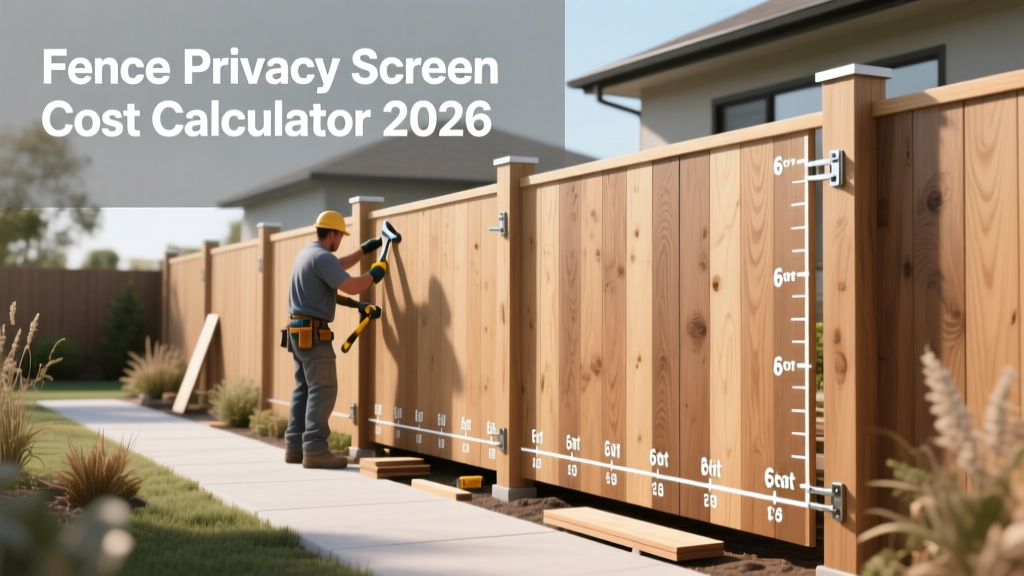
The True Cost of Fence Privacy Screens in 2026
Building a fence privacy screen requires precise material quantification and an understanding of localized labor rates. In 2026, the national average cost for a professionally installed 6-foot-tall privacy screen ranges from $32 to $85 per linear foot, translating to $4,800 to $12,750 for a standard 150-linear-foot backyard perimeter. However, these baseline figures from HomeGuide's 2026 fencing cost data obscure the granular expenses of hardware, concrete footings, and terrain-specific engineering that dictate your final budget.
This calculator framework bypasses generic estimates, providing the exact mathematical formulas and material matrices required to procure supplies and forecast labor for wood, vinyl, composite, and metal privacy screens.
Material Breakdown: Price Per Linear Foot & Square Foot
Selecting the right material dictates both the upfront capital and the long-term maintenance liability. The matrix below details 2026 market rates for premium privacy screen materials, assuming a standard 6-foot height.
| Material Type | Cost per Linear Ft (6ft High) | Cost per Sq Ft | Expected Lifespan | Wind Load Resistance |
|---|---|---|---|---|
| Bamboo Reed Rolls (Attached to existing wire) | $4.50 - $8.00 | $0.75 - $1.35 | 2 - 5 Years | Low (Tears in high wind) |
| Western Red Cedar (Horizontal Slat) | $35.00 - $55.00 | $5.80 - $9.15 | 15 - 25 Years | Moderate (Requires gaps) |
| Heavy-Duty Vinyl (PVC Privacy Panels) | $40.00 - $65.00 | $6.65 - $10.80 | 30+ Years | High (Engineered extrusions) |
| Composite Slatted (e.g., Trex Fencing) | $75.00 - $110.00 | $12.50 - $18.30 | 50+ Years | High (Heavy mass, rigid) |
| Corten Steel Panels (Corrugated) | $85.00 - $130.00 | $14.15 - $21.65 | 40+ Years | Extreme (Requires steel posts) |
Step-by-Step Quantity Calculator Framework
Contractors frequently under-order materials by failing to account for the pitch of the boards and the waste factor. Use this exact mathematical framework to calculate your procurement list.
Step 1: Calculating Board Quantities (The Pitch Formula)
For a traditional vertical cedar privacy screen using 1x6 dog-ear boards, you cannot simply divide the linear footage by the board width. A nominal 1x6 board actually measures 5.5 inches wide. If you install them with a standard 0.5-inch gap to prevent warping and allow minor wind passage, the 'pitch' (coverage per board) is 6 inches.
- Formula: (Total Linear Feet × 12 inches) ÷ Pitch = Total Boards
- Example (150 LF): (150 × 12) ÷ 6 = 300 boards.
- Waste Factor: Add 10% for end cuts, warped boards, and splitting during nailing. 300 × 1.10 = 330 boards.
Step 2: Post, Rail, and Concrete Quantification
Structural integrity relies on proper post spacing. For a 6-foot privacy screen, maximum on-center (OC) spacing is 8 feet to prevent rail sagging.
- Spans: 150 LF ÷ 8 ft = 18.75. Round up to 19 spans.
- Posts: 19 spans require 20 posts. Add 2 extra for corner bracing and waste = 22 posts.
- Horizontal Rails: A 6-foot screen requires three 2x4 rails (top, middle, bottom) per 8-foot span. 19 spans × 3 rails = 57 rails. Assuming 16-foot lumber, you need 29 pieces of 16-foot 2x4s (cut in half to yield 58 rails).
Hidden Costs & Edge Cases That Break Budgets
The most common budget overruns in fence privacy screen construction stem from environmental and regulatory variables that generic calculators ignore.
Wind Load Engineering and ASTM Standards
A solid privacy screen acts as a massive sail. According to guidelines referenced by the American Fence Association, solid fences in high-wind zones must be engineered to withstand specific lateral loads. If you live in a region with sustained winds exceeding 90 mph, building codes often require you to adhere to International Code Council (ICC) wind load standards (ASTM E330).
Soil Conditions and Rock Excavation
Standard pricing assumes loamy or clay soil. If your property sits on caliche, shale, or heavy bedrock, manual post hole digging becomes impossible. Renting a pneumatic rock hammer or hiring a contractor with a hydraulic auger attachment adds $8 to $15 per linear foot to the labor cost. Always perform a test dig with a manual clamshell digger before finalizing your labor contract.
DIY vs. Professional Installation: Labor Cost Matrix
Labor typically accounts for 40% to 60% of the total fence privacy screen budget. The table below breaks down 2026 installation rates based on the execution method.
| Installation Method | Cost per Linear Foot (Labor Only) | Timeframe (150 LF) | Warranty & Liability |
|---|---|---|---|
| DIY (Owner Labor) | $0.00 | 3 - 5 Weekends | None; owner assumes all risk |
| General Handyman | $12.00 - $20.00 | 3 - 4 Days | Limited; rarely covers structural failure |
| Licensed Fence Contractor | $25.00 - $45.00 | 2 - 3 Days | 1-5 Year workmanship warranty; insured |
Expert Procurement and Sourcing Strategy
To optimize your budget and ensure material consistency, avoid purchasing privacy screen materials from big-box home improvement centers for projects exceeding 100 linear feet. Big-box retailers often source wood from mixed mills, resulting in significant color and grain variation across your fence line.
Instead, source Western Red Cedar or composite materials from specialized regional lumber yards or direct-from-manufacturer distributors. When ordering composite privacy screens (such as Trex or Fiberon), request materials from the same manufacturing 'lot number.' Composite extrusions can vary slightly in hue between production runs, and a mismatched lot will result in a visibly segmented fence. Furthermore, specialized yards typically offer 'contractor pricing' tiers, which can reduce your material spend by 12% to 18% compared to retail shelf prices, even for non-licensed buyers purchasing in high volume.