How Much Does It Cost to Build a Fence? A Durability Analysis
Discover how much it costs to build a fence that lasts. We analyze 30-year total ownership costs, material failure modes, and 2026 pricing data.
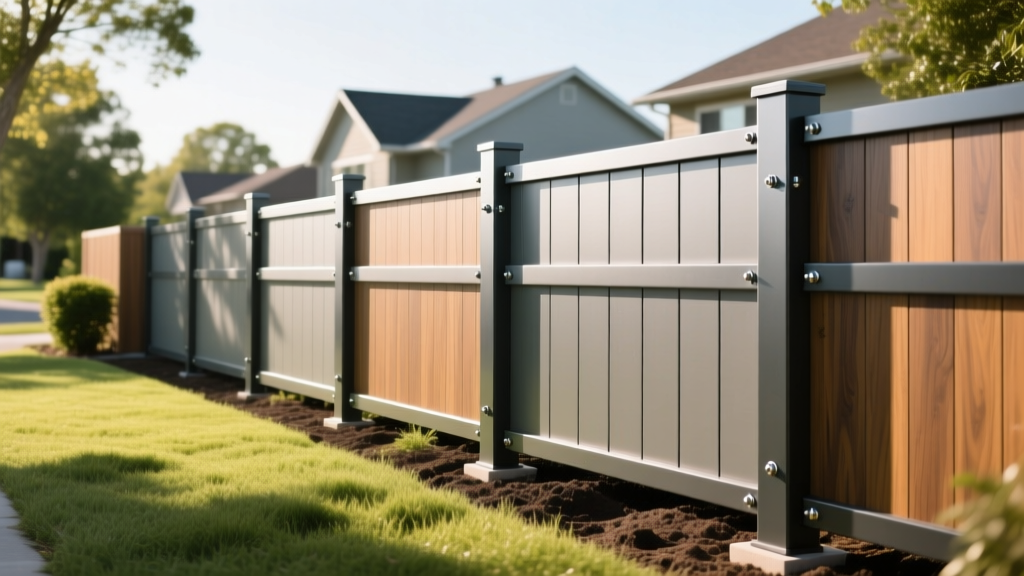
The True Cost Equation: Initial Build vs. 30-Year Lifespan
When evaluating how much it costs to build a fence, property owners frequently make a critical financial error: they only calculate the initial installation price. A $22 per linear foot pressure-treated pine fence and a $45 per linear foot cellular PVC fence appear to have a massive price gap on day one. However, when subjected to a 30-year durability analysis factoring in maintenance, rot mitigation, and replacement cycles, the total cost of ownership (TCO) often inverts. In 2026, material science and labor rates dictate that the cheapest upfront fence is rarely the most economical over its lifespan.
TCO = Initial Material & Labor + (Maintenance Cost × Frequency) + Replacement Factor (Initial Cost × Percentage of Fence Rebuilt over 30 Years)
Material-by-Material Durability & Cost Breakdown
Pressure-Treated Pine & Western Red Cedar
Wood remains the most common fencing material, but its durability is entirely dependent on chemical retention levels and installation depth. According to the American Wood Protection Association (AWPA), fence posts set in soil must meet the UC4A (Ground Contact) standard, requiring a minimum preservative retention of 0.25 pcf (pounds per cubic foot) for copper azole or ACQ treatments. Big box retailers frequently stock UC3B (Above Ground) lumber rated at 0.15 pcf. If a contractor uses UC3B posts and sets them in concrete, ground moisture will trap rot, causing structural failure in 5 to 7 years. Western Red Cedar offers natural tannins that resist decay, yielding a 20 to 25-year lifespan, but requires UV-blocking sealants every 3 to 4 years to prevent graying and splintering.
Cellular PVC & Vinyl
Not all vinyl fencing is manufactured equally. High-end cellular PVC utilizes a co-extrusion process, where a dense inner core provides structural rigidity and an outer cap layer contains high concentrations of titanium dioxide (TiO2) to block UV degradation. Mono-extruded vinyl, often sold as a budget alternative, lacks this cap layer and will chalk, fade, and become brittle within 10 to 12 years in high-sun environments. For privacy fences exceeding 6 feet in height, 2026 building codes in high-wind zones require internal aluminum reinforcement channels within the vinyl rails to prevent bowing and catastrophic wind-load failure.
Ornamental Aluminum & Steel
Aluminum fencing offers a 50+ year lifespan because it does not rust, but its durability relies entirely on the powder-coating standard. Specify AAMA 2604 compliant coatings, which require the finish to withstand 3,000 hours of salt spray testing without blistering. Steel fencing is stronger and resists impact better, but if the galvanized zinc undercoating is scratched during installation, oxidation will compromise the panel within a decade. Always demand isolated fasteners; if aluminum rails are screwed directly into pressure-treated wood without a rubber or plastic isolator, the copper in the wood treatment will trigger rapid galvanic corrosion, destroying the aluminum.
Wood-Plastic Composite (WPC)
Composite fencing, such as heavy-duty interlocking privacy systems, blends wood fibers with polyethylene. While immune to rot and insects, WPC is highly susceptible to thermal expansion. Composite boards can expand or contract up to 1/8 inch for every 10-degree Fahrenheit temperature shift. Installers must use specialized hidden fastener brackets that allow for lateral movement; rigidly face-screwing composite pickets will result in severe warping and buckling during summer heat waves.
30-Year Total Cost of Ownership Matrix
The following matrix projects the true cost to build a fence over a 30-year horizon, based on 2026 national average labor rates and material pricing for a standard 6-foot privacy fence.
| Material | Initial Cost (per lin. ft.) | 30-Yr Maintenance | 30-Yr Replacement | Total 30-Yr TCO |
|---|---|---|---|---|
| Pressure-Treated Pine | $22 - $28 | $8.50 | $12.00 | $42.50 - $48.50 |
| Western Red Cedar | $35 - $45 | $9.00 | $0.00 | $44.00 - $54.00 |
| Cellular PVC / Vinyl | $40 - $55 | $1.50 | $0.00 | $41.50 - $56.50 |
| Ornamental Aluminum | $45 - $65 | $0.00 | $0.00 | $45.00 - $65.00 |
| Wood-Plastic Composite | $55 - $75 | $1.50 | $0.00 | $56.50 - $76.50 |
Note: Maintenance costs include periodic staining/sealing for wood and power washing for vinyl/composite. Replacement costs account for the statistical probability of replacing 30-50% of wood pickets and posts over three decades due to rot or storm damage, as tracked by Angi's fencing cost databases.
Hidden Failure Modes That Destroy Fence ROI
Even premium materials will fail prematurely if installation ignores local geotechnical and meteorological realities. The American Fence Association highlights several critical installation errors that void manufacturer warranties and accelerate depreciation:
- Frost Heave in Northern Climates: Setting posts in straight-walled Sonotubes allows frozen soil to grip the concrete and push the post upward during freeze-thaw cycles. Posts must be set in bell-shaped footings below the local frost line, with the concrete sloped away from the wood at the grade line to shed water.
- Wind Load Miscalculation: A solid 6-foot privacy fence acts as a sail. In regions with sustained winds over 40 mph, standard 4x4 wood posts set 24 inches deep will snap at the grade line. Upgrading to 2.5-inch galvanized steel PostMaster posts ($35-$45 per unit) hidden behind wood pickets eliminates wind-shear failure.
- Concrete Moisture Trapping: Encasing the entire bottom of a wood post in concrete without a gravel drainage base traps groundwater against the end-grain of the wood. This creates an incubator for fungal decay. The correct method involves a 6-inch gravel base, setting the post, and pouring concrete only to 2 inches below grade, capping it with soil.
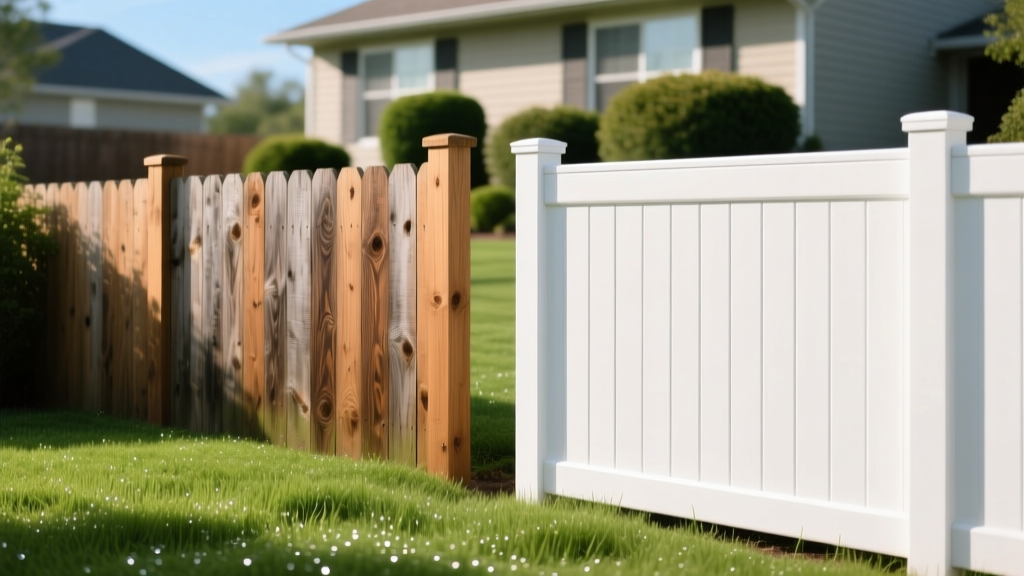
Decision Framework: Matching Soil and Climate to Material
To maximize the ROI of your fence build, select your material based on your specific environmental stressors rather than just aesthetic preference.
Scenario A: Coastal or High-Salt Environments
Avoid: Steel and standard aluminum. Salt spray accelerates oxidation and compromises powder coatings. Specify: Marine-grade stainless steel hardware with cellular PVC panels, or heavy-gauge aluminum coated to AAMA 2604 standards with stainless steel fasteners.
Scenario B: Heavy Clay Soil with Poor Drainage
Avoid: Wood posts set directly in earth or standard concrete. Clay retains moisture and expands, crushing wood fibers and accelerating rot. Specify: Composite or Vinyl panels mounted on galvanized steel anchor posts driven deep into the subsoil, bypassing the active clay layer entirely.
Scenario C: Budget-Constrained with High Wind
Avoid: Chain link (lacks privacy) or standard wood posts (will snap). Specify: Pressure-treated pine pickets and rails attached to galvanized steel structural posts. This hybrid approach keeps the initial cost under $28 per linear foot while providing the structural integrity of a $50 per linear foot commercial fence.
Frequently Asked Questions
Does adding a fence increase property value enough to justify the cost?
According to 2026 real estate appraisal data, a well-maintained privacy fence typically recoups 50% to 70% of its initial cost at resale. However, a rotting or leaning wood fence actively deducts value, as buyers factor in the demolition and replacement costs. Vinyl and composite fences yield the highest ROI due to their zero-maintenance transferability to new owners.
How deep should fence posts be set for a 6-foot fence?
The universal rule of thumb is that one-third of the total post length must be underground. For a 6-foot above-ground fence, you must use a 9-foot post and set it 36 inches deep. In areas with a frost line, the bottom of the concrete footing must extend at least 6 inches below that frost line, regardless of the one-third rule.
Written by
Elena RodriguezElena Rodriguez is a civil engineer and technical writer specializing in concrete technology, masonry systems, and ASTM/ACI compliance. She earned her B.S. in Civil Engineering from Texas A&M University and spent a decade at a materials testing laboratory, performing over 2,000 concrete compressive strength tests and masonry prism evaluations. Elena is an ACI-certified Field Testing Technician (Grade I) and a member of ASTM Committee C12 on Natural Building Stone. She currently consults on forensic engineering cases involving concrete failures and moisture intrusion. Based in San Antonio, TX, Elena is a proud member of the Society of Women Engineers (SWE) and coaches her daughter's FIRST Robotics team.
More from Elena Rodriguez
View all
Walls & Panels
Cost Analysis: Light Gauge Steel Framing Advantages and Disadvantages
Evaluate light gauge steel framing advantages and disadvantages through a strict cost analysis lens, comparing material, labor, and lifecycle expenses.
Aug 4, 2026

Walls & Panels
Gypsum Board Types: Exact Specifications, Thickness & Dimensions
Compare standard, Type X, and moisture-resistant gypsum board types. Get exact specifications, thicknesses, dimensions, and ASTM standards for your project.
Aug 4, 2026

Fire Resistance
Best Fire-Resistant Outdoor Decking Materials: 2026 Buyer Guide
Discover the best fire-resistant outdoor decking materials for 2026. Compare Class A PVC, aluminum, and hardwood options for WUI compliance and safety.
Aug 4, 2026