High-Tensile vs. Woven Wire Cattle Fence: A Lifespan Analysis
Compare high-tensile and woven wire cattle fence durability. Analyze coating classes, gauge thickness, and expected lifespans to maximize your ROI.
The True Cost of Fence Failure: Why Durability Dictates ROI
When evaluating a cattle fence, the initial cost per linear foot is only a fraction of the total lifecycle expense. A premature fence failure resulting from wire degradation, sagging, or structural collapse costs between $3.50 and $6.00 per linear foot to replace, factoring in modern labor rates and material disposal. For a standard 100-acre perimeter (approximately 5.5 miles of fencing), a failure at year seven instead of year twenty-five represents a catastrophic capital loss exceeding $100,000.
Making the correct material selection requires moving beyond generic 'field fence' labels and analyzing the metallurgical properties, tensile ratings, and mechanical failure modes of the two dominant agricultural barriers: woven wire and high-tensile smooth wire. This analysis breaks down the exact specifications that determine whether your cattle fence will last 10 years or 40 years.
Material Breakdown: Metallurgy and Mechanical Profiles
Woven Wire (Field Fence) Durability Profile
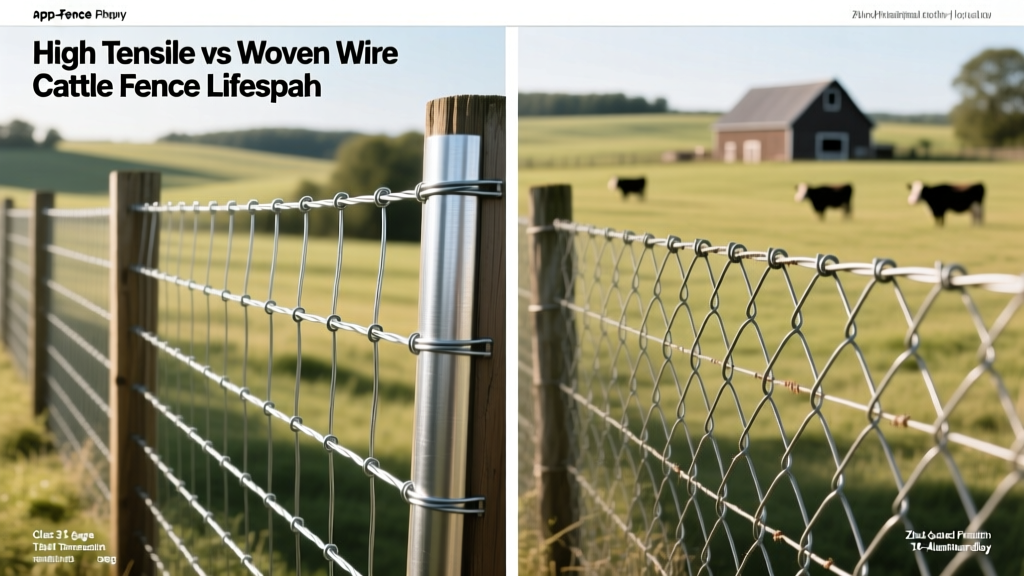
Woven wire consists of horizontal line wires and vertical stay wires locked together by mechanical knots (such as the S-Knot or Fixed-Knot). Its primary durability advantage is its physical barrier density, which prevents calves from pushing through and deters predators. However, its lifespan is heavily dictated by the knot type and wire gauge.
- Fixed-Knot vs. S-Knot: Fixed-knot woven wire utilizes a separate piece of wire to bind the intersection, creating a rigid joint that resists vertical sliding. S-Knots (or square knots) rely on the line and stay wires wrapping around each other. Under heavy animal pressure, S-Knots can slip, causing the fence to deform permanently. For high-durability applications, fixed-knot is mandatory.
- Gauge Specifications: Standard agricultural woven wire is typically 14.5-gauge (0.072 inches). For extended durability and resistance to bull impact, upgrade to 12.5-gauge (0.099 inches). The 37% increase in cross-sectional area exponentially increases the wire's resistance to permanent deformation.
High-Tensile Smooth Wire Durability Profile
High-tensile cattle fence utilizes smooth, unknotted wires stretched to extreme tensions. The durability of this system relies entirely on the wire's yield strength and the structural integrity of the corner bracing.
- Tensile Strength Ratings: Standard soft wire yields at approximately 50,000 psi. True high-tensile wire is manufactured to yield between 150,000 psi and 200,000+ psi. This high yield point allows the wire to stretch and snap back when a tree falls on it or a cow runs into it, whereas soft wire would permanently stretch and sag.
- Spacing and Droppers: High-tensile fences typically use 4 to 6 strands spaced 4 to 10 inches apart. To maintain wire spacing and prevent animals from pushing between strands, composite or wood droppers (spacers) are installed every 16 to 20 feet.
Never purchase Class 1 galvanized wire for a permanent cattle fence. Class 1 coating (0.40 oz/sq ft of zinc) will rust through in 2 to 5 years in humid or coastal environments. Always specify a minimum of Class 3 galvanization (0.80 oz/sq ft) for a 15-20 year lifespan. For maximum longevity (30-50 years), specify Zinc-Aluminum alloy coatings (typically 90% zinc, 10% aluminum), which offer superior sacrificial protection and barrier resistance against micro-cracking during tensioning.
Lifespan Matrix: Expected Years in Service by Specification
The following matrix correlates specific wire specifications with their expected functional lifespans and current 2026 material costs. Costs reflect wire-only pricing per linear foot, excluding posts and labor.
| Fence Type & Spec | Coating Class | Tensile Strength | Expected Lifespan | Wire Cost / Lin. Ft. |
|---|---|---|---|---|
| Woven Wire (14.5 ga, S-Knot) | Class 1 Zinc | ~60,000 psi | 5 - 8 Years | $0.65 - $0.85 |
| Woven Wire (12.5 ga, Fixed-Knot) | Class 3 Zinc | ~80,000 psi | 15 - 20 Years | $1.10 - $1.40 |
| Woven Wire (12.5 ga, Fixed-Knot) | Zinc-Aluminum | ~110,000 psi | 30 - 40+ Years | $1.50 - $1.90 |
| High-Tensile (12.5 ga, 5-Strand) | Class 3 Zinc | 150,000+ psi | 20 - 25 Years | $0.90 - $1.10 (Total) |
| High-Tensile (12.5 ga, 5-Strand) | Zinc-Aluminum | 200,000+ psi | 40 - 50+ Years | $1.20 - $1.50 (Total) |
Environmental and Mechanical Failure Modes
Understanding how a cattle fence actually fails allows you to engineer preventative measures during installation.
1. Ground-Level Corrosion (The Bottom Wire Problem)
The lowest horizontal wire on a woven wire fence is constantly exposed to soil moisture, fertilizer runoff, and decaying vegetation. This creates a highly corrosive microenvironment. Pro-Tip: When installing woven wire, leave a 2-inch gap between the bottom wire and the soil line, and apply a heavy brush-clearing regimen along the fence line. Alternatively, use a polymer-coated bottom wire if available from the manufacturer.
2. Tension Loss and Creep
All wire experiences 'creep' (slow, permanent deformation under constant stress). High-tensile wire is highly resistant to creep, but temperature fluctuations cause it to expand in summer and contract in winter. If a high-tensile cattle fence is not equipped with inline tensioners (such as Gripple tensioning tools) at the corners or mid-span, the wire will eventually sag below the 150 lb minimum tension threshold, rendering it ineffective for cattle containment.
3. Animal Impact and Memory
Woven wire absorbs impact by deforming. If a 1,500 lb bull runs through a 14.5-gauge woven fence, the S-Knots will slip, and the wire will stretch past its yield point. The fence will remain permanently bowed, creating a weak spot that invites future breaches. High-tensile wire, conversely, acts like a rubber band. It will stretch under the bull's impact and snap back into place, provided the corner posts do not pull inward.
Post Selection and Corner Bracing: The Hidden Variable
The most durable wire in the world will fail in five years if the corner posts lean. According to the USDA NRCS Practice Standard for Fencing, corner and gate posts endure massive horizontal loads that compound with wire tension and vertical weight.
The H-Brace Configuration
For high-tensile cattle fence, the diagonal brace is obsolete. You must use an H-Brace system. The standard dimensions require:
- An 8-inch diameter, pressure-treated wood corner post set 42 inches deep in tamped soil or concrete.
- A 4-inch diameter brace post set 36 inches deep, positioned 8 feet back from the corner post.
- A 4-inch diameter horizontal brace pinned into both posts.
- A 9-gauge galvanized brace wire looped from the top of the corner post to the bottom of the brace post, tightened with a 1/2-inch steel tensioning pin (stretcher bar).
This configuration transfers the horizontal pull of the wire into downward compression on the brace post, virtually eliminating corner lean.
Fastener Specifications: Avoiding the Staple Trap
A common installation error that drastically reduces a cattle fence's lifespan is driving fencing staples flush into wooden line posts. As the wood absorbs moisture and expands, or as the wire expands and contracts with temperature changes, a flush-driven staple will pinch the wire. This causes micro-fractures in the zinc or zinc-aluminum coating, exposing the raw steel core to moisture and initiating rust.
Installation Standard: Use 1.75-inch or 2-inch hot-dipped galvanized staples. Drive them only until snug, leaving a 1/8-inch to 1/4-inch gap between the staple crown and the wood. This allows the wire to slide longitudinally during thermal expansion without stripping its protective coating. For composite or steel T-posts, use specific extruded aluminum or UV-stabilized polymer clips rather than bending the post tabs, which damages the post's own galvanization.
Decision Framework: Selecting the Right System for Your Operation
Use the following operational parameters to finalize your cattle fence selection:
- Choose 12.5-ga Fixed-Knot Woven Wire (Zinc-Aluminum) if: You are managing cow-calf pairs where calf containment is critical, you border public highways (requiring a dense physical barrier for liability reduction), or you have high predator pressure. Expect to pay $4.50 - $6.50 per linear foot fully installed.
- Choose 12.5-ga High-Tensile (5-Strand, Zinc-Aluminum) if: You are managing yearlings or mature cattle in large rotational grazing paddocks, you have heavy snow loads or falling timber risks (the wire will shed debris better), and you need to minimize upfront capital expenditure. Expect to pay $2.00 - $3.50 per linear foot fully installed.
For further technical specifications on wire coatings and knot structures, consult the Red Brand Fence 101 Educational Hub or your regional agricultural extension office. By matching the metallurgical properties of the wire to the specific mechanical stresses of your terrain and livestock, you ensure your perimeter remains secure for decades, not just seasons.