The True Cost to Build a Fence in 2026: Material & Labor Breakdown
Discover the exact cost to build a fence in 2026. We break down material prices, labor rates, and hidden fees for wood, vinyl, and metal fences.

The Baseline: National Fence Construction Costs
Calculating the accurate cost to build a fence requires moving beyond basic per-foot averages. In 2026, the national average for a standard 150-linear-foot residential privacy fence ranges from $3,400 to $7,200 installed. However, this baseline fluctuates wildly based on material selection, regional labor rates, and subsurface soil conditions. While lumber prices have stabilized compared to the early 2020s, the cost of specialized PVC resins and powder-coated aluminum alloys has driven up premium fencing options.
2026 National Cost Highlights
- Average Total Spend: $4,850 (for 150 linear feet of 6-foot privacy fencing)
- Low-End (Chain Link): $1,600 - $2,400
- High-End (Composite/Wrought Iron): $8,500 - $13,500
- Labor vs. Material Ratio: Labor typically accounts for 45% to 55% of the total invoice.
Material Deep-Dive: Pricing per Linear Foot
The choice of material dictates not only the upfront cost to build a fence but also the long-term maintenance budget. Below is a comparative matrix of the most common residential fencing materials, reflecting 2026 market pricing for both raw materials and professional installation.
| Material Type | Material Cost (per LF) | Installed Cost (per LF) | Lifespan & Maintenance |
|---|---|---|---|
| Pressure-Treated Pine | $8 - $14 | $22 - $32 | 15-20 years. Requires annual sealing. |
| Western Red Cedar | $15 - $22 | $30 - $45 | 20-30 years. Naturally rot-resistant. |
| Vinyl (Virgin PVC) | $16 - $28 | $35 - $55 | 30+ years. Zero maintenance beyond washing. |
| Aluminum (Ornamental) | $18 - $30 | $40 - $65 | 50+ years. Rust-proof powder coating. |
| Wood-Plastic Composite | $25 - $40 | $55 - $85 | 25-30 years. No painting or staining. |
When selecting wood, specify #2 grade or better pressure-treated Southern Yellow Pine for structural posts. For vinyl, insist on virgin PVC with UV inhibitors (such as profiles from CertainTeed or Barrette) rather than recycled PVC, which is prone to brittleness and yellowing within five years in high-sun climates.
Labor Variables: Where the Budget Expands
According to Angi's 2026 fencing cost report, labor rates average $35 to $60 per linear foot, but this number is highly sensitive to site conditions. A flat, clear backyard in a region with loamy soil will sit at the bottom of that range. The following variables will trigger labor surcharges:
Subsurface Soil and Bedrock
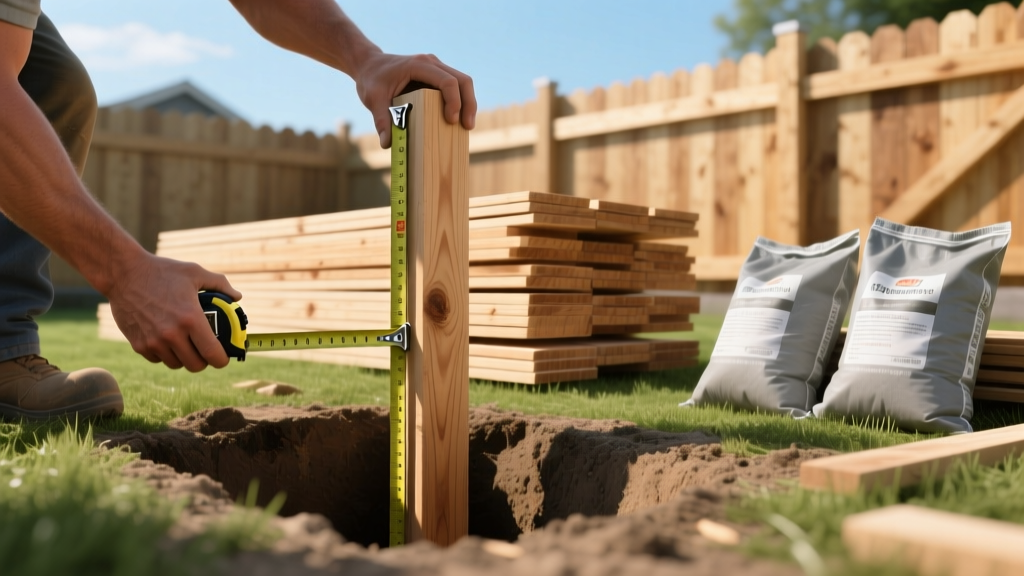
Fence posts must be set below the local frost line to prevent winter heaving. In Zone 5, this means digging 36-inch deep holes; in Zone 4, holes must be 48 inches deep. If contractors encounter caliche soil (common in the Southwest) or shallow bedrock, manual digging becomes impossible.
- Rock Drilling/Augering Surcharge: $15 to $25 per post.
- Jackhammering Bedrock: $150 to $300 per hour.
- Concrete Volume: A standard 4x4 post set 36 inches deep requires roughly 1.5 bags of 50-lb fast-setting concrete mix (approx. $7 to $9 per bag). Rocky soil requires wider holes, increasing concrete costs by 30% to 50%.
Slopes and Grade Changes
Building on a slope requires either "stepping" or "racking" the fence panels. Stepping involves custom-cutting rails and leaving triangular gaps at the bottom of each panel (which must be filled with custom kickboards). Racking requires specialized routed posts and hinged rail brackets. Both methods add 15% to 25% to the total labor cost compared to flat-ground installation.
Hidden Costs That Derail Fence Budgets
Homeowners frequently receive initial quotes that omit critical ancillary services. Based on HomeGuide's installation data, ensure your contractor's proposal explicitly addresses the following line items:
Warning: Common Quote Omissions
- Old Fence Demolition and Hauling: Tearing out and disposing of an existing 150-foot wood fence costs $4 to $7 per linear foot. If the old posts are set in deep concrete, extraction adds significant labor time.
- Gate Upgrades: A standard 4-foot single gate adds $350 to $600. However, a 6-foot double-drive gate requires heavy-duty steel drop pins, self-closing hinges, and a reinforced 6x6 steel-wrapped post to prevent sagging, pushing the cost to $900 to $1,500.
- Utility Locating: Before any augering begins, contractors must contact the national 811 utility locator service. While the marking service is free, hitting an unmarked shallow irrigation line or fiber-optic cable can result in thousands of dollars in repair liabilities.
- HOA Permitting and Surveys: If your property requires a boundary survey to verify setback lines, expect to pay $400 to $800 to a licensed surveyor before installation can begin.
Cost-Saving Framework: Where to Compromise and Where to Invest
To optimize the cost to build a fence without sacrificing structural integrity, apply this decision matrix to your project:
| Project Element | Where to Invest (Do Not Skimp) | Where to Compromise (Save Money) |
|---|---|---|
| Posts & Footings | Use 6x6 pressure-treated posts instead of 4x4s for gate and corner posts. Set in gravel-base concrete. | N/A. Post failure destroys the entire fence. |
| Pickets & Panels | Virgin PVC or Cedar for high-visibility front yards. | Use standard #2 grade pressure-treated pine for rear perimeter boundaries. |
| Hardware | Stainless steel or hot-dipped galvanized screws and heavy-duty self-closing gate hinges. | Standard black powder-coated latches instead of premium smart-lock gate hardware. |
The "Shadowbox" Alternative
If you want the look of a premium privacy fence but need to reduce material costs, consider a shadowbox (or board-on-board) design using standard pine. By alternating pickets on opposite sides of the rail, you use thinner, less expensive 1x6 pickets rather than thick tongue-and-groove boards, while still achieving near-total privacy and allowing wind to pass through, reducing structural stress on the posts.
Expert FAQs on Fence Pricing
Does adding a fence increase property value enough to justify the cost?
A well-maintained privacy or ornamental aluminum fence typically yields a 50% to 70% return on investment at resale. However, in markets where fenced yards are the standard expectation for families and pet owners, an unfenced yard can reduce the buyer pool by up to 30%, making the fence a necessary defensive investment rather than a pure value-add.
Is it cheaper to build a fence in the winter?
Yes. Scheduling installation between November and February (in climates where the ground does not freeze solid) can reduce labor costs by 10% to 15%. Contractors are often desperate to keep crews working during the off-season and will offer aggressive discounts on labor, though material costs remain static.
How much does it cost to stain or seal a new wood fence?
Do not stain a new pressure-treated fence immediately; the wood must cure and dry for 3 to 6 months. Once ready, professional staining costs $1.50 to $3.00 per square foot. For a 6-foot tall, 150-foot long fence (900 sq. ft. per side), expect to pay $2,700 to $5,400 for a high-quality, oil-based semi-transparent sealant application.
Written by
Elena RodriguezElena Rodriguez is a civil engineer and technical writer specializing in concrete technology, masonry systems, and ASTM/ACI compliance. She earned her B.S. in Civil Engineering from Texas A&M University and spent a decade at a materials testing laboratory, performing over 2,000 concrete compressive strength tests and masonry prism evaluations. Elena is an ACI-certified Field Testing Technician (Grade I) and a member of ASTM Committee C12 on Natural Building Stone. She currently consults on forensic engineering cases involving concrete failures and moisture intrusion. Based in San Antonio, TX, Elena is a proud member of the Society of Women Engineers (SWE) and coaches her daughter's FIRST Robotics team.
More from Elena Rodriguez
View all
Walls & Panels
Cost Analysis: Light Gauge Steel Framing Advantages and Disadvantages
Evaluate light gauge steel framing advantages and disadvantages through a strict cost analysis lens, comparing material, labor, and lifecycle expenses.
Aug 4, 2026

Walls & Panels
Gypsum Board Types: Exact Specifications, Thickness & Dimensions
Compare standard, Type X, and moisture-resistant gypsum board types. Get exact specifications, thicknesses, dimensions, and ASTM standards for your project.
Aug 4, 2026

Fire Resistance
Best Fire-Resistant Outdoor Decking Materials: 2026 Buyer Guide
Discover the best fire-resistant outdoor decking materials for 2026. Compare Class A PVC, aluminum, and hardwood options for WUI compliance and safety.
Aug 4, 2026