Selecting Flooring for Radiant Floor Heating Systems
Compare thermal conductivity, R-values, and material limits to select the best flooring for radiant floor heating systems. Expert taxonomy and specs.
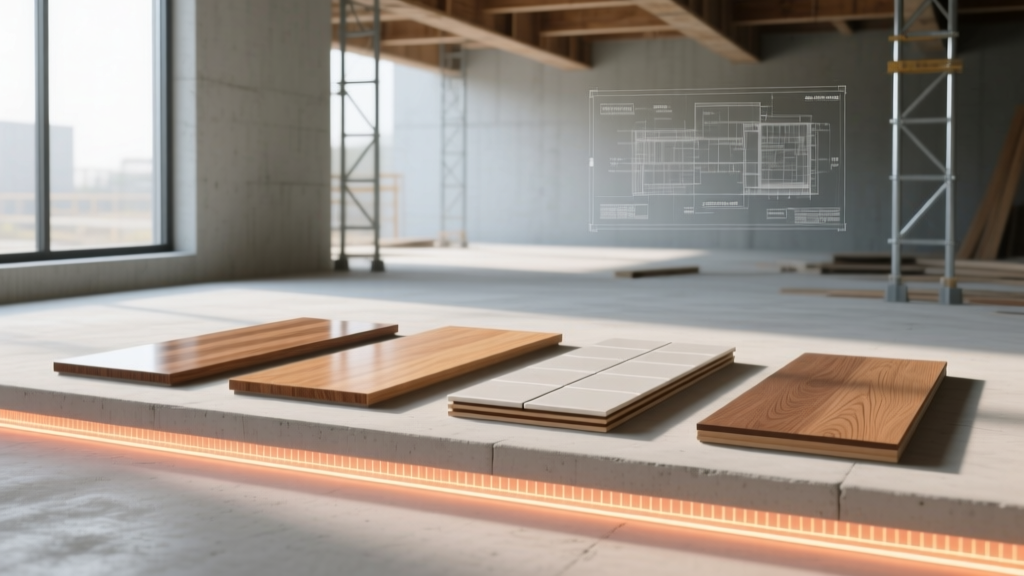
The Physics of Flooring Over Radiant Heat
Selecting floor coverings for radiant floor heating requires balancing two competing physical properties: thermal conductivity (k-value) and dimensional stability. Radiant systems transfer heat upward through the floor assembly. If the flooring material acts as an insulator, the system must work harder, increasing energy consumption and risking damage to the heating elements. Conversely, if the material expands and contracts aggressively under thermal cycling, it will buckle, gap, or crack.
According to the U.S. Department of Energy, the total R-value of the floor covering should not exceed 1.0 for electric radiant systems and 0.5 for hydronic (water-based) systems. Exceeding these thresholds traps heat below the surface, leading to inefficient operation and potential system failure. Below is a material taxonomy categorized by thermal performance and structural compatibility.
Tier 1: High-Conductivity Inorganics (Optimal)
Ceramic, porcelain, and natural stone are the undisputed best materials for radiant floor heating. Their high density and mineral composition allow heat to pass through with minimal resistance.
Porcelain and Ceramic Tile
Porcelain tile boasts a thermal conductivity of approximately 1.5 W/m·K, making it highly efficient. However, installation over radiant heat requires strict adherence to movement accommodation standards. Large-format tiles (any edge longer than 15 inches) are prone to tenting when subjected to thermal expansion.
- Mortar Selection: Use ANSI A118.15 (improved modified dry-set mortar) rather than standard A118.4. The higher polymer content provides superior bond strength and flexibility under thermal stress.
- Uncoupling Membranes: Installing a polyethylene uncoupling membrane (such as Schluter-Ditra) is mandatory for hydronic systems. It absorbs horizontal shear stresses caused by the expansion of the PEX tubing and substrate, preventing crack transmission to the tile.
Natural Stone
While stone conducts heat well, it is inherently micro-fissured. Marble and limestone require a crack-isolation membrane rated for thermal cycling. Slate and quartzite are more dimensionally stable but must be sealed with a penetrating, heat-stable impregnator to prevent plasticizer migration from adhesives.
Tier 2: Dimensionally Stable Organics (Viable)
Wood is a natural insulator (k-value ~0.15 W/m·K) and is hygroscopic, meaning it reacts to both temperature and humidity changes. Solid hardwood is almost universally prohibited over radiant heat due to its high shrinkage coefficient. Engineered wood is the only viable organic option.
Engineered Wood Specifications
Engineered flooring utilizes a cross-ply construction that restricts lateral movement. When selecting engineered wood for radiant systems, adhere to these strict parameters:
- Core Material: Require a Baltic birch plywood core. Avoid HDF (High-Density Fiberboard) or MDF cores, which can degrade and off-gas formaldehyde when repeatedly heated above 80°F.
- Species Selection: Choose species with low dimensional change coefficients. Quartersawn white oak, walnut, and ash are optimal. Avoid maple, hickory, and pecan, which are prone to severe checking and gapping under thermal stress.
- Thickness and Width: Limit total thickness to 5/8 inch (15mm) to maintain an acceptable R-value (under 0.5). Plank width should not exceed 4 inches; wider planks exponentially increase the risk of edge-curling.
The Radiant Professionals Alliance (RPA) strongly recommends using a continuous data-logging hygrometer in rooms with wood flooring over radiant heat to ensure ambient relative humidity remains strictly between 35% and 55%.
Tier 3: Temperature-Sensitive Synthetics (Conditional)
The synthetic flooring market has expanded rapidly, but not all polymers tolerate continuous heat exposure. Standard Luxury Vinyl Tile (LVT) and Wood Plastic Composite (WPC) cores can soften, warp, or release volatile organic compounds (VOCs) when heated.
SPC (Stone Polymer Composite) Vinyl
SPC flooring replaces the wood-plastic core with a limestone-PVC composite, creating a highly rigid, dimensionally stable plank that resists thermal expansion. SPC is the only vinyl category recommended for radiant systems.
- Off-Gassing Risks: Ensure the SPC product carries a FloorScore or GREENGUARD Gold certification. Heating low-quality PVC accelerates the release of phthalates and plasticizers.
- Underlayment Restrictions: If the SPC does not have an attached pad, you must use a high-density, radiant-rated underlayment (minimum 20 lbs/ft³ density) with an R-value no greater than 0.15. Standard foam underlayments will trap heat and melt.
⚠️ The 85°F (29°C) Warranty Threshold
Nearly all flooring manufacturers (including engineered wood and SPC vinyl) explicitly void their warranties if the surface temperature of the floor exceeds 85°F (29.4°C). Your radiant system must be equipped with a floor-sensing thermostat with a hard high-limit cutoff set precisely to 85°F to protect your material investment.
Material Selection Matrix: Thermal & Structural Data
The following matrix provides baseline specifications for comparing flooring materials over radiant heating systems. Use this to verify product data sheets during procurement.
| Material Type | Thermal Conductivity (k) | Max R-Value | Approved Fastening | Max Surface Temp |
|---|---|---|---|---|
| Porcelain / Ceramic Tile | ~1.50 W/m·K | 0.05 (per 1/4") | Thin-set (Modified) | 104°F (40°C) |
| Natural Stone (Granite/Slate) | ~2.00 W/m·K | 0.08 (per 3/4") | Thin-set + Membrane | 104°F (40°C) |
| Engineered Wood (Plywood Core) | ~0.15 W/m·K | 0.45 (at 5/8") | Glue-Down / Floating | 85°F (29°C) |
| SPC Luxury Vinyl | ~0.25 W/m·K | 0.20 (at 5mm) | Floating / Glue-Down | 85°F (29°C) |
| Polished Concrete (Slab-on-Grade) | ~1.70 W/m·K | N/A (Substrate) | N/A (Integral) | 104°F (40°C) |
Fastening Methods Taxonomy: What to Avoid
The method used to secure the flooring to the subfloor is just as critical as the material itself. Thermal expansion dictates the fastening strategy.
Prohibited: Nail-Down and Staple-Down
Mechanical fasteners are strictly prohibited over hydronic radiant systems. A single misplaced 2-inch cleat nail can puncture a pressurized PEX water line, resulting in catastrophic flooding and requiring the demolition of the floor to access the leak. Even over electric mats, nails can sever heating cables, creating a severe fire hazard.
Recommended: Full-Spread Glue-Down
For engineered wood and SPC vinyl, a full-spread urethane adhesive provides the best thermal transfer. Urethane adhesives remain permanently flexible, allowing the flooring to expand and contract microscopically without breaking the bond. Avoid water-based acrylic adhesives, which can re-emulsify and fail when exposed to continuous heat and moisture vapor.
Conditional: Floating Floors
Floating floors (click-lock engineered wood or SPC) are acceptable but introduce an air gap between the subfloor and the flooring material. Air is an insulator (R-value of ~0.9 per inch). To mitigate this, floating floors over radiant heat must utilize a specialized, high-density thermal underlayment to bridge the gap and conduct heat upward.
Cost and Performance ROI Breakdown
While the initial material cost varies, the operational ROI of radiant floor heating is heavily influenced by the flooring choice. A highly conductive floor allows the boiler or electric mat to run at a lower water/element temperature, reducing monthly energy costs by up to 15% compared to insulative floor coverings.
- Porcelain Tile: $4.00 – $12.00 / sq. ft. (Material only). Highest upfront cost and installation labor, but offers zero thermal degradation and the lowest long-term operational costs.
- Engineered Oak: $6.00 – $14.00 / sq. ft. Moderate thermal resistance requires the hydronic system to run slightly hotter, marginally increasing winter utility bills.
- SPC Vinyl: $3.00 – $7.00 / sq. ft. Lowest material cost, but strict 85°F limit means the system cannot be used for rapid high-heat recovery in poorly insulated spaces.
Ultimately, the selection of flooring for radiant systems must prioritize physics over aesthetics. By strictly adhering to R-value limits, utilizing modified setting materials, and enforcing hard temperature cutoffs, you ensure both the longevity of the floor covering and the efficiency of the heating system.