Most Durable Stair Flooring Options for High-Traffic Homes
Compare the most durable stair flooring options for high-traffic homes. Analyze wear layers, slip resistance, and edge impact costs.

The Mechanics of Stair Wear: Why Treads Fail
Stairs endure significantly more physical abuse than flat flooring. Every time a person ascends or descends, the front two inches of the tread—the nosing—absorbs concentrated heel strikes, rotational pivot forces, and debris scraping. While a standard living room floor experiences distributed, flat-footed traffic, stair treads face localized impact forces up to three times greater. When evaluating stair flooring options for durability, surface scratch resistance is only half the equation; edge integrity, dimensional stability, and adhesive elastomericity are the true determinants of lifespan.
Hardwood: Janka Hardness and Edge Chipping
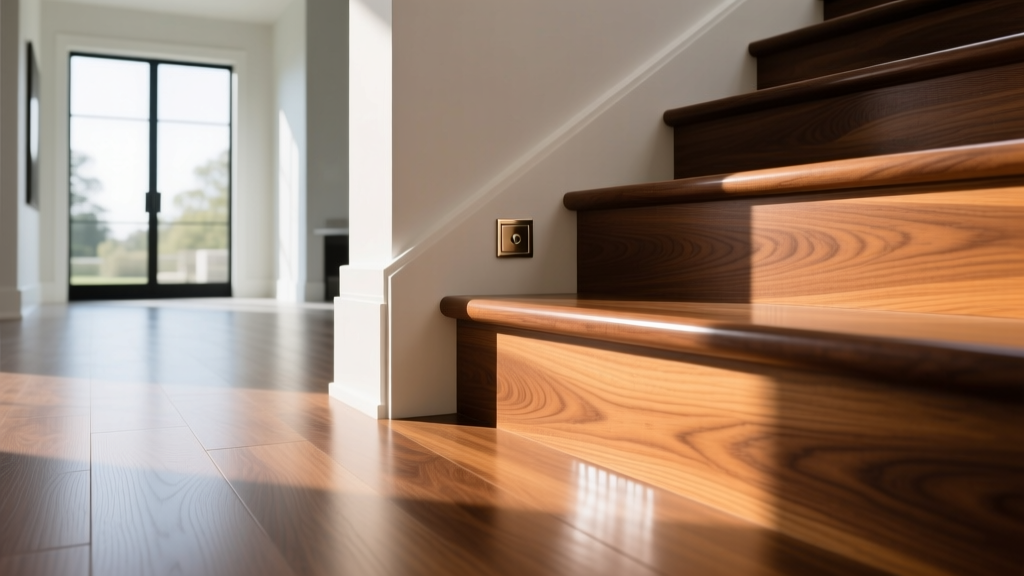
Solid hardwood remains a premium choice, but not all species survive stair traffic. The durability of wood stairs is dictated by the Janka hardness scale and the finish curing process. Red Oak (Janka rating 1290) is the industry baseline, but for high-traffic homes, harder species like Hickory (1820) or Hard Maple (1450) are vastly superior at resisting heel-dent compression.
Finish Technology Matters More Than Species
A Janka rating only measures dent resistance, not scratch resistance. For stair treads, specify prefinished treads with UV-cured aluminum oxide coatings. According to the National Wood Flooring Association, aluminum oxide finishes increase surface abrasion resistance by up to 400% compared to standard polyurethane. Brands like StairTek offer 72-inch solid treads with commercial-grade aluminum oxide finishes that withstand heavy dog claws and shoe grit without micro-scratching.
Dimensional Stability Warning: Solid hardwood treads thicker than 1 inch are prone to cupping if the home's humidity fluctuates between 30% and 50%. Engineered hardwood treads with a 4mm+ sawn wear layer provide the exact same surface durability as solid wood but feature a cross-plywood core that eliminates seasonal cupping and edge-gapping.
Luxury Vinyl Plank (LVP): Wear Layers and Adhesive Chemistry
LVP has dominated the flat-floor market, but stair applications require specific structural profiles. The primary durability metric for LVP is the wear layer thickness, measured in mils. While 12-mil wear layers are sufficient for bedrooms, stair treads require a minimum 20-mil to 22-mil wear layer to prevent the decorative print layer from wearing through at the pivot zone.
The Flush-Mount vs. Overlap Nosing Debate
Never use overlap nosings on stairs. Overlap profiles create a 3mm lip that catches dirt, snags vacuum cleaners, and eventually snaps off under repetitive toe-strikes. Flush-mount stair nosings (available from manufacturers like COREtec and Shaw) sit perfectly level with the tread plank, creating a seamless, trip-free transition.
Laminate and Porcelain Tile: High Impact but Hidden Risks
Both laminate and tile offer exceptional surface hardness, but they introduce unique failure modes when applied to stairs.
Laminate: AC Ratings and Moisture Traps
Laminate flooring is graded by the European EN 13329 standard, ranging from AC1 (light residential) to AC6 (heavy commercial). For stairs, mandate an AC4 or AC5 rating. The aluminum oxide wear layer on AC5 laminate easily survives pet claws and heavy boots. However, laminate's weakness is moisture. If wet shoes or pet accidents seep into the locking mechanisms at the stair edge, the high-density fiberboard (HDF) core will swell, causing irreversible edge-peaking. Ensure all stair tread seams are sealed with a silicone-based joint sealant during installation.
Porcelain Tile: Edge Profiles and Slip Resistance
Porcelain tile is virtually impervious to scratching and denting. The challenge lies in the exposed front edge. Standard field tiles have a glazed top and an unglazed, porous body. If used on a stair edge, the exposed clay body looks unfinished and chips easily. You must source specialized surface-bullnose porcelain treads or use anodized aluminum edge profiles, such as the Schluter-RONDEC or QUADEC systems, to protect the edge.
Furthermore, tile can be dangerously slippery. The Tile Council of North America and ANSI A137.1 standards require a Dynamic Coefficient of Friction (DCOF) of 0.42 or higher for level interior spaces, but stairs demand even higher traction. Specify tiles with a textured, matte, or micro-grit finish. High-gloss polished porcelain should never be installed on stair treads.
Comprehensive Durability & Cost Matrix
The following matrix breaks down the real-world performance and installed costs of the most durable stair flooring options. Costs reflect 2026 national averages for material and professional installation per standard 36-inch wide tread and riser.
| Material Type | Avg. Cost Per Tread | Impact / Dent Rating | Slip Resistance (DCOF) | Primary Failure Mode |
|---|---|---|---|---|
| Engineered Hardwood (4mm+ wear layer) | $140 - $185 | High (Janka dependent) | 0.50 - 0.60 (Matte finish) | Surface micro-scratching over 10+ years |
| Rigid Core LVP (22-mil wear layer) | $95 - $130 | Very High (Limestone core) | 0.65+ (Embossed texture) | Nosing delamination if wrong adhesive used |
| AC5 Laminate (12mm thickness) | $80 - $115 | Moderate (HDF core dents) | 0.45 - 0.55 | Edge swelling from trapped moisture |
| Textured Porcelain Tile (PEI IV/V) | $180 - $260 | Extreme (Impervious) | 0.60+ (Textured/Matte) | Grout cracking at the riser joint |
Expert Verdict: Matching Material to Household Traffic
Selecting the right material requires aligning the physical properties of the floor with the specific abuse profile of your household.
- For Homes with Large Dogs and Heavy Foot Traffic: Rigid Core LVP with a 22-mil wear layer and flush-mount nosing is the undisputed champion. The limestone-composite core resists dog-claw dents, the embossed surface provides maximum slip resistance, and it is 100% waterproof, eliminating the moisture swelling risks associated with laminate and solid wood.
- For Luxury Builds and Long-Term ROI: Engineered hardwood (Hickory or Hard Maple species) with an aluminum oxide finish offers the best balance of authentic aesthetics and structural stability. It avoids the cupping issues of solid wood while delivering a 30+ year lifespan when properly maintained.
- For Commercial Spaces or Mudroom Stairs: Textured porcelain tile with an anodized aluminum Schluter edge profile is mandatory. While the upfront cost per tread is the highest, the material is entirely impervious to water, salt, and heavy impacts, yielding a virtually indestructible stairwell.
Final Installation Directive
Regardless of the material chosen, stair flooring durability is ultimately dictated by the subfloor preparation. Ensure the stair sub-treads are sanded flat, free of drywall dust, and primed if using urethane adhesives. A $200 flooring material will fail in months if installed over a compromised, uneven sub-tread.
Written by
David NakamuraDavid Nakamura is a licensed architect (AIA) and construction technology writer focused on sustainable building methods, mass timber engineering, and high-performance building envelopes. He holds a Master of Architecture from the University of Washington and is a certified Passive House Consultant (CPHC). David spent eight years at the Seattle firm Mithun, where he led the design of three LEED Platinum projects, before founding his own practice specializing in net-zero residential design. He serves on the editorial advisory board of GreenBuilder Magazine and has authored peer-reviewed papers on cross-laminated timber (CLT) connections for the Journal of Structural Engineering. In his spare time, David teaches woodworking at Pratt Fine Arts Center and kayaks the Puget Sound.
More from David Nakamura
View all
Construction Cost
Labor Cost to Build a Deck Per Sq Ft: 2026 Installation Guide
Discover the exact labor cost to build a deck per sq ft in 2026. This installation guide breaks down contractor rates, complexity factors, and hidden fees.
Aug 4, 2026

Construction Cost
How Much Does It Cost to Build a 3 Bedroom House? Financing Guide
Learn exactly how much it costs to build a 3 bedroom house and explore 2026 financing options, construction loan types, and budget frameworks for your build.
Aug 4, 2026

Construction Cost
Cost to Build a Tennis Court: 2026 Guide
How much does it cost to build a tennis court in 2026? Breakdowns for asphalt, concrete, and synthetic surfaces plus fencing and lighting.
Jul 30, 2026