Carpet and Installation Cost in 2026: Room-by-Room Scenario Guide
Analyze carpet and installation cost across four real-world room scenarios. Match fibers, pads, and labor methods to your exact application needs.
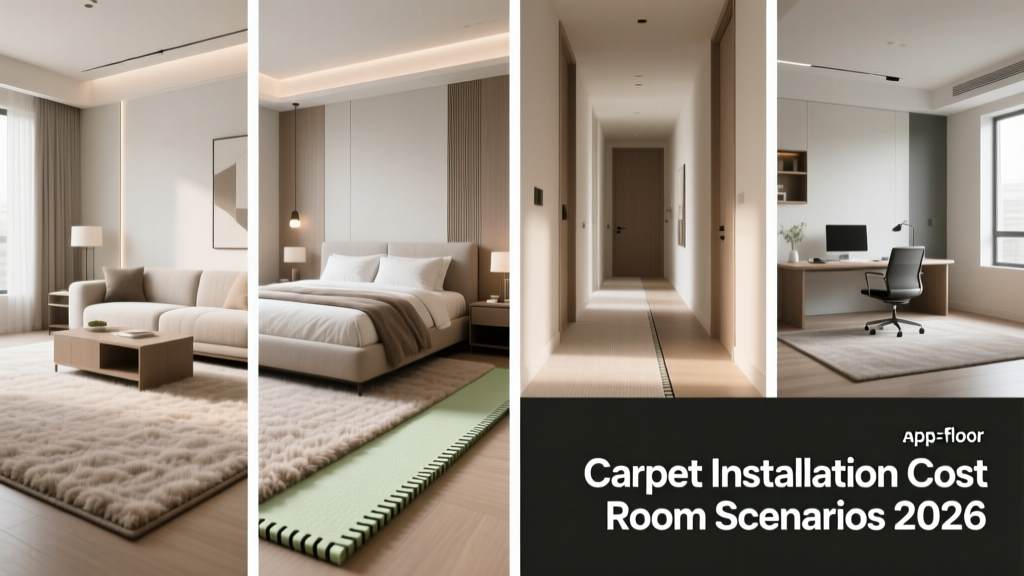
The Anatomy of a Carpet Quote: Beyond the Square Foot Price
Quoting a flooring project based solely on the sticker price of the carpet roll is the most common financial mistake homeowners make. The true carpet and installation cost is a composite of four distinct variables: the fiber and face weight of the carpet, the density and material of the underlayment (pad), the specific installation method required by the environment, and the site preparation labor. In 2026, material supply chains have stabilized, but specialized labor for complex installations commands a premium.
To provide actionable guidance, we must abandon generic 'average cost' calculators. Instead, we evaluate carpet and installation cost through the lens of application-fit. Below, we break down four distinct residential scenarios, specifying the exact material grades, pad types, and installation techniques required for each, alongside realistic 2026 pricing.
Scenario 1: The High-Traffic Family Room (Pets, Kids, and Spills)
The family room demands extreme durability, stain resistance, and easy maintenance. Standard polyester fibers will crush and mat within two years under heavy foot traffic and pet claws. The application-fit solution here is a high-density Triexta or solution-dyed Nylon 6,6.
Material & Pad Specification
- Carpet: Mohawk SmartStrand Forever Clean (Triexta) or Shaw Anso Nylon (Nylon 6,6). Target a minimum 40 oz face weight and a twist level of at least 5 twists per inch (TPI) to prevent fraying.
- Pad: Moisture-barrier polyurethane pad (e.g., Mohawk SmartCushion, 8lb density). The moisture barrier prevents pet accidents from seeping into the subfloor, mitigating long-term odor and wood rot.
- Installation Method: Power-stretch installation. According to This Old House carpet buying guide, a power stretcher is mandatory to prevent premature wrinkling and buckling in high-traffic zones.
Material (40oz Triexta): $4.50 - $5.50
Moisture-Barrier Pad: $1.25 - $1.75
Labor (Power Stretch & Tack Strip): $1.50 - $2.00
Total Scenario Cost: $7.25 - $9.25 / sq. ft.
Scenario 2: The Luxury Master Suite (Acoustics and Underfoot Comfort)
Bedrooms prioritize acoustic dampening, thermal insulation, and luxurious underfoot feel over extreme abrasion resistance. This scenario justifies the premium cost of natural fibers or ultra-plush synthetics paired with high-resilience foam.
'Wool carpets naturally regulate humidity and resist static electricity, making them the premier choice for master suites where barefoot comfort and indoor air quality are paramount.' — Carpet and Rug Institute
Material & Pad Specification
- Carpet: 100% Wool plush (e.g., Karastan) or high-end Nylon 6 cut pile. Target a luxurious 55 oz to 65 oz face weight. Wool inherently resists soiling due to its natural lanolin coating.
- Pad: Prime polyurethane memory foam (e.g., Leggett & Platt 1/2-inch, 8lb density). Memory foam provides superior acoustic deadening and a plush, sink-in feel that standard rebond cannot match.
- Installation Method: Stretch-in installation with upgraded transition moldings. Seams must be heat-sealed with premium thermoplastic tape to prevent peaking in plush piles.
Cost Breakdown (Per Square Foot)
| Component | Specification | 2026 Cost Range |
|---|---|---|
| Carpet Material | 55oz - 65oz Wool Plush | $9.00 - $14.00 |
| Underlayment | 1/2' Memory Foam (8lb) | $1.50 - $2.25 |
| Labor & Seam Sealing | Stretch-in + Premium Tape | $1.75 - $2.50 |
| Total Scenario Cost | $12.25 - $18.75 / sq. ft. | |
Scenario 3: Below-Grade Basements (Moisture and Mold Mitigation)
Basements present a hostile environment for traditional carpeting due to concrete subfloor moisture vapor transmission (MVT) and the risk of hydrostatic pressure leaks. Installing a traditional stretch-in carpet with a sponge rubber or rebond pad in a basement is a guaranteed pathway to mold growth.
Before installing any soft flooring below grade, perform an ASTM F1869 calcium chloride test or use an in-situ relative humidity (RH) probe. If MVT exceeds 3 lbs per 1,000 sq ft over 24 hours, a moisture mitigation epoxy primer is mandatory before carpet installation.
Material & Pad Specification
- Carpet: Commercial-grade level-loop Nylon 6 or modular carpet tiles (e.g., Interface or Shaw Contract). Loop piles do not hold water like cut piles, and synthetic backings resist rot. For air quality concerns in enclosed spaces, consult EPA guidelines on indoor air quality to select low-VOC certified products.
- Installation Method: Full-spread direct glue-down. This eliminates the air gap between the carpet and the concrete where condensation typically forms.
Cost Breakdown (Per Square Foot)
- Commercial Loop Material: $2.50 - $4.00
- Moisture Mitigation Primer (If required): $1.50 - $3.00
- Adhesive & Labor (Glue-Down): $2.00 - $3.50
- Total Scenario Cost: $4.50 - $7.50 / sq. ft. (Adds $1.50+ if moisture primer is needed)
Scenario 4: The Investment Property Flip (Maximizing ROI on a Budget)
When preparing a rental property or a house for immediate resale, the goal is visual appeal and basic functionality at the lowest possible capital expenditure. Durability expectations are capped at a 3-to-5-year lifecycle.
Material & Pad Specification
- Carpet: Basic Polyester (PET) Berber or low-pile cut loop (e.g., Shaw Life Guard or TrafficMaster). Polyester offers excellent initial stain resistance and vibrant color options but lacks the long-term resiliency of nylon. Target a 35 oz to 40 oz face weight.
- Pad: Standard 1/2-inch, 6lb rebond (recycled polyurethane foam). This is the industry standard builder-grade pad.
- Installation Method: Standard stretch-in. Knee-kicking may be used in small closets to save time, though power stretching is still preferred for the main fields.
Material (35oz Polyester): $1.50 - $2.25
Rebond Pad (6lb): $0.35 - $0.50
Labor (Basic Stretch-in): $1.00 - $1.50
Total Scenario Cost: $2.85 - $4.25 / sq. ft.
Hidden Cost Variables That Derail Budgets
When calculating your final carpet and installation cost, contractors often exclude site-specific prep work. Factor in these variables to avoid mid-project change orders:
1. Old Material Tear-Out and Disposal
Removing existing carpet and pad typically costs $0.50 to $0.75 per square foot. However, if the underlying pad was glued directly to the concrete, or if asbestos-containing mastic is discovered under old vinyl tiles, disposal costs can spike to $1.50 - $3.00 per square foot due to hazardous material handling protocols.
2. Subfloor Preparation
Wood subfloors often require re-screwing to eliminate squeaks ($0.25/sq ft) or patching with Portland cement-based leveling compound for concrete slabs ($1.00 - $2.50 per bag, covering roughly 40 sq ft). Carpet will telegraph any subfloor imperfections, making prep non-negotiable.
3. Furniture Moving and Baseboard Clearances
Most installation quotes assume empty rooms. Moving heavy furniture adds $100 to $300 per room. Additionally, if your baseboards were installed directly on the hard floor without a gap, the carpet cannot be tucked properly. You may need to pay a carpenter to undercut the door jambs and trim ($15 - $25 per opening).
Fiber-to-Application Decision Matrix
Use this matrix to quickly align your specific room requirements with the correct carpet fiber, ensuring you do not overpay for unnecessary performance or underpay for critical durability.
| Fiber Type | Best Application | Resiliency | Stain Resistance | 2026 Avg Material Cost |
|---|---|---|---|---|
| Nylon 6,6 | High-traffic, heavy furniture | Excellent | Very Good (Treated) | $4.00 - $7.00 |
| Triexta (PTT) | Households with pets/kids | Very Good | Excellent (Inherent) | $4.50 - $8.00 |
| Polyester (PET) | Low-traffic, budget flips | Poor | Good | $1.50 - $3.50 |
| Wool | Master suites, luxury formal | Good | Moderate | $9.00 - $15.00+ |
| Olefin (Polypropylene) | Basements, indoor/outdoor | Poor | Excellent | $1.50 - $3.00 |
By matching the exact fiber, face weight, and pad density to the specific environmental and traffic demands of your room, you transform the carpet and installation cost from a blind expense into a calculated, long-term investment in your property's functionality and value.