What Is the Cheapest Flooring Option? 2026 Cost Breakdown
Discover what is the cheapest flooring option in 2026. We analyze material, installation, and hidden costs for sheet vinyl, laminate, and more.

The Direct Answer: What Is the Cheapest Flooring Option?
If you are strictly minimizing upfront material expenses, sheet vinyl is the undisputed cheapest flooring option on the market in 2026, with prices starting as low as $0.75 per square foot. However, if you already have a structurally sound, level concrete slab, painted or sealed concrete drops the material cost to roughly $0.40 to $0.80 per square foot, bypassing the need for a separate floor covering entirely.
But flooring economics are rarely just about the sticker price of the material. To truly answer what the cheapest flooring option is, we must evaluate the total installed cost—factoring in subfloor preparation, underlayment, adhesives, and professional labor versus DIY viability. A $1.00 per square foot peel-and-stick tile that requires $300 in subfloor leveling compound is no longer a budget-friendly option.
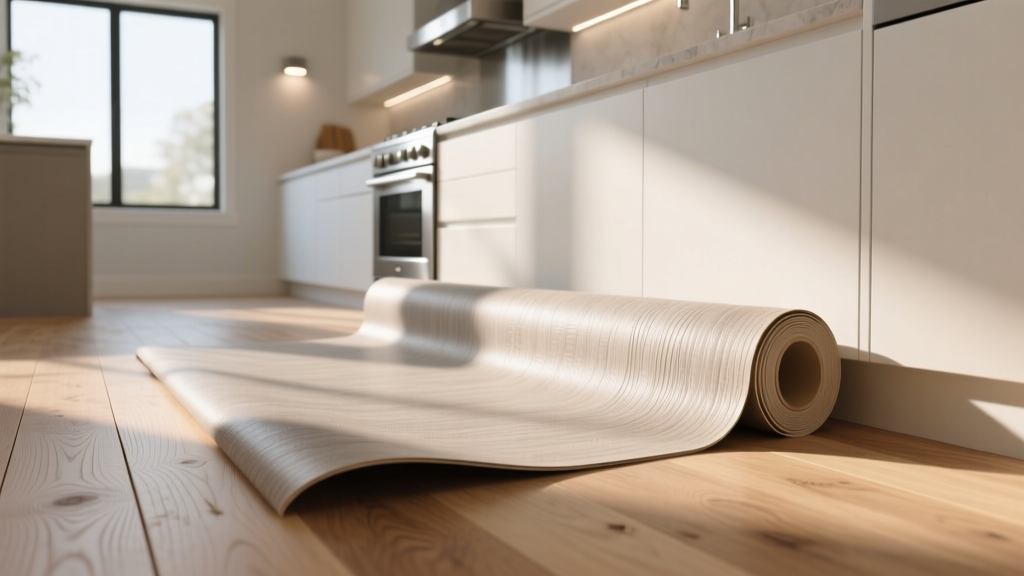
2026 Material Cost Matrix: The Bottom 5
Below is a comparative breakdown of the five lowest-cost flooring categories available in 2026. Pricing reflects national averages for residential-grade materials and standard professional installation rates, as tracked by industry estimators like HomeGuide's flooring cost data.
| Flooring Type | Material Cost (Sq. Ft.) | Pro Install Cost (Sq. Ft.) | Total DIY Cost | Expected Lifespan |
|---|---|---|---|---|
| Sheet Vinyl | $0.75 - $2.50 | $1.50 - $3.00 | $0.75 - $2.50 | 10 - 15 Years |
| Thin Laminate (6-8mm) | $1.20 - $2.80 | $2.00 - $4.00 | $1.60 - $3.50 | 15 - 20 Years |
| Peel-and-Stick LVT | $1.00 - $2.50 | $1.50 - $2.50 | $1.00 - $2.50 | 5 - 10 Years |
| Carpet Tiles | $1.50 - $3.50 | $1.00 - $2.00 | $1.50 - $3.50 | 8 - 12 Years |
| Painted Concrete | $0.40 - $0.80 | $1.50 - $3.00 | $0.40 - $0.80 | 3 - 5 Years |
Deep Dive: Analyzing the Top 3 Budget Contenders
1. Sheet Vinyl: The Undisputed Budget King
Modern sheet vinyl is not the peeling, faded linoleum of the 1970s. Products like Tarkett FiberFloor or Armstrong Stylistik utilize fiberglass backing that allows for loose-lay installation over smooth plywood, eliminating the need for expensive adhesives. At $0.75 to $2.50 per square foot, it offers the lowest absolute material cost.
- The DIY Advantage: Because it comes in 12-foot-wide rolls, a standard 10x10 kitchen requires only one or two seams. With a $15 tube of vinyl seam sealer and a $20 floor roller, a homeowner can install it in an afternoon.
- The Failure Mode: Sheet vinyl is highly susceptible to tearing when heavy appliances (like refrigerators) are dragged across it. Furthermore, if the subfloor has any moisture issues, the fiberglass backing can trap mold against the wood.
2. Thin-Profile Laminate (6mm - 8mm)
Laminate flooring offers the aesthetic of hardwood at a fraction of the price. Budget laminates (6mm to 8mm thickness) from brands like TrafficMaster or Pergo Outlast range from $1.20 to $2.80 per square foot. They utilize a floating click-lock system, making them highly accessible for DIYers.
- The Hidden Cost (Underlayment): Many ultra-cheap laminates do not feature a pre-attached underlayment pad. You must purchase a separate 2mm foam moisture barrier, adding $0.40 to $0.60 per square foot to your total budget. Always opt for pre-attached pad laminates to keep costs genuinely low.
- The Failure Mode: Laminate is essentially compressed wood fiber (HDF/MDF). If water sits on the seams for more than 30 minutes, the edges will absorb moisture, swell, and 'peak.' Once laminate swells, it cannot be sanded down; the planks must be replaced.
3. Carpet Tiles: The Modular Miracle
Originally reserved for commercial offices, residential carpet tiles (from manufacturers like FLOR or Interface) have become a staple for budget-conscious basements and playrooms. Priced between $1.50 and $3.50 per square foot, their true financial benefit lies in their modularity.
- The Long-Term Savings: If a pet ruins a section of traditional wall-to-wall carpet, you must replace the entire room (costing hundreds in labor and material). With carpet tiles, you simply pull up the damaged 18x18 squares and replace them for $10.
- The Installation Caveat: Most budget carpet tiles use a peel-and-stick adhesive backing. This adhesive requires a perfectly smooth, sealed surface. If you stick them directly over raw, porous concrete, the adhesive will fail within a year. You must budget for a concrete sealer primer first.
Hidden Costs That Destroy Budget Floors
When calculating what the cheapest flooring option is for your specific home, you must audit your space for these three budget-killers:
- Subfloor Leveling: Budget floors require flat subfloors. If your plywood has dips greater than 3/16-inch over a 10-foot span, you must use self-leveling compound. A 50 lb bag costs roughly $35 but only covers 50 square feet at a 1/4-inch depth. A severely uneven room can easily add $400+ in prep materials.
- Baseboard and Shoe Molding: Floating floors (laminate and LVT) require a 1/4-inch expansion gap around the perimeter of the room. If you do not want to pay a carpenter to remove and reinstall your existing baseboards ($2 to $4 per linear foot), you must install quarter-round shoe molding to hide the gap, adding $0.50 to $1.00 per linear foot in materials and paint.
- Transition Strips: Moving from a budget laminate to an existing tile floor requires a T-molding or reducer strip. Manufacturer-matched transition strips cost $25 to $45 each. A house with multiple rooms and hallways can easily rack up $150 just in transition hardware.
Cost-Per-Year Framework: When 'Cheap' Becomes Expensive
To make a financially sound decision, divide the total installed cost by the expected lifespan. This 'annualized cost' reveals the true financial footprint of the floor.
| Material | Total Installed Cost (500 sq ft) | Lifespan | Annualized Cost |
|---|---|---|---|
| Peel-and-Stick LVT | $850 (DIY) | 7 Years | $121 / year |
| Sheet Vinyl | $900 (DIY) | 15 Years | $60 / year |
| 8mm Laminate | $1,400 (DIY) | 20 Years | $70 / year |
As the data shows, while peel-and-stick LVT has a lower day-one material cost, sheet vinyl actually provides a better long-term return on investment for DIYers due to its superior durability and longer lifespan. For comprehensive installation averages across different materials, Angi's flooring cost guide provides excellent localized benchmarks to compare against your contractor quotes.
Expert Verdict: Which Room Gets Which Budget Floor?
Do not apply a single 'cheap' flooring strategy across an entire house. Match the material to the room's specific environmental stressors to avoid premature replacement costs.
- Kitchens & Bathrooms: Use Sheet Vinyl. Its seamless nature (or minimal seams) prevents water from penetrating the subfloor. Avoid laminate here entirely; the humidity and spill risks will destroy the HDF core within a few years.
- Living Rooms & Bedrooms: Use 8mm Laminate. These areas are dry and require a more premium aesthetic to maintain home resale value. The click-lock installation is forgiving, and the acoustic underlayment reduces echo.
- Basements: Use Carpet Tiles or Painted Concrete. Basements are prone to hydrostatic pressure and minor moisture vapor transmission from the slab. Sheet vinyl and laminate will trap this moisture and mold. Carpet tiles can be easily lifted if a sump pump failure occurs, and painted concrete breathes adequately if sealed with a vapor-permeable epoxy.
- Laundry Rooms: Use Sheet Vinyl. Washing machine leaks are inevitable. A fully glued-down or loose-lay sheet vinyl with sealed seams will protect your subfloor from catastrophic water damage far better than any floating floor.
Ultimately, the cheapest flooring option is the one that survives the specific conditions of your room without requiring replacement in five years. By calculating total installed costs, respecting subfloor prep requirements, and choosing the right material for the room's moisture profile, you can achieve a durable, beautiful floor without breaking your renovation budget.
Written by
Marcus ChenMarcus Chen is a licensed structural engineer (PE) and building materials analyst with over 12 years of experience across residential, commercial, and industrial construction. He holds a Master of Science in Civil Engineering from UC Berkeley and spent six years at Thornton Tomasetti before transitioning to independent consulting and technical writing. Marcus specializes in material selection for seismic-prone regions, concrete reinforcement strategies, and lifecycle cost analysis. His work has been cited by the American Concrete Institute (ACI) and the Structural Engineers Association of California (SEAOC). When he is not on a job site or at his desk, you will find him hiking the Sierra Nevada or restoring a 1920s craftsman bungalow in Oakland, CA.
More from Marcus Chen
View all
Construction Cost
How Much Did the Eiffel Tower Cost to Build?
How much did the Eiffel Tower cost to build in 1889? We adjust for inflation and compare its budget to modern skyscraper construction.
Aug 4, 2026

Fire Resistance
What Is a Fire Resistant Material? Testing & Certification Guide
Discover what is a fire resistant material through ASTM and UL testing. Learn how fire ratings, certifications, and assemblies work in construction.
Aug 4, 2026

Construction Cost
How Much Did the Burj Khalifa Cost to Build?
How much did the Burj Khalifa cost to build? We break down the $1.5B project and extract 5 money-saving strategies for your next build.
Jul 30, 2026