When to Install Matting on Floor Surfaces: An Application-Fit Guide
Match the right matting on floor surfaces to your specific scenario. Compare anti-fatigue, entrance, and industrial mats for optimal safety and ROI.
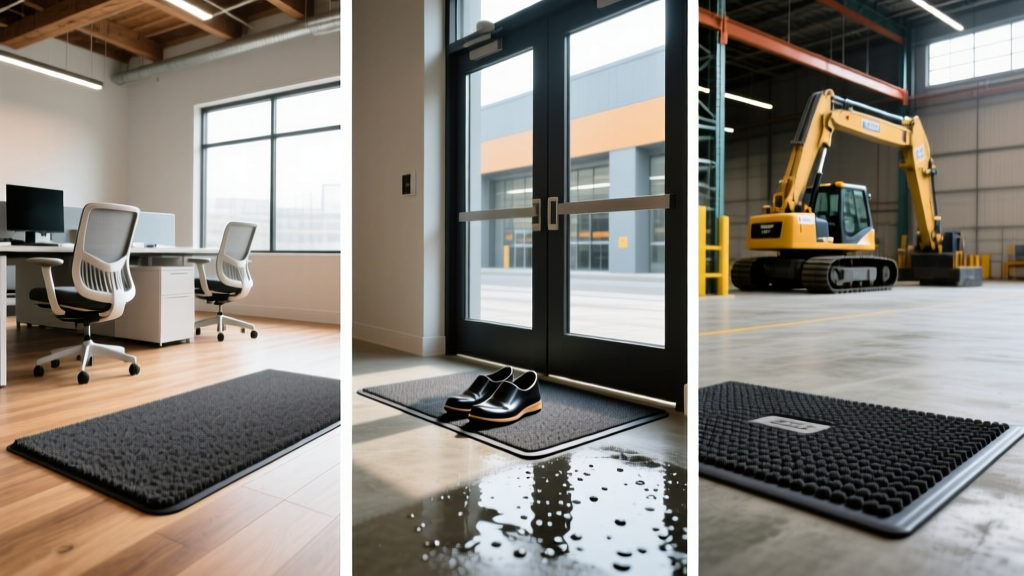
The Case for Modular Matting Over Permanent Flooring
While permanent flooring systems like polished concrete, epoxy coatings, and luxury vinyl tile (LVT) dominate commercial and industrial design, they cannot solve every environmental challenge. Applying specialized matting on floor substrates provides targeted solutions for moisture control, ergonomic support, and impact absorption that permanent floors simply cannot offer. The decision to deploy modular matting should not be an afterthought; it requires a precise application-fit strategy based on traffic volume, chemical exposure, and subfloor compatibility.
Choosing the wrong matting system leads to rapid degradation, subfloor damage, and severe trip hazards. This guide breaks down the exact material specifications, thickness requirements, and failure modes for high-stakes flooring scenarios, ensuring your matting investment delivers measurable safety and operational returns.
Scenario Matching Matrix: Traffic, Moisture, and Load
Before selecting a material, map your environment to the correct performance matrix. The table below outlines the primary operational scenarios and the non-negotiable material requirements for each.
| Scenario | Primary Hazard | Required Material | Critical Specification | Avg. Cost (per sq. ft.) |
|---|---|---|---|---|
| Commercial Entrances | Moisture & Dirt Ingress | Nitrile Rubber / Crush-proof Nylon | Bi-level scraper profile, 1.5 gal/sq yd water capacity | $10.00 - $18.00 |
| Industrial Assembly | Worker Fatigue & Joint Stress | Closed-Cell Polyurethane or Nitrile | 3/4" thickness, 50-60 Shore A durometer | $6.00 - $12.00 |
| Commercial Kitchens | Grease Slips & Fluid Pooling | 100% Grease-Proof Nitrile | NSF certified, drainage holes, COF > 0.6 | $5.00 - $9.00 |
| Heavy Fitness Zones | Subfloor Impact & Vibration | Vulcanized Recycled Rubber | 3/8" to 3/4" thickness, 90 Shore A durometer | $3.50 - $7.00 |
Deep Dive: High-Traffic Commercial Entrances
The first 15 feet of any commercial entrance dictate the cleanliness and safety of the entire facility. Standard carpet mats fail in this zone because they trap moisture at the surface, creating a slip hazard and allowing dirt to be tracked further inside.
The Bi-Level Scraper System
For high-traffic vestibules, specify bi-level surface matting. These systems feature raised rubber cleats with yarn situated below the cleat height. As foot traffic steps on the raised rubber, the shoe sole is scraped clean, while the dirt and moisture fall into the lower yarn reservoir. Look for mats constructed with 100% high-twist, heat-set nylon yarn backed by a nitrile rubber base. Nitrile is essential here; standard SBR (styrene-butadiene rubber) backing will crack in freezing temperatures and degrade under UV exposure from glass doors.
Water Dam Borders: Ensure the matting features a 3/8" raised rubber water dam border. A high-quality 3x5 foot entrance mat with this specification can hold up to 1.5 gallons of water per square yard without leaking onto the LVT or terrazzo subfloor below.
Deep Dive: Industrial Anti-Fatigue Workstations
Prolonged standing on unyielding surfaces like sealed concrete restricts blood flow and causes severe musculoskeletal fatigue. According to NIOSH Ergonomics Guidelines, properly engineered anti-fatigue matting reduces lower limb blood pooling and decreases worker fatigue by up to 30%. However, not all "anti-fatigue" mats are created equal.
Material Durometer and Thickness
The effectiveness of an anti-fatigue mat relies on its durometer (hardness) and compression deflection. A mat that is too soft causes instability, forcing the worker's micro-muscles to overcompensate, which actually increases fatigue. A mat that is too hard provides no ergonomic benefit.
- Light Assembly / Standing Desks: Specify 1/2" thick closed-cell polyurethane foam with a 50 Shore A durometer. This provides adequate cushioning for lighter workers and allows for smooth rolling of light stools.
- Heavy Manufacturing / CNC Machining: Specify 3/4" thick 100% nitrile rubber with a 60 Shore A durometer. Nitrile resists oils, metal shavings, and coolants that would instantly destroy polyurethane foam.
Edge Profile Warning: In environments where pallet jacks or heavy carts are used, you must specify beveled edges (typically a 3-degree slope). Straight-edge mats in forklift or cart zones will curl within weeks, creating a severe trip hazard that violates OSHA Standard 1910.22 for walking-working surfaces.
⚠️ The Plasticizer Migration Trap
Never place standard sulfur-cured rubber matting directly on Luxury Vinyl Tile (LVT), Vinyl Composition Tile (VCT), or polyurethane-coated concrete. The chemical reaction between the rubber's antioxidants and the floor's plasticizers causes permanent yellow staining that cannot be stripped or buffed out. If you must use rubber matting on these surfaces, require a "non-staining" polyurethane-backed mat or lay down a protective PET film barrier first.
Deep Dive: Wet Processing & Commercial Kitchens
Kitchen environments demand mats that handle continuous fluid exposure, animal fats, and aggressive cleaning chemicals. The primary failure mode in commercial kitchens is the use of standard rubber mats that absorb grease, becoming heavy, foul-smelling, and highly slippery on their underside.
Grease-Proof vs. Grease-Resistant
When procuring kitchen matting, verify the spec sheet explicitly states 100% Grease-Proof Nitrile. "Grease-resistant" is a marketing term that often masks SBR blends which will eventually swell and blister when exposed to fryer oil. Furthermore, the mat must feature large, strategically placed drainage holes (minimum 1.5" diameter) to allow fluids to pass through to the trench drain, rather than pooling under the mat and breeding bacteria.
Verify the mat's slip resistance by checking for National Floor Safety Institute (NFSI) certification. The wet dynamic coefficient of friction (DCOF) must exceed 0.60 to meet commercial safety thresholds.
Subfloor Compatibility & Installation Edge Cases
Loose-laying heavy matting on floor surfaces without proper securing mechanisms leads to edge curling, shifting, and buckling. The installation method must match the subfloor type:
- Polished Concrete & Epoxy: Use double-sided butyl rubber tape. Butyl maintains its adhesion in fluctuating temperatures and does not leave a gummy residue when the mat is removed for deep cleaning. Avoid standard acrylic tapes, which will dry out and shatter under heavy rolling loads.
- Interlocking Modular Systems: For large coverage areas (like warehouse aisles), avoid individual loose mats entirely. Specify interlocking PVC or rubber tiles with hidden dovetail joints. This creates a wall-to-wall unified surface that prevents liquid from seeping between mats while allowing individual damaged tiles to be swapped out.
- Raised Access Floors (Data Centers): Never use adhesive-backed matting on raised access floor panels. The adhesive will compromise the anti-static properties of the floor and make lifting panels for under-floor cable maintenance nearly impossible. Use heavy-weight, loose-lay anti-static (ESD) matting with conductive copper grounding straps attached to the floor grid.
Maintenance Realities and Lifecycle Costs
The lifecycle cost of floor matting is heavily dictated by maintenance protocols. A $150 entrance mat can last five years or five months depending on how it is cleaned.
Extraction vs. Pressure Washing: Never use high-pressure washers on closed-cell polyurethane anti-fatigue mats or bi-level entrance mats. The PSI will tear the yarn from the backing and fracture the foam cells, causing the mat to absorb water like a sponge. Instead, use a commercial hot-water extraction unit (carpet cleaner) for entrance mats, and a low-pressure foaming degreaser with a soft-bristle deck brush for kitchen mats.
Implement a strict rotation schedule. In high-traffic commercial entrances, purchase three sets of matting: one in use, one in the laundry, and one drying. Rotating them weekly extends the functional lifespan of the fibers by up to 40%, delaying the capital expenditure of full replacement.