Cost of Different Flooring Options: 2026 Price Breakdown
Compare the true installed costs, hidden fees, and ROI of different flooring options in 2026. Expert pricing data for hardwood, LVP, tile, and laminate.

The True Cost of Different Flooring Options: Material vs. Installation
When evaluating different flooring options, homeowners frequently make the mistake of budgeting solely for the material. In 2026, the total cost of ownership (TCO) encompasses material acquisition, specialized labor, subfloor preparation, and long-term maintenance. A budget-friendly laminate might cost $2.50 per square foot at the register, but once you factor in mandatory moisture barriers, acoustic underlayment, and professional installation, the realized cost often triples. Conversely, premium porcelain tile carries a steep upfront labor cost but requires virtually zero maintenance over a 50-year lifespan.
To make an informed financial decision, you must analyze the complete installed price. Below is the 2026 comprehensive cost matrix for the most prevalent residential flooring materials.
| Flooring Material | Avg Material Cost (Sq Ft) | Avg Labor Cost (Sq Ft) | Total Installed Range | Expected Lifespan |
|---|---|---|---|---|
| Solid Hardwood (3/4' Oak) | $6.00 - $12.00 | $4.50 - $8.00 | $10.50 - $20.00 | 50+ Years (Refinishable) |
| Engineered Hardwood | $5.00 - $10.00 | $3.50 - $6.50 | $8.50 - $16.50 | 25 - 40 Years |
| Luxury Vinyl Plank (SPC Core) | $3.00 - $7.00 | $2.00 - $4.00 | $5.00 - $11.00 | 15 - 25 Years |
| Porcelain Tile (Large Format) | $4.00 - $12.00 | $6.00 - $12.00 | $10.00 - $24.00 | 50+ Years |
| Laminate (12mm AC4) | $2.50 - $5.00 | $2.00 - $3.50 | $4.50 - $8.50 | 15 - 20 Years |
| Sheet Vinyl | $1.50 - $3.50 | $1.50 - $3.00 | $3.00 - $6.50 | 10 - 15 Years |
Hardwood and Engineered Wood: Premium Upfront, High ROI
Solid hardwood remains the gold standard for resale value, but its installation parameters are rigid. According to the National Wood Flooring Association (NWFA), solid 3/4-inch hardwood must be acclimated to the home's interior environment for 3 to 7 days prior to installation, maintaining a relative humidity between 30% and 50%. Failure to acclimate results in severe cupping or gapping within the first seasonal change.
Furthermore, the Janka hardness rating of your chosen wood species directly impacts labor costs. Installing a standard Red Oak (Janka rating of 1290) is straightforward. However, if you opt for exotic species like Brazilian Walnut (Janka rating of 3680), installers must use specialized carbide-tipped saw blades and pre-drill nail holes, increasing labor costs by 15% to 25%.
Never install solid hardwood below grade (basements) or over radiant heating systems. The dimensional instability of solid wood in high-moisture or high-heat environments leads to catastrophic warping. For below-grade applications, engineered hardwood with a cross-plywood core is the only viable wood option, as its layered construction resists expansion and contraction.
Luxury Vinyl Plank (LVP) and Tile: The Waterproof Contenders
When analyzing different flooring options for wet areas like bathrooms, kitchens, and basements, LVP and porcelain tile dominate the market. However, not all LVP is created equal. In 2026, the market is split between WPC (Wood Plastic Composite) and SPC (Stone Plastic Composite) cores. SPC cores are denser, heavier, and highly resistant to indentation from heavy furniture, making them the superior choice for high-traffic living areas. When purchasing LVP, ignore the overall thickness and focus strictly on the wear layer. A 12-mil wear layer is sufficient for low-traffic bedrooms, but you must specify a 20-mil wear layer for main living areas to prevent scratching from pet claws and foot traffic.
Porcelain tile offers unmatched longevity, but large-format tiles (anything with one edge longer than 15 inches, such as 24x48 planks) require advanced installation techniques. The Tile Council of North America mandates the use of lippage control systems (like the Tuscan Leveling System) and specific large-format trowels (1/2' x 1/2' square notch) to ensure proper mortar coverage. This specialized labor is why tile installation costs often exceed the material costs themselves.
Laminate and Sheet Vinyl: Budget-Conscious Solutions
For investment properties or tight renovation budgets, laminate and sheet vinyl offer the lowest barrier to entry. When selecting laminate, rely on the AC (Abrasion Criteria) rating rather than marketing terms like 'scratch-resistant'. AC3 is rated for moderate residential use (bedrooms), while AC4 is required for heavy residential use (living rooms, hallways). Additionally, laminate requires a floating installation over an underlayment. If installing over a concrete subfloor, you must budget an extra $0.40 to $0.70 per square foot for a 6-mil polyethylene vapor barrier to prevent moisture migration from destroying the fiberboard core.
Hidden Cost Factors That Derail Flooring Budgets
The most common budget overruns occur before the new flooring is even unboxed. Factor these hidden costs into your financial model:
- Subfloor Leveling: Most modern click-lock floors require a subfloor variance of no more than 3/16 inch over a 10-foot radius. Applying self-leveling underlayment (SLU) and primer costs between $1.50 and $3.00 per square foot.
- Demolition and Haul-Away: Removing existing flooring and disposing of it at a municipal landfill adds $1.00 to $2.50 per square foot. If the existing floor is pre-1980 vinyl, asbestos testing and abatement can spike this cost to $5.00+ per square foot.
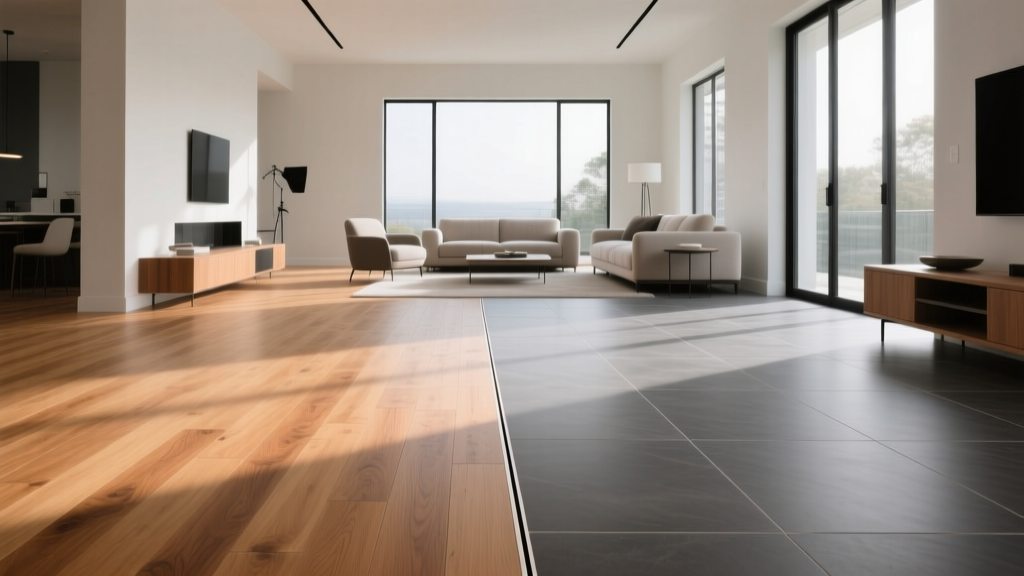
- Baseboards and Transitions: Professional installers typically charge $1.50 to $2.50 per linear foot to remove, undercut, and reinstall baseboards, plus $15 to $30 per transition strip (T-moldings, reducers) between different flooring types.
Cost vs. Resale Value: Which Options Actually Pay Off?
According to remodeling impact reports published by the National Association of Realtors (NAR), flooring upgrades consistently yield some of the highest returns on investment in real estate. Solid hardwood routinely recovers 100% to 106% of its installed cost at resale, largely because buyers perceive it as a premium, permanent fixture. Engineered hardwood and high-end porcelain tile typically recover 70% to 85%. Conversely, sheet vinyl and budget laminate recover less than 50% of their cost, as buyers often factor in the immediate expense of ripping them out and replacing them after purchase.
Decision Framework: Matching Options to Your Specific Scenario
Use this rapid-decision matrix to select the right material based on your specific room constraints and budget parameters:
- Scenario A: Below-grade basement with potential moisture seepage.
Verdict: SPC-core Luxury Vinyl Plank (glue-down or click-lock). Avoid all wood and laminate products. - Scenario B: Main living area with large dogs and high foot traffic.
Verdict: 20-mil (or higher) LVP or through-body porcelain tile. Avoid soft solid woods like Pine or American Cherry. - Scenario C: Maximizing resale value in a primary bedroom or dining room.
Verdict: 3/4-inch solid hardwood (White Oak or Maple). The premium upfront cost is fully recouped at closing. - Scenario D: Quick flip or rental property with a strict $5/sqft total budget.
Verdict: 8mm AC3 Laminate or commercial-grade sheet vinyl. Keep labor costs low by utilizing floating or full-spread adhesive installations.
Written by
Priya KapoorPriya Kapoor is a real estate market analyst and construction economics researcher with expertise in housing affordability, development feasibility, and infrastructure investment. She holds a Master of Regional Planning from Cornell University and previously worked as a senior analyst at CBRE's Investment Properties group, where she modeled returns for $4B in mixed-use development pipelines. Priya now runs an independent research practice advising developers, municipalities, and REITs on construction cost forecasting and market timing. She publishes the quarterly "BuildMat Market Pulse" report tracking material price indices across 12 commodity categories. Based in Austin, TX, Priya serves on the board of Habitat for Humanity Austin and is a marathon runner.
More from Priya Kapoor
View all
Construction Cost
Cost to Build a 1600 Sq Ft Home in 2026: Full Breakdown
Accurate 2026 cost to build a 1600 sq ft home—material, labor, and regional pricing breakdowns included. Plan your budget with real-time estimates.
Aug 11, 2026

Wood & Lumber
Name the Types of Wood for Pressure Treatment and Preservation
Learn how to name the types of wood best suited for pressure treatment. Compare species treatability, chemical retention levels, and 2026 preservation costs.
Aug 4, 2026

Stone & Masonry
Stone Veneer Suppliers Lindenhurst: 2026 Cost Analysis
Analyze 2026 stone veneer costs in Lindenhurst, NY. Compare local supplier pricing, delivery fees, and Suffolk County installation labor rates.
Aug 4, 2026