Countertop Materials Ranked by Durability and Expected Lifespan
Compare top countertop materials by durability, Mohs hardness, and lifespan. Discover which surfaces resist scratches, heat, and stains for long-term value.
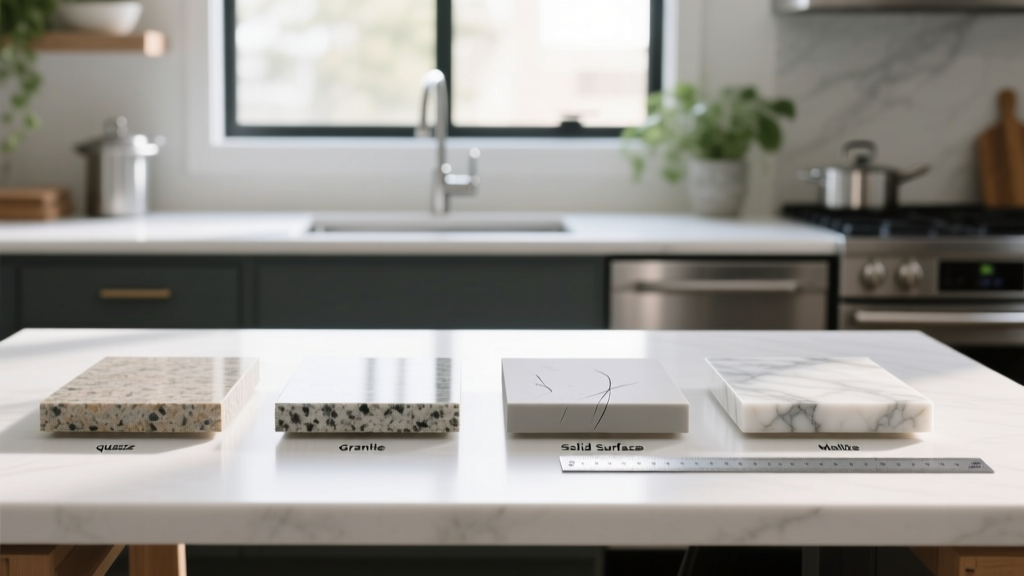
The Physics of Surface Wear: Mohs Hardness vs. Polymer Binders
When evaluating countertop materials for high-traffic kitchens and commercial spaces, surface hardness is only half the equation. The Mohs scale of mineral hardness provides a baseline for scratch resistance, but it fails to account for the binders that hold engineered surfaces together. For example, while natural quartz crystals rank at a 7 on the Mohs scale, the polymer resins used to bind them in engineered quartz countertops typically rank between 2 and 3. This means your surface is only as scratch-resistant as its weakest chemical component.
Understanding the distinction between mineral hardness and binder vulnerability is critical for predicting the true lifespan of your installation. According to the Mohs Hardness Scale guidelines, everyday kitchen hazards like steel knives (Mohs 5.5) will not scratch pure granite or sintered stone, but they can easily micro-scratch the resin matrix in engineered quartz, leading to dull spots over time. As of 2026, manufacturers have introduced advanced acrylic and urethane-based resins to mitigate this, but the fundamental physics of composite materials remain a primary driver of long-term wear.
Countertop Materials Durability and Lifespan Matrix
The following matrix breaks down the five most prominent countertop materials based on empirical durability metrics, thermal thresholds, and current 2026 market pricing. Lifespan estimates assume standard residential use with proper maintenance protocols.
| Material | Mohs Hardness | Heat Threshold | Stain Resistance | Expected Lifespan | Avg Cost (2026) |
|---|---|---|---|---|---|
| Sintered Stone (e.g., Dekton) | 8 - 9 | Up to 1,200°F | Exceptional | 30+ Years | $90 - $140 / sq ft |
| Natural Granite | 6 - 7 | Up to 1,200°F | High (Sealed) | 30+ Years | $60 - $150 / sq ft |
| Engineered Quartz | 7 (Mineral) / 3 (Resin) | ~300°F (Resin limit) | Exceptional | 20 - 25 Years | $75 - $125 / sq ft |
| Large-Format Porcelain | 8 (Glazed) | Up to 1,000°F | Exceptional | 25+ Years | $60 - $100 / sq ft |
| Solid Surface (e.g., Corian) | 2 - 3 | ~212°F | High | 15 - 20 Years | $50 - $90 / sq ft |
Critical Failure Modes and Edge Cases
Marketing brochures often highlight best-case scenarios, but real-world longevity is determined by how materials handle edge cases and environmental stressors. Below is an analysis of the most common failure modes for premium surfaces.
Engineered Quartz: UV Degradation and Thermal Shock
Quartz is highly stain-resistant, but it is vulnerable to two specific failure modes. First, prolonged exposure to direct UV sunlight causes polyester-based resins to yellow and become brittle. If your kitchen features large south-facing windows, you must specify UV-stable acrylic resins from manufacturers like Caesarstone or Cambria. Second, thermal shock is a major risk. Placing a 400°F cast-iron pan directly on quartz will not immediately melt the surface, but the rapid temperature differential can cause the resin to expand at a different rate than the quartz aggregate, resulting in permanent micro-fractures or 'clouding' that cannot be buffed out.
Sintered Stone: Edge Chipping and Fabrication Stress
Sintered stone is created by subjecting raw minerals to extreme heat and pressure, mimicking the metamorphic process of the earth. The result is a near-indestructible surface. However, its extreme density makes it highly brittle. The number one failure mode for sintered stone is edge chipping. If a heavy pot strikes a sharp, 90-degree eased edge, the material can chip. To mitigate this, fabricators must use specialized diamond bridge saws and apply a slight micro-bevel or bullnose profile to all exposed edges. Furthermore, undermount sink cutouts require precision waterjet cutting; traditional routing creates stress fractures that propagate over time.
Natural Granite: Fissures vs. Structural Cracks
Homeowners frequently confuse natural fissures with structural cracks. Fissures are microscopic, naturally occurring separations in the stone that do not compromise structural integrity. However, if a granite slab is improperly supported over a dishwasher—where heat and moisture cycle daily—these micro-fissures can expand into structural cracks. The Natural Stone Institute mandates that all stone overhangs and cutouts be reinforced with structural epoxy and corbels, yet this step is frequently skipped by budget fabricators.
⚠️ Warning: The Dishwasher Steam Trap
Never install engineered quartz or solid surface materials directly over a dishwasher without a thermal barrier. The repetitive blast of 160°F steam during the dry cycle will degrade the polymer binders from underneath, causing the surface to warp, delaminate, or lose its polish within 3 to 5 years. Always specify a heat-resistant foil tape or a stainless steel thermal shield between the appliance and the substrate.
Lifespan vs. ROI: Repairability and Long-Term Value
Durability is not just about resisting damage; it is about the ability to recover from it. When calculating the return on investment for countertop materials, you must factor in repairability.
- Solid Surface (Corian/Avonite): While it scratches easily (Mohs 2-3), solid surface is homogeneous. Deep scratches, burns, and minor chips can be sanded out with 400-grit sandpaper and polished back to a factory finish in under an hour. This makes it highly cost-effective for commercial and rental properties despite its lower initial hardness.
- Engineered Quartz: Zero repairability. Deep scratches or burns expose the aggregate and cannot be sanded out because the resin pattern is only consistent at the surface level. Damaged sections require full slab replacement.
- Natural Stone: Moderate repairability. Professional stone restorers can diamond-hone and re-polish granite or marble to remove etching and light scratches, though color-matching epoxy fills for deep chips requires high expertise.
Evidence-Based Maintenance Protocols for Maximum Longevity
To achieve the maximum expected lifespan of your chosen material, you must abandon generic cleaning advice and adopt chemistry-specific maintenance protocols.
'The most common cause of premature stone degradation is not physical impact, but chemical etching from improper pH cleaners.' — International Stone Restoration Association
1. pH-Neutral Cleaning for Natural Stone
Granite and marble contain calcium carbonate and other reactive minerals. Acidic cleaners (vinegar, lemon-based sprays, ammonia) will chemically etch the surface, destroying the polish. Use only pH-neutral cleaners (pH 7.0 to 8.0). For daily maintenance, a simple mixture of warm water and a single drop of mild dish soap is chemically sufficient and prevents surfactant buildup.
2. Impregnating Sealers vs. Topical Coatings
Never use topical waxes or acrylic coatings on natural stone; they trap moisture and create a hazy, artificial sheen. Instead, use a fluoropolymer-based impregnating sealer. Unlike silicon-based sealers that sit near the surface, fluoropolymers penetrate deep into the capillary structure of the stone, bonding at a molecular level to repel both water and oil-based stains. According to the EPA guidelines on indoor air quality, ensure any solvent-based sealers used indoors have low VOC ratings to prevent off-gassing in poorly ventilated kitchens. Reapply fluoropolymer sealers every 3 to 5 years, depending on surface traffic.
3. The 'Water Drop' Diagnostic Test
To determine if your natural stone requires resealing, perform the water drop test. Place a 3-inch puddle of water on the surface in a high-use zone (near the sink). If the stone darkens within 3 minutes, the capillary network is exposed, and immediate resealing is required. If the water beads up and leaves no dark spot after 15 minutes, the impregnator is still fully active.
Final Selection Framework
Choosing the right countertop material requires aligning the physical properties of the surface with the behavioral realities of the household. If your priority is absolute thermal and scratch resistance with zero maintenance, sintered stone is the undisputed leader. If you require a seamless, repairable surface for a high-abuse environment, solid surface remains the most pragmatic choice. Engineered quartz offers the best balance of aesthetic consistency and stain resistance, provided you respect its thermal and UV limitations. By prioritizing material science over marketing trends, you ensure your surfaces perform flawlessly for decades.