Vinyl Planks Taxonomy: WPC, SPC, and LVP Selection Guide
Navigate the vinyl planks taxonomy. Compare WPC, SPC, and traditional LVP core constructions to select the exact waterproof flooring for your space.
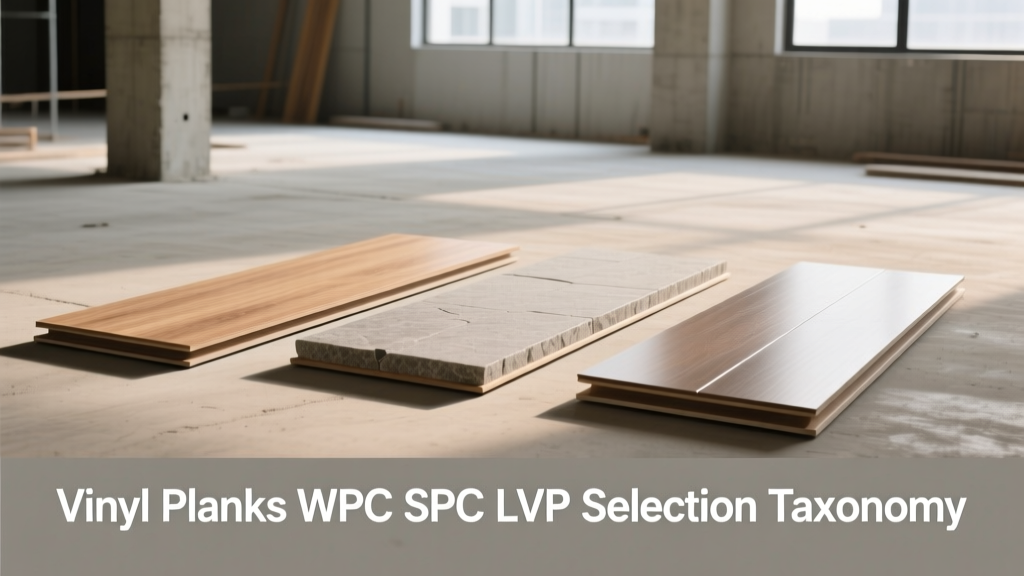
The Anatomy of Modern Vinyl Planks
The term 'vinyl flooring' is no longer sufficient for specification or procurement. Modern vinyl planks are complex, multi-layered engineered products designed to replicate hardwood and stone while offering complete waterproofing. Before evaluating core taxonomies, it is critical to understand the four universal layers that dictate the performance of any resilient plank:
- Wear Layer: The transparent, sacrificial top coat (typically urethane, aluminum oxide, or ceramic bead infused) that resists scratches, stains, and UV fading.
- Printed Design Film: A high-resolution vinyl layer that provides the visual aesthetic, including embossed-in-register (EIR) textures that align physical grain with the visual wood pattern.
- Core Layer: The structural backbone of the plank. This is where the primary taxonomy diverges into LVP, WPC, and SPC.
- Backing/Underlayment: The bottom layer, often cork, IXPE foam, or EVA, which provides sound dampening, moisture resistance, and minor subfloor forgiveness.
Core Construction Taxonomy: LVP vs. WPC vs. SPC
The core layer is the defining characteristic of modern vinyl planks. According to the Resilient Floor Covering Institute (RFCI), the evolution of core materials has shifted the industry from flexible sheets to rigid, dimensionally stable planks. Here is the technical breakdown of the three primary core types.
1. Traditional Flexible LVP (Luxury Vinyl Plank)
Traditional LVP features a solid, flexible PVC (polyvinyl chloride) core. It is manufactured using a calendering process that presses heated PVC resin into thin, dense sheets.
2. WPC (Wood Plastic Composite)
WPC cores are created by mixing PVC resins with wood flour or wood dust, and crucially, a foaming agent. This foaming process introduces microscopic air pockets into the core, making the plank thicker, lighter, and significantly softer underfoot than traditional LVP. WPC was the original 'rigid core' innovation, prized for its acoustic dampening and thermal insulation properties. However, the foamed structure makes it more vulnerable to heavy point-load indentation (e.g., from heavy appliances or stiletto heels).
3. SPC (Stone Plastic Composite)
SPC represents the current apex of rigid core technology. The core is formulated from limestone dust (calcium carbonate) combined with PVC stabilizers. No foaming agents are used. The result is an ultra-dense, remarkably rigid core that is virtually impervious to indentation and extreme temperature fluctuations. As of 2026, SPC dominates the commercial and high-traffic residential sectors because its dimensional stability allows it to be installed in sunrooms or over radiant heating systems without expanding or contracting.
Technical Specification Matrix
Use this matrix to compare the physical properties and current market pricing of the three vinyl plank taxonomies.
| Feature | Flexible LVP | WPC Core | SPC Core |
|---|---|---|---|
| Core Density | High (Solid PVC) | Low (Foamed) | Ultra-High (Limestone) |
| Indentation Resistance | Moderate | Low to Moderate | Exceptional |
| Subfloor Forgiveness | Poor (Telegraphs) | Excellent | Good (Rigid bridging) |
| Underfoot Comfort | Firm | Soft / Warm | Hard / Firm |
| Avg. Cost (Installed) | $3.50 - $5.50 / sq ft | $5.00 - $8.00 / sq ft | $4.50 - $7.50 / sq ft |
The Wear Layer: Decoding Mils vs. Millimeters
A frequent point of failure in material selection is confusing the wear layer thickness with the total plank thickness. Industry standards, including those outlined by ASTM International for resilient flooring, measure the wear layer in mils (one-thousandth of an inch), not millimeters.
- 6 to 8 Mils: Light residential. Suitable for guest rooms or low-traffic bedrooms. Will show micro-scratches within 3-5 years.
- 12 Mils: Standard residential. The baseline for living rooms, kitchens, and hallways. Offers a 10-15 year lifespan against normal wear.
- 20 Mils: Heavy residential / Light commercial. Required for homes with large dogs, active children, or light retail spaces.
- 22+ Mils (up to 40 mils): Heavy commercial. Specified for hospitals, airports, and high-traffic retail. Often features enhanced urethane coatings for chemical resistance.
Warning: A plank marketed as '5mm thick' refers to the total profile (core + wear layer + backing). If the 5mm plank only has a 6-mil wear layer, it is a low-grade product despite the thick overall profile. Always verify the wear layer specification independently.
Installation Realities: Locking Systems and Acclimation
The rigid nature of WPC and SPC planks necessitates precision click-lock mechanisms. The industry relies on two primary patented systems:
- Unilin (Angle-Angle): Requires the installer to angle the long side, drop it, and then tap the short side into place using a tapping block. Highly secure but slower to install.
- Valinge (Drop-Lock / Fold-Down): Allows the short side to simply fold down and lock into the adjacent plank. Significantly faster for large, open rooms, but can be prone to peaking if the subfloor is uneven.
Expert Insight on Acclimation: A persistent myth is that waterproof vinyl planks do not require acclimation. While SPC is highly dimensionally stable, the Floor Covering Weekly installation guidelines and most manufacturer warranties strictly mandate a 48-hour acclimation period in the installation environment (between 65°F and 85°F). Failing to acclimate can result in joint separation or 'peaking' when the planks eventually adjust to the room's ambient temperature.
Selection Decision Framework
Use this framework to finalize your vinyl plank taxonomy selection based on your specific project parameters:
Choose Flexible LVP When:
- You are working with a strict budget and the material cost is the primary constraint.
- The installation is a temporary fix, a flip property, or a low-traffic rental unit.
- The subfloor is perfectly level (self-leveled concrete) and you are gluing the planks down rather than floating them.
Choose WPC When:
- The installation is in a bedroom, nursery, or multi-story condo where acoustic dampening (IIC sound ratings) and underfoot warmth are the highest priorities.
- The subfloor has minor imperfections that you want the thicker, softer core to absorb without extensive leveling compound work.
Choose SPC When:
- The space experiences extreme temperature fluctuations (sunrooms, cabins, or over radiant heat systems).
- You are installing in a commercial space, a kitchen with heavy appliances, or a home with large, active dogs where indentation resistance is non-negotiable.
- You require a thin profile to match transitions to existing adjacent flooring (SPC is typically 4mm-6mm thick, whereas WPC is 6mm-8mm).