Maintaining Inexpensive Basement Flooring Options: Expert Guide
Learn how to clean, protect, and extend the life of inexpensive basement flooring options like LVP, sheet vinyl, and painted concrete with expert tips.

The Basement Moisture Factor: Why Maintenance Differs Here
Basements present a uniquely hostile environment for flooring. Unlike above-grade rooms, below-grade concrete slabs are in constant contact with surrounding soil, making them susceptible to hydrostatic pressure, capillary action, and vapor emission. When selecting and maintaining inexpensive basement flooring options, the primary enemy is not foot traffic—it is moisture. According to the Environmental Protection Agency (EPA), controlling indoor moisture is the single most critical factor in preventing mold growth and structural degradation in below-grade spaces.
Maintaining budget-friendly floors like luxury vinyl plank (LVP), sheet vinyl, painted concrete, or interlocking tiles requires a dual approach: strict surface cleaning protocols and aggressive environmental control. Below is a material-specific maintenance framework designed to maximize the lifespan of your investment.
Luxury Vinyl Plank (LVP) and Sheet Vinyl Upkeep
LVP and sheet vinyl are the most popular inexpensive basement flooring options due to their 100% waterproof surface ratings. However, "waterproof surface" does not mean "waterproof installation." The vulnerabilities lie in the seams, the click-lock mechanisms, and the underlying core materials.
Daily and Weekly Cleaning Protocols
- Dry Dusting: Use a microfiber dust mop daily. Basements accumulate fine concrete dust and drywall particulate that acts like sandpaper underfoot, prematurely wearing down the urethane wear layer of LVP.
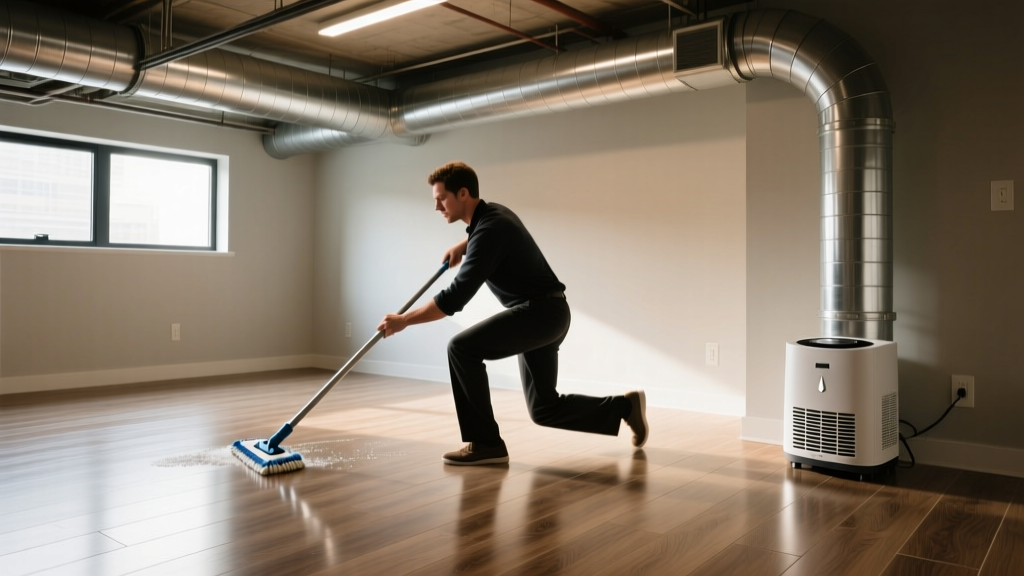
- Wet Mopping: Use a damp (not soaking) microfiber mop with a pH-neutral cleaner specifically formulated for vinyl, such as Bona Hard-Surface Floor Cleaner. Avoid alkaline cleaners, which leave a dulling film.
- The Steam Mop Ban: Never use a steam mop on click-lock LVP. The combination of high heat (often exceeding 200°F) and forced vapor pressure will push moisture through the microscopic gaps in the click-lock seams. This causes the high-density fiberboard (HDF) core to swell, leading to irreversible edge curling and delamination.
Handling Seams and Moisture Intrusion
If a basement sump pump fails or a water heater leaks, LVP must be addressed immediately. While the planks themselves will not warp, water trapped beneath the floating floor will breed mold on the concrete slab. For sheet vinyl, perimeter sealing is critical. Inspect the silicone caulk at the baseboards every six months. If the caulk shows signs of peeling or blackening, strip it and reapply a 100% silicone waterproof sealant to prevent surface water from migrating under the sheet.
Painted and Epoxy-Coated Concrete Maintenance
Painting or applying a budget water-based epoxy to a concrete slab is the most cost-effective flooring option available, often costing less than $1.50 per square foot in materials. However, concrete is highly alkaline and porous, requiring specialized maintenance to prevent coating failure.
Preventing Efflorescence Blistering
Efflorescence occurs when water-soluble salts migrate through the concrete pores and crystallize on the surface as the water evaporates. This crystallization creates hydrostatic pressure beneath the paint film, causing it to blister and peel. To maintain painted concrete:
- Clean spills immediately to prevent liquid from penetrating micro-cracks in the paint.
- Never use acidic cleaners (like vinegar or muriatic acid) on painted concrete, as they will chemically degrade the binder in the paint.
- Use a mild, non-alkaline detergent (like a few drops of Dawn dish soap in warm water) for routine mopping.
| Cleaning Agent | pH Level | Effect on Painted/Epoxy Concrete |
|---|---|---|
| White Vinegar | 2.5 (Acidic) | Degrades epoxy binders; strips paint gloss. |
| Mild Dish Soap | 7.0 - 8.0 (Neutral) | Safe for routine cleaning; removes surface oils. |
| Ammonia | 11.0 (Alkaline) | Causes chalking and premature fading of pigments. |
| TSP (Trisodium Phosphate) | 12.0 (Highly Alkaline) | Use only for heavy degreasing; requires thorough rinsing. |
Interlocking Foam and Rubber Tile Care
Interlocking EVA foam or recycled rubber tiles are favored for basement gyms and playrooms. Their maintenance challenge is not the top surface, but the hidden gap between the tile and the slab. Because these tiles are laid as floating floors without adhesive, moisture vapor freely condenses on the underside of the impermeable rubber or foam.
For the top surface of rubber tiles, avoid petroleum-based solvents or oil-soap cleaners (like Murphy's Oil Soap). These break down the vulcanized rubber, leaving a permanently sticky residue that attracts dirt. Use a dedicated rubber floor cleaner or a simple dilution of isopropyl alcohol and water (1:10 ratio) to disinfect and cut through sweat and grime.
Troubleshooting Common Basement Floor Failures
When inexpensive basement flooring options fail, the root cause is almost always environmental rather than mechanical. Use this diagnostic matrix to identify and correct issues before a full replacement is required.
- Symptom: White, crusty powder accumulating in the seams of sheet vinyl or under foam tiles.
Diagnosis: Active efflorescence driven by high vapor emission rates (VER).
Action: Remove the affected flooring. Etch the concrete using a 1:10 muriatic acid solution, neutralize with baking soda, and apply a penetrating silane-siloxane concrete sealer (such as RadonSeal) before reinstalling the floor. - Symptom: LVP planks are "peaking" (edges pushing upward) or clicking sounds when walked on.
Diagnosis: Lack of expansion gap combined with seasonal humidity swelling, or an uneven subfloor causing the click-lock joints to flex and break.
Action: Remove the baseboards and verify a minimum 1/4-inch expansion gap around the entire perimeter. If the gap is closed, cut the edge planks with an oscillating multi-tool to relieve tension. - Symptom: Persistent musty odor despite clean flooring surfaces.
Diagnosis: Microbial volatile organic compounds (MVOCs) emanating from trapped moisture beneath the flooring or inside the drywall bottom plates.
Action: As detailed by Building Science Corporation, basements require specific vapor control layers. If the odor persists, the flooring must be pulled to inspect the slab, and a commercial-grade dehumidifier must be deployed immediately.
Environmental Controls: The Ultimate Maintenance Hack
The most effective maintenance routine for any inexpensive basement flooring is invisible: strict climate control. According to Shaw Floors manufacturer guidelines, maintaining a stable indoor environment is a strict requirement to keep LVP warranties valid.
To protect your flooring investment, adhere to these environmental baselines:
- Relative Humidity (RH): Maintain basement RH strictly between 35% and 55%. Spikes above 65% will cause HDF-cored LVP to expand, while drops below 30% will cause PVC to become brittle and shrink, opening the seams to water intrusion.
- Dehumidifier Sizing: Do not rely on your central HVAC system to dehumidify the basement. Install a dedicated, Energy Star-certified dehumidifier. For a standard 1,000-square-foot basement, a 50-pint unit with a continuous gravity drain hooked directly to a floor drain or sump pump is mandatory.
- Temperature Stability: Keep the basement temperature above 60°F year-round. Cold concrete slabs combined with warm, humid air from upstairs will cause condensation directly on the surface of sheet vinyl and painted concrete, creating a slip hazard and promoting mold.
By pairing rigorous, material-specific cleaning habits with uncompromising environmental controls, you can easily extend the functional lifespan of budget-friendly basement floors by a decade or more, ensuring your below-grade living spaces remain safe, dry, and visually appealing.
Written by
James ThorntonJames Thornton is a construction industry veteran with 25 years of hands-on experience in wood framing, lumber grading, and residential building codes. He started as a framing carpenter in rural Oregon, earned his ICC Residential Building Inspector certification, and eventually became a senior plan reviewer for the City of Portland Bureau of Development Services. James holds a B.S. in Wood Science & Technology from Oregon State University and is a certified lumber grader through the West Coast Lumber Inspection Bureau (WCLIB). He has inspected over 3,000 residential construction sites and authored the city's internal guide on advanced framing techniques (2x6 at 24" O.C.). James lives in Bend, OR, where he builds custom timber-frame cabins and competes in lumberjack sports.
More from James Thornton
View all
Insulation
Best Home Insulation Materials: Complete 2026 Guide
Compare top home insulation materials for 2026. Find R-values, installed costs per square foot, and best uses for fiberglass, spray foam, and mineral wool.
Aug 4, 2026

Sustainable Building
Certify Your Green Building Material for LEED and WELL
Step-by-step guide to certifying a green building material for LEED v5 and WELL v2. Master EPDs, HPDs, and VOC limits for 2026 project specifications.
Aug 4, 2026

Stone & Masonry
Veneer Stacked Stone Panels: Interior Design & Style Showcase
Discover how veneer stacked stone panels transform interiors. Explore modern design profiles, material pairings, and technical installation specs.
Aug 4, 2026