Top LVT Flooring Options for High-Traffic Homes: 2026 Guide
Discover the top LVT flooring options for high-traffic homes in 2026. Compare wear layers, rigid core vs. flexible, and exact costs for durable installations.
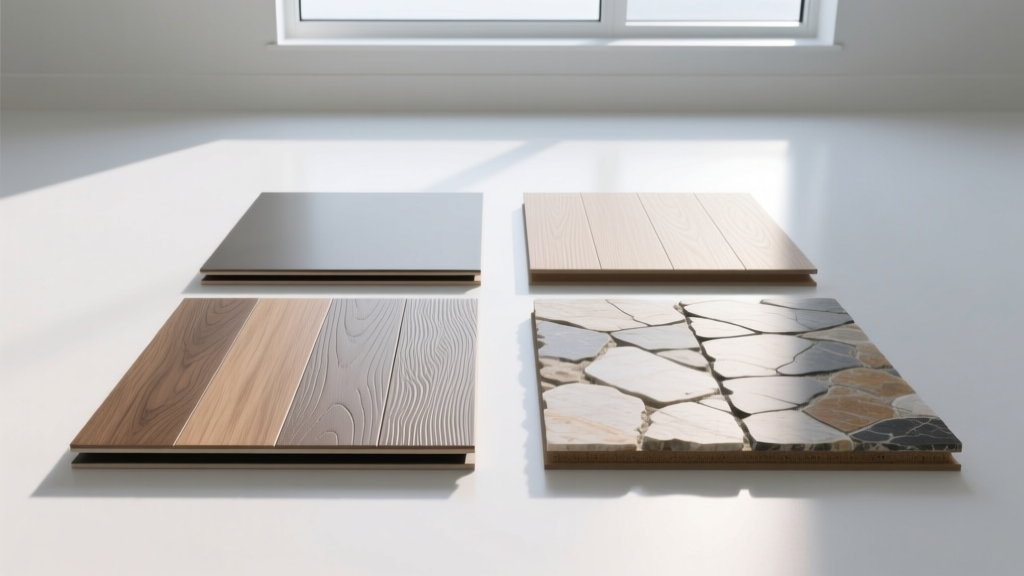
The Structural Core: SPC vs. WPC Deflection Mechanics
When evaluating lvt flooring options for high-traffic environments, the visual embossing is irrelevant if the structural core cannot resist point-load deflection. The market is currently dominated by two rigid core technologies, each with distinct mechanical properties that dictate their performance under heavy furniture, pet claws, and constant foot traffic.
Stone Plastic Composite (SPC)
SPC cores are engineered from a high-density mixture of limestone powder and polyvinyl chloride. According to the Resilient Floor Covering Institute (RFCI), SPC's defining characteristic is its dimensional stability. It boasts a density of roughly 1.8 to 2.0 g/cm³, making it highly resistant to permanent indentation. If you are placing a 600-pound refrigerator or a piano on the floor, SPC will resist the static load without compromising the click-lock mechanism. However, its rigidity means it transfers more impact noise and requires a flawlessly flat subfloor.
Wood Plastic Composite (WPC)
WPC incorporates a foaming agent into the wood-plastic polymer blend, creating a micro-cellular core structure. This aeration reduces the density to approximately 1.0 to 1.2 g/cm³, yielding superior acoustic dampening (often achieving IIC ratings of 50+ without secondary underlayment). While WPC is more forgiving over minor subfloor imperfections, it is susceptible to permanent indentation under static loads exceeding 250 psi. For high-traffic homes with heavy, concentrated furniture, WPC requires wider distribution pads.
2026 LVT Flooring Options Matrix: Heavy-Duty Models
The following matrix highlights top-performing rigid core models available in 2026, specifically selected for their wear layer technology and core density suitable for active households.
| Brand / Model | Core Type | Wear Layer | Total Thickness | Price / Sq Ft | Best Application |
|---|---|---|---|---|---|
| COREtec Pro Plus XL | SPC | 20 mil Urethane | 5.0mm | $4.50 - $5.20 | Active households with heavy furniture |
| Karndean Korlok Select | Rigid Core (SPC blend) | 20 mil K-Guard+ | 6.5mm | $6.00 - $7.50 | Premium residential, high acoustic needs |
| Shaw Floorté Premier | WPC | 30 mil Urethane | 8.0mm | $5.50 - $6.80 | Multi-story homes needing sound reduction |
| Provenza LVP Waterproof | SPC | 22 mil Ceramic Bead | 5.5mm | $3.80 - $4.90 | Homes with large dogs and high scratch risk |

Decoding the Wear Layer: Urethane vs. Ceramic Bead
The wear layer is the transparent top coat that protects the printed vinyl film. While many consumers assume a thicker wear layer is universally better, the chemical composition matters more than the mil thickness. The ASTM F3261 standard for rigid core flooring outlines rigorous testing for these surfaces, but real-world performance varies by coating type.
'A 20 mil wear layer infused with ceramic bead or aluminum oxide particulates will consistently outperform a standard 28 mil urethane coating in micro-scratch resistance. The ceramic beads act as microscopic armor against pet claws and grit, whereas standard urethane is more prone to scuffing under sheer lateral force.'
If your primary concern is large dogs or sandy entryways, prioritize a ceramic bead-enhanced coating (like Karndean's K-Guard+ or Provenza's UV-cured ceramic finish) over a thicker, standard polyurethane layer. Standard urethane is easier to buff out if scuffed, but ceramic bead prevents the scuff from occurring in the first place.
Installation Edge Cases That Void Manufacturer Warranties
Even the highest-rated lvt flooring options will fail catastrophically if installation tolerances are ignored. Manufacturer warranties in 2026 are increasingly strict regarding the following edge cases:
- Subfloor Flatness Tolerances: Rigid core SPC requires a subfloor flatness of 3/16 inch over a 10-foot radius. If installed over an uneven slab, the click-lock mechanism will flex under foot traffic, eventually snapping the fiberglass reinforcing tape inside the joint and causing plank separation.
- Expansion Gap Compression: A mandatory 1/4-inch expansion gap must be maintained at all vertical obstructions (walls, cabinets, pipes). Installers frequently 'pinch' the floor by driving shims too tightly or failing to cut the drywall undercut, leading to compressive buckling during seasonal humidity shifts.
- Adhesive Misuse on Floating Floors: Never use perimeter adhesive or glue-down methods on a floating click-lock system unless explicitly directed by the manufacturer's commercial installation guide. Restricting the floor's lateral movement will cause the core to fracture.
The 2026 Cost Breakdown: Material, Prep, and Labor
Budgeting for high-traffic LVT requires looking beyond the per-box material cost. Proper subfloor preparation and acoustic underlayments significantly impact the final price. For a comprehensive look at current market rates, refer to the Shaw Floors Vinyl Technical Guides for underlayment compatibility.
| Cost Component | Low-End Estimate | High-End Estimate | Notes & Variables |
|---|---|---|---|
| LVT Material (SPC/WPC) | $3.00 / sq ft | $7.50 / sq ft | Depends on core thickness and wear layer tech |
| Underlayment (if not attached) | $0.40 / sq ft | $1.20 / sq ft | IXPE foam is standard; cork is premium for acoustics |
| Subfloor Prep (Leveling) | $0.00 / sq ft | $3.50 / sq ft | Required if slab deviates >3/16' over 10 feet |
| Professional Installation Labor | $1.50 / sq ft | $3.50 / sq ft | Includes transitions, base shoe removal, and cleanup |
| Total Project Cost | $4.90 / sq ft | $15.70 / sq ft | Heavily dependent on existing subfloor condition |
Practical Decision Framework: Matching LVT to Your Subfloor
To finalize your selection, use this conditional framework based on your home's specific structural and environmental factors:
Scenario A: Slab-on-Grade with Minor Cracking
Recommendation: WPC with an attached cork underlayment. The foamed core will bridge minor telegraphing imperfections that would otherwise cause SPC click-locks to fail. Ensure a 6-mil polyethylene vapor barrier is laid first to prevent alkaline moisture migration.
Scenario B: Second-Story Over a Living Space
Recommendation: WPC or a thick (6.5mm+) SPC with a high-density acoustic pad. Impact noise (IIC rating) is critical here. Look for products that explicitly publish their IIC test results (aim for 50+ in multifamily or strict HOA environments).
Scenario C: High-Sun Exposure / Conservatory
Recommendation: High-density SPC only. SPC's limestone core resists thermal expansion up to 50% better than WPC. You must still use T-moldings at every doorway and limit direct UV exposure with window treatments to prevent the printed decorative film from fading, regardless of the core type.
Scenario D: Heavy Static Loads (Home Gym, Grand Piano)
Recommendation: Commercial-grade SPC with a minimum 28 mil wear layer and a high-density core. Alternatively, consider a glue-down LVT (rather than floating click-lock) for the specific room, as the direct-to-subfloor adhesive eliminates joint stress entirely under extreme point loads.
Written by
David NakamuraDavid Nakamura is a licensed architect (AIA) and construction technology writer focused on sustainable building methods, mass timber engineering, and high-performance building envelopes. He holds a Master of Architecture from the University of Washington and is a certified Passive House Consultant (CPHC). David spent eight years at the Seattle firm Mithun, where he led the design of three LEED Platinum projects, before founding his own practice specializing in net-zero residential design. He serves on the editorial advisory board of GreenBuilder Magazine and has authored peer-reviewed papers on cross-laminated timber (CLT) connections for the Journal of Structural Engineering. In his spare time, David teaches woodworking at Pratt Fine Arts Center and kayaks the Puget Sound.
More from David Nakamura
View all
Construction Cost
Labor Cost to Build a Deck Per Sq Ft: 2026 Installation Guide
Discover the exact labor cost to build a deck per sq ft in 2026. This installation guide breaks down contractor rates, complexity factors, and hidden fees.
Aug 4, 2026

Construction Cost
How Much Does It Cost to Build a 3 Bedroom House? Financing Guide
Learn exactly how much it costs to build a 3 bedroom house and explore 2026 financing options, construction loan types, and budget frameworks for your build.
Aug 4, 2026

Construction Cost
Cost to Build a Tennis Court: 2026 Guide
How much does it cost to build a tennis court in 2026? Breakdowns for asphalt, concrete, and synthetic surfaces plus fencing and lighting.
Jul 30, 2026