Vintage Floor Lamps: Flooring Weight Ratings and Protection Specs
Analyze how heavy vintage floor lamps impact hardwood, LVP, and tile. Explore point-load PSI, thermal limits, and exact flooring protection specifications.
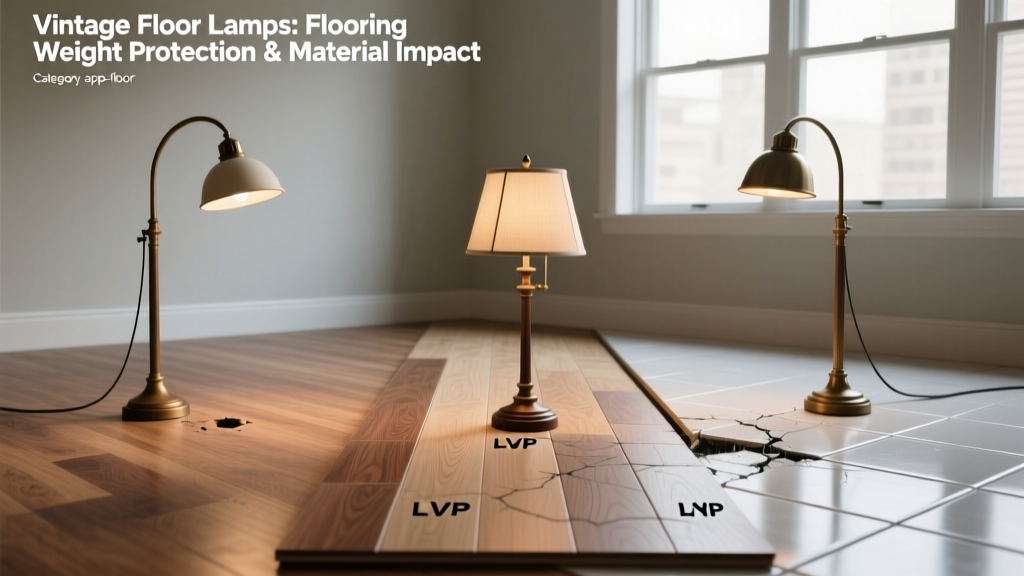
The Point-Load Physics of Vintage Lighting
Integrating mid-century and antique lighting into modern interiors requires more than an eye for design; it demands an understanding of material science. When placing vintage floor lamps on contemporary flooring, the primary structural concern is point-load pressure. Unlike modern, lightweight LED fixtures, vintage lamps—particularly 1960s cast-iron torchieres, solid brass banker’s lamps, and heavy marble-based arc lamps—frequently weigh between 35 and 85 pounds.
The damage potential is dictated by the footprint of the base. A 50-pound lamp with a wide, 12-inch diameter base distributes weight evenly, exerting a negligible 0.44 pounds per square inch (PSI). However, many vintage designs feature narrow pedestals or three small caster feet. That same 50-pound lamp resting on a 1-inch diameter pedestal exerts over 63 PSI. This concentrated force exceeds the yield strength of many resilient flooring wear layers, leading to permanent compression and structural failure.
Flooring Material Performance Matrix
Not all flooring categories respond to sustained, high-PSI loads identically. The following matrix outlines how common flooring materials perform under the specific weight and thermal profiles of vintage lighting fixtures.
| Flooring Type | Point-Load Tolerance | Thermal Limit (Surface) | Primary Failure Mode |
|---|---|---|---|
| Solid Hardwood | High (Dependent on Janka) | 180°F+ | Cellular crushing / denting |
| Engineered Wood | Moderate to High | 160°F | Veneer delamination / denting |
| SPC Rigid Core LVP | Very High | 140°F | Subfloor telegraphing / joint stress |
| WPC Vinyl | Low to Moderate | 120°F | Permanent plastic indentation |
| Glue-Down LVT | Moderate | 110°F (Adhesive softens) | Adhesive failure / edge curling |
| Porcelain Tile | Extreme | 300°F+ | Grout cracking (rarely tile failure) |
Hardwood Specifications and Janka Hardness Ratings
When installing solid or engineered hardwood in rooms featuring heavy vintage floor lamps, the Janka hardness rating is your most critical specification. The National Wood Flooring Association (NWFA) provides extensive guidelines on how concentrated loads affect wood cellular structures. Woods with a Janka rating below 1,000 lbf (such as American Cherry at 950 lbf) will permanently dent under the narrow base of a vintage brass lamp within weeks.
- Red Oak (1,290 lbf): The industry baseline. Acceptable for wide-base vintage lamps, but requires protective felt for pedestal bases.
- Hickory (1,820 lbf): Highly recommended for high-traffic areas where heavy lamps are occasionally repositioned.
- Brazilian Walnut / Ipe (3,680 lbf): Virtually immune to point-load denting from residential lighting fixtures.
Resilient Flooring: LVP, SPC, and Indentation Recovery
The luxury vinyl market has evolved significantly, but placing heavy vintage floor lamps on older or lower-tier flexible vinyl remains a major risk. According to testing standards referenced by the Resilient Floor Covering Institute (RFCI), residual indentation is measured under sustained static loads. Flexible LVT and WPC (Wood Plastic Composite) cores are highly susceptible to plastic deformation. If a 60-pound vintage torchiere sits on a WPC floor for more than 48 hours, the core may compress and fail to recover, leaving a permanent depression.
Specifying the Right Vinyl for Heavy Fixtures
To safely support vintage lamps, you must specify SPC (Stone Plastic Composite) rigid core vinyl. SPC utilizes a limestone-dust and PVC matrix that boasts a compressive strength exceeding 2,000 PSI. When selecting an SPC product, verify the following specifications:
- Wear Layer Thickness: Minimum 22 mil (0.55mm). While a 20 mil wear layer resists scratches, a 22 mil or 28 mil layer provides the structural rigidity needed to bridge minor subfloor imperfections under heavy loads.
- Core Thickness: Minimum 5mm. Thinner SPC cores (3mm-4mm) lack the mass to resist edge-cracking at the click-lock joints when subjected to asymmetric point loads.
- Attached Underlayment: Avoid SPC with pre-attached soft cork or foam pads if heavy vintage lamps will be used. The soft underlayment acts as a sponge, allowing the rigid SPC core to flex and indent under concentrated weight.
Thermal Stress: Heat Output vs. Flooring Melt Points
Weight is only half of the performance equation. Vintage lighting frequently relies on high-wattage incandescent, halogen, or early-generation CFL bulbs, which generate significant radiant and conductive heat. Furthermore, many mid-century lamps house heavy magnetic transformers or ballasts directly inside the metal base plate.
For rooms utilizing vintage halogen torchieres or transformer-heavy fixtures, floating SPC floors or ceramic tile are the only resilient options that will not suffer thermal adhesive failure. Hardwood is also highly tolerant of these temperatures, provided the finish is a modern aluminum oxide or UV-cured polyurethane rather than a traditional wax or shellac, which can soften and cloud at 120°F.
Protection Specifications: Pads, Glides, and Mats
Relying on the factory-installed felt pads on a vintage lamp is a critical error. Original 1970s felt is often degraded, glued with acidic adhesives that stain wood, and lacks the density to distribute modern point loads. When prepping a vintage floor lamp for newly installed flooring, adhere to these exact protection specifications:
1. High-Density Wool Felt Pads
For lamps with flat, wide bases, use 100% high-density wool felt pads with a minimum thickness of 1/4 inch. Avoid synthetic foam or rubber pads; rubber can undergo chemical plasticizer migration, permanently staining LVP and polyurethane wood finishes. Secure the felt using a neutral-cure silicone adhesive rather than standard acrylic adhesives to prevent residue transfer.
2. Polycarbonate Mats for Pedestal Bases
For lamps with narrow pedestals or heavy casters, felt is insufficient. You must use a clear, extruded polycarbonate mat. Polycarbonate has a high compressive yield strength and will not crack under 80+ pound loads. Specify a mat with a minimum thickness of 1/8 inch (3.17mm) and a flat, non-textured bottom to prevent trapping abrasive dust against the floor.
3. Caster Retrofitting
If your vintage lamp has been retrofitted with casters for mobility, inspect the wheel material. Hard nylon or metal casters will gouge engineered wood and scratch LVP wear layers. Replace them with 2-inch to 3-inch soft polyurethane (PU) tread casters with a durometer rating of 85A to 90A. This provides the hardness necessary to roll smoothly while remaining soft enough to absorb micro-impacts without denting the flooring.
FAQ: Vintage Lamp and Flooring Compatibility
Can I use a rubber-backed rug under my heavy vintage lamp to protect the floor?
No. Natural rubber and synthetic PVC rug pads contain plasticizers that react chemically with the polyurethane finishes on hardwood and the wear layers of LVP. Over time, especially when accelerated by the heat of a vintage lamp base, these plasticizers will leach into the floor, causing irreversible yellowing and finish degradation. Always use 100% felt or woven polyester rug pads.
How often should I move my vintage lamp to prevent LVP indentation?
If you are using a high-quality SPC rigid core vinyl with a 22-mil wear layer, you do not need to move the lamp. SPC is engineered for static load resistance. However, if you have WPC or flexible LVT, the lamp should be shifted by at least two inches every 14 days to allow the foam core time to recover its cellular structure.