How Much Does It Cost to Build a Basement? 2026 Regional Guide
Discover how much it costs to build a basement in 2026. Explore regional pricing, excavation variables, and material breakdowns for your foundation budget.

2026 Basement Construction Cost Snapshot
- Unfinished Basement: $45 - $85 per square foot
- Fully Finished Basement: $120 - $195+ per square foot
- Average 1,500 Sq Ft Unfinished Total: $67,500 - $127,500
- Primary Cost Drivers: Soil composition, regional frost line depth, and local concrete pricing.
Regional Cost Variations: Where Are You Building?
The question of how much does it cost to build a basement cannot be answered with a single national average. Geography dictates everything from the depth of your footings to the type of soil your excavation crew will encounter. In 2026, supply chain stabilization has leveled out some material costs, but localized labor shortages and strict regional building codes continue to create massive price disparities across the United States.
| Region | Unfinished Cost (per sq ft) | Finished Cost (per sq ft) | Primary Regional Cost Drivers |
|---|---|---|---|
| Northeast | $70 - $95 | $150 - $210 | Deep frost lines (48"+), bedrock excavation, high union labor rates. |
| Midwest | $55 - $75 | $125 - $165 | Expansive clay soils requiring engineered piers, standard frost depths. |
| South | $45 - $60 | $110 - $140 | High water tables, shallow frost lines, heavy waterproofing requirements. |
| West | $65 - $100 | $145 - $220 | Seismic reinforcement (rebar density), rocky terrain, strict energy codes. |
The Anatomy of Basement Construction Costs
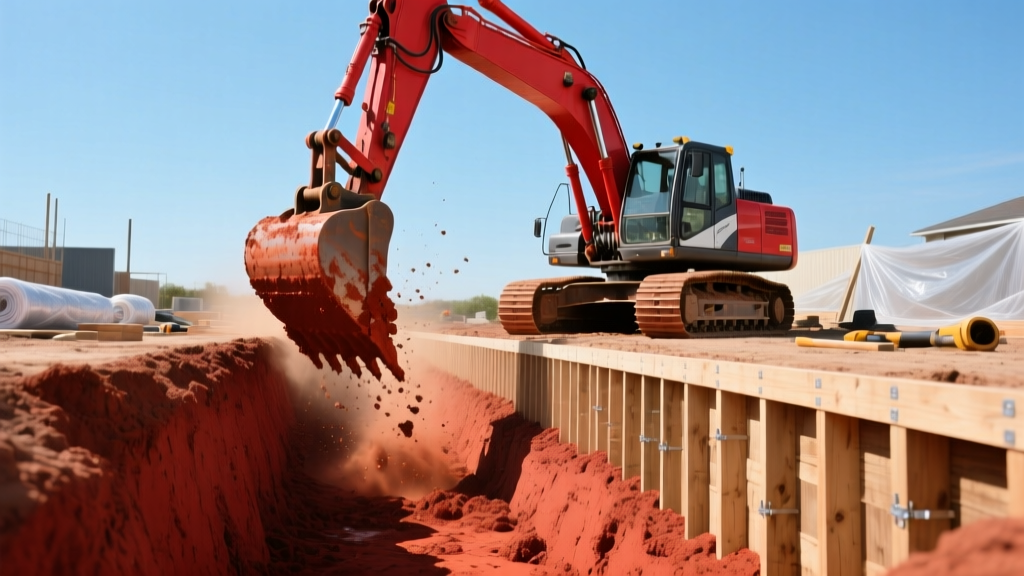
To build an accurate budget, you must break the project down into its core structural phases. A standard 1,500-square-foot basement with 8-foot walls requires moving roughly 450 cubic yards of earth and pouring over 60 cubic yards of concrete.
1. Excavation and Site Prep
Standard dirt excavation costs between $3 and $6 per cubic yard. However, haul-away fees, soil testing, and site grading add significant overhead. If your soil report indicates expansive clay, you may need to over-excavate and backfill with compacted gravel, pushing excavation costs from a baseline of $2,500 to over $6,000.
2. Footings and Foundation Walls
Footings must be poured with a minimum 3,000 PSI concrete mix, typically 24 inches wide and 8 inches deep. The walls themselves are usually 8-inch thick poured concrete rated at 4,000 PSI. In 2026, expect to pay $14 to $19 per square foot of wall area for standard poured concrete. If you opt for Insulated Concrete Forms (ICF) like Fox Blocks or BuildBlock, add $5 to $8 per square foot upfront, though this eliminates the need for later framing and insulation.
3. Backfill and Compaction
Once walls are cured and waterproofed, backfilling must be done in 8-inch lifts (layers) with mechanical compaction. Improper backfilling is the leading cause of bowing basement walls and hydrostatic pressure failures. Budget $1,500 to $3,000 for engineered backfill materials and labor.
Hidden Regional Variables That Destroy Budgets
Homeowners frequently ask how much does it cost to build a basement, only to be blindsided by subsurface conditions. The ground beneath your lot holds hidden financial risks that vary wildly by region.
Frost Line Depth Variations
The International Residential Code (IRC) mandates that footings must extend below the local frost line to prevent frost heave from cracking your foundation. In South Carolina, the frost line is roughly 12 inches deep. In Minnesota, it can exceed 60 inches. This means a northern builder must excavate significantly deeper and pour substantially more concrete for the footings and foundation walls, adding $8,000 to $15,000 to the base cost compared to a southern build.
Bedrock and High Water Tables
If your excavation crew hits bedrock, standard digging stops. Blasting or mechanical hammering bedrock costs between $40 and $120 per cubic yard. A moderate bedrock encounter can easily add $10,000 to $25,000 to your foundation budget. Conversely, in coastal or low-lying southern regions, a high water table requires continuous dewatering during construction and the installation of heavy-duty under-slab vapor barriers (minimum 15-mil polyethylene) and sub-slab depressurization systems.
Waterproofing and Drainage: Non-Negotiable Expenses
Treating waterproofing as an optional upgrade is a catastrophic financial mistake. According to the U.S. Department of Energy, moisture intrusion in basements not only destroys finished materials but severely compromises the thermal envelope and indoor air quality of the entire home.
"Basements are inherently prone to moisture problems. Proper exterior waterproofing, combined with interior drainage and insulation strategies, is critical to preventing mold growth and structural degradation." — U.S. Department of Energy, Energy Saver Guidelines.
The 2026 Standard Waterproofing System:
- Exterior Membrane: Fluid-applied rubberized asphalt (e.g., Tremco or Henry) applied to the exterior walls.
- Protection Board: HDPE dimple board to protect the membrane from backfill abrasion and relieve hydrostatic pressure.
- Exterior French Drain: 4-inch perforated PVC pipe wrapped in filter fabric, bedded in washed gravel at the footing base.
- Interior Sump Pump: A cast-iron pedestal or submersible pump. For reliable performance, specify a Zoeller M53 (1/3 HP) or a Wayne CDU980E (3/4 HP) with a battery backup system. Budget $2,800 to $4,500 for a complete interior/exterior water management system.
Decision Framework: Unfinished vs. Finished ROI
When calculating how much does it cost to build a basement, you must decide if the space will be conditioned (finished) or left as raw storage. Data from the National Association of Home Builders (NAHB) consistently shows that basement square footage, even when unfinished, adds measurable appraisal value to a home, but finished space yields a higher functional return.
Pro-Tip: The Rough-In Strategy
If you are building an unfinished basement but plan to finish it within 5 years, spend the extra $1,200 to $1,800 to install "rough-in" plumbing for a future bathroom during the initial slab pour. Trenching through cured concrete later to add a toilet flange and shower drain will cost upwards of $4,000 and risk structural cracking.
Frequently Asked Questions
Is a walkout basement more expensive to build?
Yes. A walkout basement requires a sloped lot, which means the foundation walls will be stepped or vary in height. The retaining wall engineering required to hold back the earth on the buried side, combined with the cost of installing commercial-grade exterior doors and large egress windows, typically adds 15% to 25% to the total foundation cost compared to a fully buried, flat-lot basement.
How much does it cost to build a basement under an existing home?
Retrofitting a basement under an existing structure (house raising and underpinning) is an extreme engineering feat. Costs range from $150 to $300+ per square foot. This process involves lifting the house on steel beams, excavating beneath it, and pouring new footings and walls in controlled segments. It is rarely cost-effective unless local zoning laws prohibit outward expansion and property values justify the massive investment.
Do I need a vapor barrier under the basement slab?
Absolutely. The American Concrete Institute (ACI) and modern building codes require a minimum 10-mil (preferably 15-mil) cross-laminated polyethylene vapor barrier placed directly beneath the 4-inch concrete slab, over a 4-inch layer of compacted gravel. This prevents soil moisture from wicking up through the concrete, which is essential if you ever plan to install hardwood, laminate, or carpet over the slab.
Written by
Marcus ChenMarcus Chen is a licensed structural engineer (PE) and building materials analyst with over 12 years of experience across residential, commercial, and industrial construction. He holds a Master of Science in Civil Engineering from UC Berkeley and spent six years at Thornton Tomasetti before transitioning to independent consulting and technical writing. Marcus specializes in material selection for seismic-prone regions, concrete reinforcement strategies, and lifecycle cost analysis. His work has been cited by the American Concrete Institute (ACI) and the Structural Engineers Association of California (SEAOC). When he is not on a job site or at his desk, you will find him hiking the Sierra Nevada or restoring a 1920s craftsman bungalow in Oakland, CA.
More from Marcus Chen
View all
Construction Cost
How Much Did the Eiffel Tower Cost to Build?
How much did the Eiffel Tower cost to build in 1889? We adjust for inflation and compare its budget to modern skyscraper construction.
Aug 4, 2026

Fire Resistance
What Is a Fire Resistant Material? Testing & Certification Guide
Discover what is a fire resistant material through ASTM and UL testing. Learn how fire ratings, certifications, and assemblies work in construction.
Aug 4, 2026

Construction Cost
How Much Did the Burj Khalifa Cost to Build?
How much did the Burj Khalifa cost to build? We break down the $1.5B project and extract 5 money-saving strategies for your next build.
Jul 30, 2026