Foundation Repair Dallas Cost: 2026 Pricing & Method Guide
Analyze the true foundation repair Dallas cost in 2026. Compare piering, mudjacking, and drainage solutions with real local pricing and soil data.
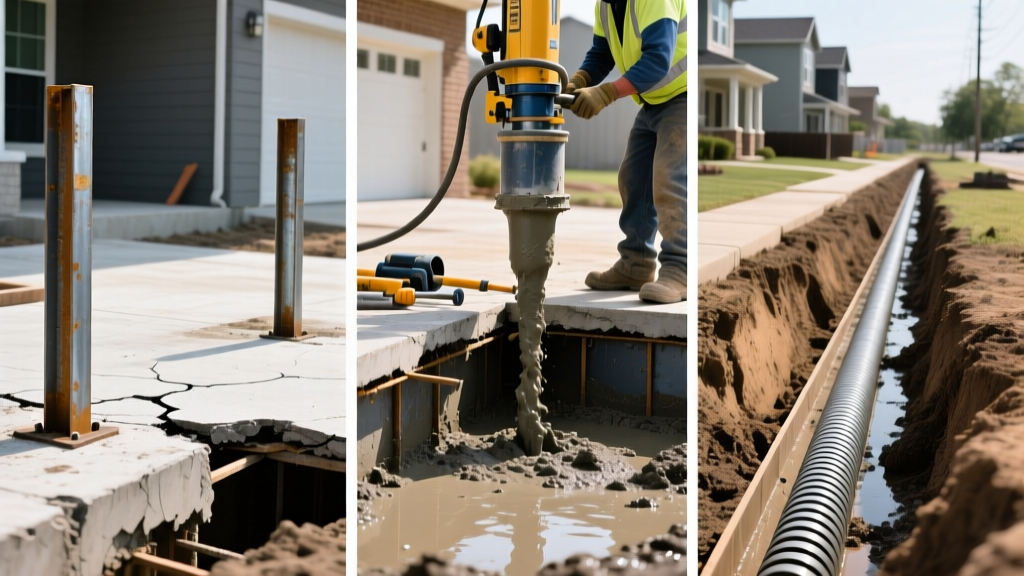
The Expansive Soil Tax: Why DFW Foundations Fail
When researching the foundation repair Dallas cost, homeowners quickly realize that North Texas presents a unique geological challenge. The Dallas-Fort Worth (DFW) metroplex sits largely on the Blackland Prairie, characterized by highly expansive clay soils, alongside complex geological formations like the Eagle Ford Shale and Austin Chalk. According to the USDA Natural Resources Conservation Service (NRCS), these clay-rich soils undergo extreme volumetric changes—swelling significantly during heavy spring rains and shrinking aggressively during the brutal, dry summer months.
This continuous cycle of heaving and settling creates immense differential stress on concrete slab-on-grade foundations and pier-and-beam structures. Consequently, the foundation repair Dallas cost is rarely a simple cosmetic fix; it is a structural intervention required to stabilize a home against active soil mechanics. In 2026, material costs, specialized labor, and strict municipal permitting have driven local repair prices upward, making it critical for homeowners to understand exactly what they are paying for.
2026 Foundation Repair Dallas Cost: Method-by-Method Breakdown
The total cost of stabilizing a foundation in Dallas depends heavily on the chosen underpinning method, the depth of the load-bearing strata, and the accessibility of the work site. Below is the current 2026 market pricing for the most common repair techniques utilized by reputable DFW contractors.
| Repair Method | Best Application | 2026 Average Cost | Expected Lifespan |
|---|---|---|---|
| Pressed Concrete Pilings | Standard slab stabilization in deep clay | $750 - $950 per pier | 20 - 40 years |
| Steel Push Piers | Heavy structural loads, reaching bedrock | $1,200 - $1,600 per pier | 75+ years |
| Helical Piers | Lighter loads, new construction, limited access | $1,500 - $2,000 per pier | 75+ years |
| Polyurethane Foam Jacking | Lifting sunken interior slabs, driveways, patios | $15 - $25 per sq. ft. | 10 - 20 years |
| Cement Slurry Mudjacking | Exterior flatwork, heavy void filling | $8 - $12 per sq. ft. | 5 - 10 years |
Note: Most average-sized Dallas homes (2,000 to 2,500 sq. ft.) requiring partial perimeter stabilization will need between 15 and 25 piers, placing the baseline underpinning cost between $11,250 and $24,000 before auxiliary services.
Hidden Cost Drivers Unique to the Dallas Metroplex
Contractor quotes often focus solely on the cost per pier. However, a comprehensive financial analysis must account for localized variables that frequently inflate the final invoice.
1. Mandatory Hydrostatic Plumbing Testing
When a foundation shifts, it often takes the embedded PVC or cast-iron plumbing lines with it. The City of Dallas and surrounding municipalities (like Plano, Frisco, and Arlington) require a hydrostatic plumbing test both before and after the foundation is lifted. Lifting a slab can snap a pipe that was previously just bent. Expect to pay $350 to $550 per test. If a leak is found, under-slab tunneling and pipe repair will add $2,500 to $6,000+ to the project.
2. Tree Root Intrusion and Moisture Barriers
DFW is heavily canopied with Post Oaks, Live Oaks, and Willow Oaks. During droughts, these trees send aggressive feeder roots under foundations seeking moisture, causing the soil to desiccate and the foundation to drop. If root barriers are required to sever these roots and protect the repair, add $60 to $90 per linear foot for high-density polyethylene (HDPE) barrier installation.
3. Masonry and Drywall Remediation
Lifting a foundation back to its original elevation (or a functional tolerance) will often close exterior brick stair-step cracks but may simultaneously pop interior drywall tape or bind door frames. Budget an additional 10% to 15% of the structural repair cost for interior cosmetic and carpentry remediation.
Repair Selection Matrix: Matching Method to Failure Mode
Choosing the wrong repair method is the most expensive mistake a homeowner can make. Use this decision framework to evaluate contractor proposals.
Scenario A: Perimeter Settlement in Deep Clay
Recommended: Pressed Concrete Pilings.
Why: Dallas clay can extend 15 to 30 feet deep before hitting stable load-bearing strata. Pressed concrete cylinders use the friction of the clay itself to hold the foundation in place. They are cost-effective and the industry standard for standard DFW slab homes.
Scenario B: Severe Structural Overload or Bedrock Proximity
Recommended: Steel Push Piers.
Why: If the home is exceptionally heavy (e.g., multi-story with masonry veneer) or located in areas where the Austin Chalk formation is near the surface, steel piers are hydraulically driven past the active soil zone directly into bedrock or a highly compacted load-bearing stratum, offering zero future settlement.
Scenario C: Interior Slab Sagging or Void Collapse
Recommended: Polyurethane Foam Jacking.
Why: If the perimeter is stable but an interior hallway or bathroom floor is sinking due to poorly compacted fill dirt or plumbing leaks, polyurethane foam (injecting high-density structural resin through 5/8-inch holes) lifts the slab with minimal intrusion and cures in 15 minutes.

Navigating Permits, Warranties, and Contractor Red Flags
The Texas Department of Insurance notes that standard homeowners policies rarely cover foundation damage caused by soil expansion, classifying it as a maintenance issue rather than a sudden peril (TDI Foundation Guidelines). Because you are likely paying out-of-pocket, protecting your investment is paramount.
The 'Free Inspection' Trap
Many high-volume DFW repair companies offer free inspections. While this saves you $500 upfront, the inspector is typically a commissioned salesperson, not a licensed engineer. Their financial incentive is to sell as many piers as possible. The Federal Trade Commission (FTC) consistently warns consumers against high-pressure home improvement sales tactics where the contractor also acts as the sole diagnostician.
Expert Action Step: Before signing any repair contract, spend $600 to $900 to hire an independent, third-party Licensed Structural Engineer (P.E.) who has no financial ties to repair companies. They will perform a relative elevation survey, identify the exact failure mechanism, and write a prescriptive specification detailing exactly how many piers are needed and where. You then hand this engineered plan to three different contractors to bid on the exact same scope of work.
Understanding the 'Lifetime Warranty'
In the Dallas market, almost every contractor offers a 'Lifetime Warranty.' Read the fine print. A legitimate warranty should cover the performance of the pier (i.e., it will not sink further into the ground). It does not cover future foundation movement caused by new plumbing leaks, extreme droughts, or the addition of heavy new structures (like a pool or second-story addition) that alter the soil moisture equilibrium. Ensure the warranty is fully transferable to a new buyer for a nominal fee (usually under $200), as this is a critical negotiation point when selling a home in North Texas.
Written by
Elena RodriguezElena Rodriguez is a civil engineer and technical writer specializing in concrete technology, masonry systems, and ASTM/ACI compliance. She earned her B.S. in Civil Engineering from Texas A&M University and spent a decade at a materials testing laboratory, performing over 2,000 concrete compressive strength tests and masonry prism evaluations. Elena is an ACI-certified Field Testing Technician (Grade I) and a member of ASTM Committee C12 on Natural Building Stone. She currently consults on forensic engineering cases involving concrete failures and moisture intrusion. Based in San Antonio, TX, Elena is a proud member of the Society of Women Engineers (SWE) and coaches her daughter's FIRST Robotics team.
More from Elena Rodriguez
View all
Walls & Panels
Cost Analysis: Light Gauge Steel Framing Advantages and Disadvantages
Evaluate light gauge steel framing advantages and disadvantages through a strict cost analysis lens, comparing material, labor, and lifecycle expenses.
Aug 4, 2026

Walls & Panels
Gypsum Board Types: Exact Specifications, Thickness & Dimensions
Compare standard, Type X, and moisture-resistant gypsum board types. Get exact specifications, thicknesses, dimensions, and ASTM standards for your project.
Aug 4, 2026

Fire Resistance
Best Fire-Resistant Outdoor Decking Materials: 2026 Buyer Guide
Discover the best fire-resistant outdoor decking materials for 2026. Compare Class A PVC, aluminum, and hardwood options for WUI compliance and safety.
Aug 4, 2026