Average Cost of Foundation Repair in Texas: 2026 Pricing Breakdown
Discover the average cost of foundation repair in Texas for 2026. Breakdowns by repair type, soil conditions, and actionable tips to save on structural fixes.

The Expansive Clay Factor: Why Texas Foundations Fail
Texas is home to some of the most aggressive expansive soils in North America. From the Houston Black clay of the Blackland Prairie to the highly reactive Eagle Ford shale beneath San Antonio and the Austin Chalk formations, the ground beneath your home is constantly moving. These soils swell significantly when wet and shrink drastically during droughts, creating a cycle of heave and settlement that exerts thousands of pounds of hydrostatic pressure on concrete slab-on-grade foundations.
Understanding this geological reality is the first step in deciphering your repair quote. When homeowners ask about the average cost of foundation repair in Texas, the answer is rarely a single flat rate. It is a highly variable figure dictated by the depth of the stable soil strata, the weight of the structure, and the specific underpinning method required to bypass the active clay zone. In 2026, with material costs for steel and concrete stabilizing but skilled labor remaining at a premium, Texas homeowners must be equipped with precise, localized data before signing a contract.
2026 Pricing Breakdown: Average Cost of Foundation Repair in Texas
The total project cost depends heavily on the number of piers required and the access limitations of your property. Most Texas slab repairs require between 15 and 35 piers. Below is a detailed breakdown of current market rates for the most common underpinning methods utilized across the state.
| Repair Method | Cost Per Pier / Unit (2026) | Typical Total Project Cost | Best Application in Texas |
|---|---|---|---|
| Steel Push Piers | $850 – $1,300 | $12,500 – $35,000+ | Heavy masonry/brick veneer homes; reaching deep load-bearing strata past Eagle Ford shale. |
| Helical Piers | $1,100 – $1,600 | $16,000 – $40,000+ | Lighter structures, new construction pre-treatment, or areas with high water tables where pushing is impossible. |
| Concrete Pressed Pilings | $550 – $850 | $8,000 – $22,000 | Standard slab-on-grade homes in Dallas-Fort Worth and Houston; cost-effective for moderate settlement. |
| Polyurethane Foam Jacking | $15 – $25 per sq. ft. | $3,500 – $9,000 | Settled interior floors, driveway aprons, and patios; not suitable for severe structural load-bearing failures. |
| Root Barriers (HDPE) | $60 – $85 per linear ft. | $1,500 – $4,000 | Protecting foundations from mature Live Oaks and Willow Oaks common in Central Texas. |
Cost Multipliers: What Pushes Your Quote Past $20,000?
While the per-pier cost provides a baseline, several hidden variables can drastically inflate your final invoice. Ignoring these factors is the primary reason homeowners experience severe sticker shock when the project commences.
⚠️ The Plumbing Leak Multiplier
Before any underpinning begins, a mandatory hydrostatic plumbing test must be performed. If a sub-slab sewer or water line is leaking, it turns the expansive clay into mud, destroying the soil's load-bearing capacity. Repairing a cast-iron sewer line break beneath a Texas slab can add $2,500 to $6,000 to your project. Never allow a contractor to install piers without first verifying the plumbing system is intact; otherwise, the new piers will sink into the water-logged soil within months.
🚨 Interior Access and Flooring Destruction
If the settlement is isolated to the interior of your home, contractors must jackhammer through your finished floors to install interior piers. The cost to remove, store, and replace hardwood, tile, or luxury vinyl plank (LVP) flooring can easily add $3,000 to $8,000. Always clarify whether your quote includes 'breakout and patching' of concrete only, or if it includes full flooring restoration.
The 'Free Inspection' Trap: Vetting a Texas Foundation Contractor
The Texas foundation repair industry is heavily saturated with sales-driven companies that offer 'free inspections.' Often, these inspections are conducted by commissioned salespeople rather than licensed structural engineers. To protect your investment, follow this strict vetting framework:
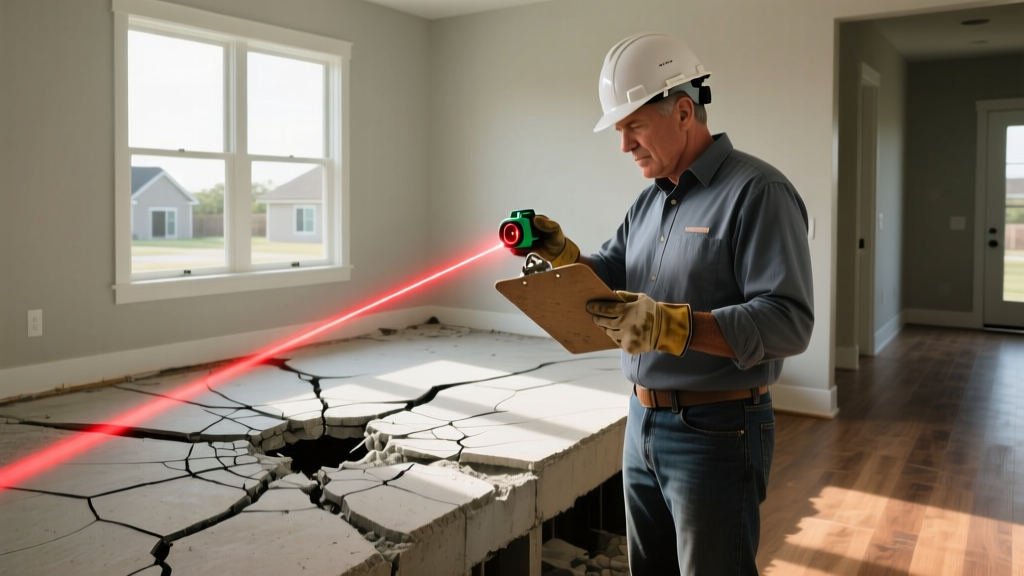
- Demand a Zip Level or Manometer Reading: Reject any contractor who uses a simple string line or visual estimation. A digital Zip Level or water manometer provides exact elevation readings down to the millimeter, creating a verifiable topographical map of your slab.
- Require a Third-Party Engineering Report: According to guidelines supported by the Foundation Performance Association, an independent Licensed Professional Engineer (P.E.) should design the pier layout. Salespeople tend to over-prescribe piers to increase commission; an engineer designs strictly for structural necessity.
- Verify the 'Shim' Warranty Loophole: Read the warranty carefully. Unethical companies will return a year later, claim the house 'settled,' and simply drive steel shims into the existing brackets to lift the house a fraction of an inch. This voids the structural integrity of the pier. Ensure your warranty explicitly covers 'pier failure or soil strata shifting,' not just cosmetic drywall cracking.
- Check the BBB and FPA Memberships: Cross-reference the company with the Better Business Bureau and verify they are an active member of state-specific trade organizations. Fly-by-night operations frequently dissolve and reopen under new LLC names to escape warranty claims.
Insurance Realities: Will Your Homeowner's Policy Cover It?
A common and costly misconception among Texas homeowners is that foundation damage is covered by standard property insurance. In almost all cases, it is not. As outlined by the Texas Department of Insurance, standard HO-3 policies explicitly exclude damage caused by earth movement, soil expansion, contraction, and settling.
'Homeowners insurance is designed for sudden and accidental events, like a fire or a windstorm. Gradual foundation movement due to Texas clay soils is considered a maintenance and geological issue, leaving the financial burden entirely on the property owner.'
The Sole Exception: If you can definitively prove that a sudden and accidental plumbing leak (such as a burst supply line) caused the soil to wash out or heave, your insurance may cover the cost to access and repair the pipe, and potentially the resulting foundation damage. However, the burden of proof is immense, requiring isotopic water testing and comprehensive engineering reports. For the vast majority of Texans dealing with seasonal drought-induced settlement, the repair costs will be strictly out-of-pocket.
Financing Your Repair
Given the out-of-pocket reality, most Texans rely on specialized foundation financing. Many reputable contractors partner with lenders offering unsecured home improvement loans with terms ranging from 36 to 120 months. Alternatively, a Texas Home Equity Loan (which carries strict constitutional protections and caps on fees in the state) remains the most cost-effective way to finance a $20,000+ structural intervention, provided you have sufficient equity built up in the property.
Final Action Steps for Texas Homeowners
Do not wait for diagonal drywall cracks to widen past 1/4 inch or for doors to completely bind in their frames. Foundation damage is progressive. By securing three independent, engineer-backed quotes and understanding the true average cost of foundation repair in Texas, you can transition from a state of panic to a position of informed negotiation. Prioritize deep-strata steel solutions over shallow concrete fixes, mandate plumbing tests, and protect your home's structural integrity for the decades to come.
Written by
Priya KapoorPriya Kapoor is a real estate market analyst and construction economics researcher with expertise in housing affordability, development feasibility, and infrastructure investment. She holds a Master of Regional Planning from Cornell University and previously worked as a senior analyst at CBRE's Investment Properties group, where she modeled returns for $4B in mixed-use development pipelines. Priya now runs an independent research practice advising developers, municipalities, and REITs on construction cost forecasting and market timing. She publishes the quarterly "BuildMat Market Pulse" report tracking material price indices across 12 commodity categories. Based in Austin, TX, Priya serves on the board of Habitat for Humanity Austin and is a marathon runner.
More from Priya Kapoor
View all
Construction Cost
Cost to Build a 1600 Sq Ft Home in 2026: Full Breakdown
Accurate 2026 cost to build a 1600 sq ft home—material, labor, and regional pricing breakdowns included. Plan your budget with real-time estimates.
Aug 11, 2026

Wood & Lumber
Name the Types of Wood for Pressure Treatment and Preservation
Learn how to name the types of wood best suited for pressure treatment. Compare species treatability, chemical retention levels, and 2026 preservation costs.
Aug 4, 2026

Stone & Masonry
Stone Veneer Suppliers Lindenhurst: 2026 Cost Analysis
Analyze 2026 stone veneer costs in Lindenhurst, NY. Compare local supplier pricing, delivery fees, and Suffolk County installation labor rates.
Aug 4, 2026