Basement Crawl Space Encapsulation Lifespan and Durability Guide
Analyze the true lifespan of basement crawl space encapsulation. Compare vapor barrier mils, tape durability, and failure points to protect your foundation.
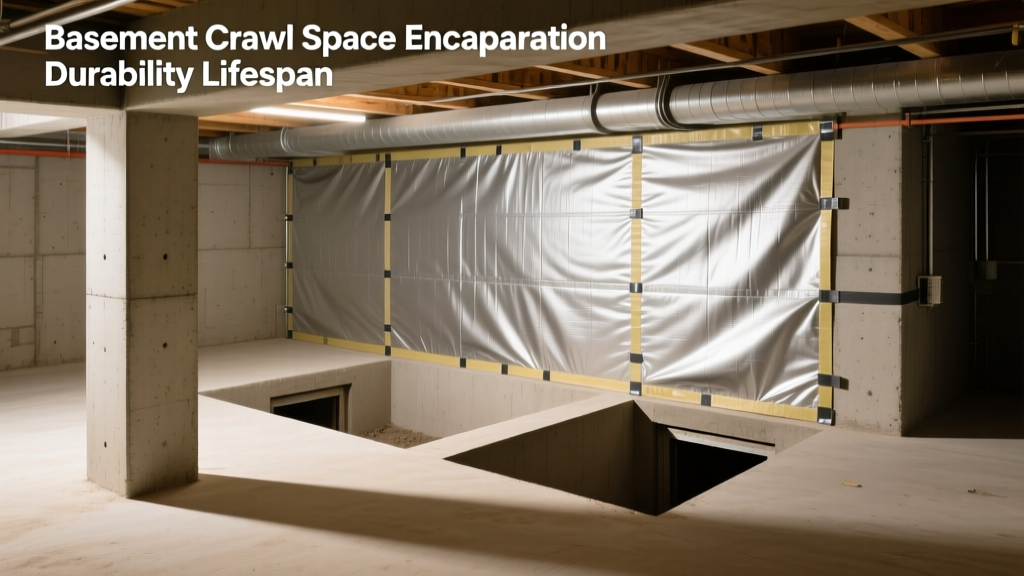
The Reality of Encapsulation Lifespans: 10 Years vs. 50 Years
While building science strictly differentiates between full basements and crawl spaces, the colloquial term 'basement crawl space' typically refers to deep, unconditioned dirt-floor substructures or partial basements with limited headroom. Encapsulating these hybrid spaces is critical for structural longevity, but not all encapsulations are created equal. A bargain-bin encapsulation using builder-grade materials will degrade, tear, and fail within 3 to 5 years, leading to catastrophic moisture rebound. Conversely, a properly engineered system using cross-laminated polyethylene and mechanical terminations can easily exceed a 50-year functional lifespan.
According to Building Science Corporation, the primary driver of encapsulation failure is not the vapor barrier material itself, but the mechanical and adhesive terminations at the perimeter walls and piers. Understanding the degradation curve of every component in your basement crawl space encapsulation system is the only way to accurately forecast your return on investment.
Vapor Barrier Material Degradation Matrix
The 'mil' thickness of a vapor barrier is a poor standalone indicator of durability. A 12-mil woven fabric may outperform a 20-mil non-laminated sheet under sheer stress. Below is a durability analysis of the most common polyethylene barriers used in 2026, factoring in puncture resistance, UV degradation, and chemical breakdown from soil gases.
| Material Type | Thickness | Puncture Resistance | Soil Gas Permeability | Expected Lifespan | 2026 Material Cost (per sq ft) |
|---|---|---|---|---|---|
| Builder-Grade Poly | 6-mil | Low (tears under foot traffic) | High (poor radon block) | 2 - 4 Years | $0.15 - $0.25 |
| Standard String-Reinforced | 12-mil | Medium (resists casual snags) | Medium | 10 - 15 Years | $0.35 - $0.50 |
| Cross-Laminated Poly | 20-mil | High (withstands heavy service) | Very Low (excellent radon block) | 25 - 50+ Years | $0.65 - $0.85 |
| Woven Coated Poly | 24-mil | Extreme (nearly indestructible) | Zero | 50+ Years | $1.10 - $1.45 |
The Weakest Links: Where Encapsulations Actually Fail
The U.S. Department of Energy notes that moisture management in substructures relies on continuous air and vapor seals. When an encapsulation fails, it rarely fails in the middle of the floor. It fails at the transitions.
Seam Tape vs. Mastic: The Adhesive Breakdown
Contractors often use generic duct tape or standard construction adhesives to seal overlapping vapor barrier sheets. This is a critical error. Standard adhesives dry out, become brittle, and detach from polyethylene within 18 to 24 months due to the plasticizers in the vinyl migrating to the surface.
- Butyl Tape (e.g., Trebor, Santa-Fe): Remains permanently tacky and flexible. Does not cure or become brittle. Lifespan matches the barrier itself (25+ years).
- Water-Based Acrylic Mastic: Excellent for sealing the barrier to concrete foundation walls, but poor for poly-to-poly seams. Requires a clean, dust-free surface to achieve a permanent bond.
- Acoustic/Standard Sealants: Will peel off polyethylene within 6 months. Never use standard silicone or polyurethane on vapor barriers.
Mechanical Fastener Pull-Through and Wall Terminations
Sealing the vapor barrier to the foundation wall requires terminating the material 6 to 12 inches below the top of the foundation wall (never below grade level, to prevent termite entry pathways).
Active System Durability: Dehumidifiers and Sump Pumps
A passive vapor barrier is only half the system. Basement crawl space encapsulation requires active conditioning to manage the air volume and any incidental liquid water. The lifespan of these mechanical components is significantly shorter than the polyethylene barrier.
| Active Component | Recommended Specification | Average Lifespan | Primary Failure Mode |
|---|---|---|---|
| Dehumidifier | 70 to 90-pint commercial grade (e.g., AlorAir, Santa-Fe) | 5 - 8 Years | Compressor burnout from continuous high-load cycling; corroded drain pans. |
| Sump Pump | 1/3 HP Cast Iron or Thermoplastic (e.g., Zoeller M53) | 7 - 10 Years | Switch failure; impeller clogging from silt and debris. |
| Effluent Pump (if required) | High-head pressure sewage pump | 5 - 7 Years | Check valve failure causing backflow and motor overheating. |
| Condensate Drain Line | PVC or rigid poly tubing (never flexible vinyl) | 20+ Years | Algae buildup and sagging in flexible lines causing overflow. |
2026 Cost vs. Lifespan ROI Framework
Homeowners often balk at the upfront cost of premium basement crawl space encapsulation. However, calculating the annualized cost reveals that cutting corners on materials actually increases long-term expenses due to premature replacement and moisture damage remediation.
| System Tier | Total Installed Cost (1,500 sq ft) | Expected Functional Life | Annualized Cost | Hidden Risk Factors |
|---|---|---|---|---|
| Budget (6-mil, basic tape) | $3,500 - $5,000 | 4 Years | $875 - $1,250 / year | High risk of mold rebound, wood rot, and musty odors returning by year 2. |
| Standard (12-mil, mastic) | $6,500 - $9,000 | 12 Years | $541 - $750 / year | Seam degradation over time; requires bi-annual inspections and tape patching. |
| Premium (20-mil, mechanical) | $10,500 - $14,000 | 30+ Years | $350 - $466 / year | Negligible barrier risk; only requires active mechanical component replacement. |
Maintenance Protocol to Maximize Barrier Longevity
Even a premium 20-mil encapsulation requires a strict maintenance protocol to ensure it reaches its maximum lifespan. Implement the following schedule to protect your foundation investment:
- Bi-Annual Visual Inspections (Spring/Fall): Walk the perimeter with a high-lumen flashlight. Look for 'tenting' where the barrier pulls away from the foundation wall, indicating mastic failure or fastener pull-through.
- Dehumidifier Coil Cleaning (Annually): Vacuum the evaporator coils and clear the drain pan. A clogged coil forces the compressor to run 30% longer, halving the unit's lifespan and spiking your electrical bill.
- Sump Pump Cycling Test (Quarterly): Manually pour 5 gallons of water into the sump pit to verify the float switch activates the pump and that the check valve holds without backflow.
- Seam Integrity Check (Every 5 Years): Perform a pull-test on overlapping seams. If the butyl tape releases without tearing the polyethylene, the seam has failed and must be re-taped after cleaning the surface with isopropyl alcohol.