Crawlspace Encapsulation Lifespan: How Long Do Liners Last?
Discover the true lifespan of crawlspace encapsulation systems. We analyze vapor barrier mil thicknesses, failure modes, and long-term durability metrics.
Quick Lifespan Summary
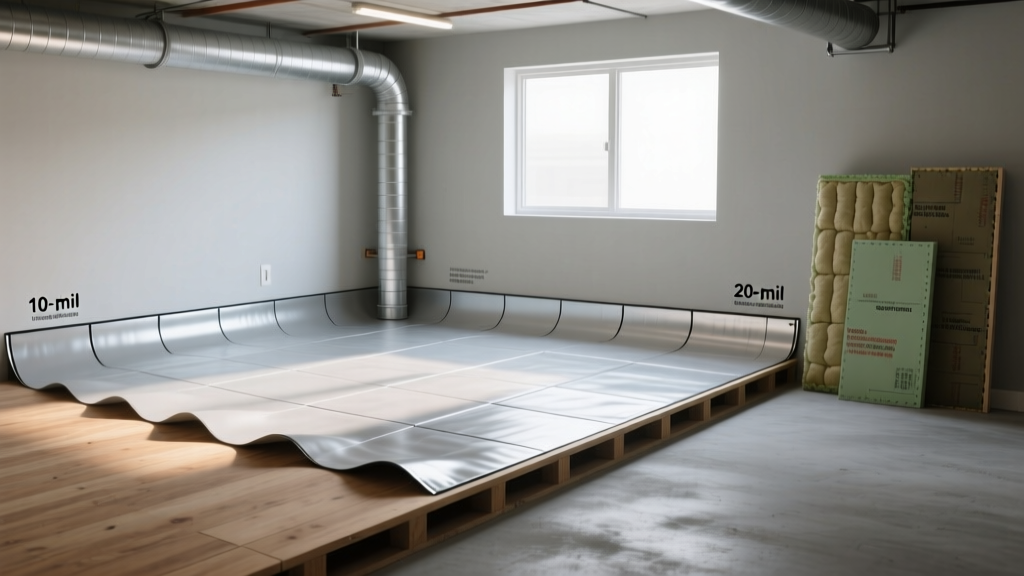
A properly installed crawlspace encapsulation system lasts between 15 and 25 years. However, budget-grade 6-mil liners without mechanical fasteners can fail in as little as 3 to 5 years. The lifespan is dictated not just by the polyethylene thickness, but by seam integrity, UV exposure, and hydrostatic pressure management.
Material Thickness and Composition: The Core Durability Drivers
The term "mil" refers to one-thousandth of an inch. While building codes in some jurisdictions still permit 6-mil polyethylene as a vapor retarder, modern building science dictates that true encapsulation requires significantly more robust materials to withstand physical abuse and long-term degradation. According to the U.S. Department of Energy, unvented crawlspaces require a continuous, sealed vapor barrier to effectively control moisture migration.
The durability of the liner is measured by two primary ASTM standards: ASTM E96 (Water Vapor Transmission) and ASTM D1004 (Tear Resistance). A high-quality encapsulation liner must exhibit a perm rating of less than 0.1 perms to be classified as a Class I vapor retarder.
| Liner Type | Thickness | Reinforcement | Expected Lifespan | Material Cost (per sq. ft.) |
|---|---|---|---|---|
| Standard Builder Grade | 6-mil | None | 3 - 5 Years | $0.15 - $0.25 |
| Contractor Standard | 10-mil | None / Light Scrim | 7 - 12 Years | $0.40 - $0.60 |
| Heavy-Duty | 12-mil | String-Reinforced | 15 - 20 Years | $0.65 - $0.85 |
| Premium Commercial | 20-mil | Heavy String / Foil | 25+ Years | $1.20 - $1.80 |
The Hidden Failure Points: Seams, Fasteners, and Penetrations
The most common reason crawlspace encapsulation systems fail before the 10-year mark is not the polyethylene tearing in the center of the floor; it is the failure of the seams and wall terminations. When analyzing lifespan, the installation methodology is just as critical as the material itself.
Seam Sealing Technologies
Overlapping liner sheets by 6 to 12 inches is mandatory. However, the adhesive used to join these overlaps dictates the longevity of the seal:
- Acrylic Mastics (Liquid Adhesives): While cheap and fast to apply, liquid mastics are prone to drying out, cracking, and losing adhesion when subjected to the cyclical temperature fluctuations of a crawlspace. Expect mastic-only seams to degrade within 5 to 7 years.
- Single-Sided Poly Tape: Standard poly tapes often fail to adhere to dusty or slightly damp concrete and soil. They are a primary culprit in premature encapsulation failure.
- Double-Sided Butyl Tape: This is the industry gold standard for 2026 installations. Butyl rubber remains permanently tacky, does not cure into a brittle solid, and accommodates minor structural shifts. Seams sealed with high-grade butyl tape routinely outlast the 20-year lifespan of a 12-mil liner.
Wall Termination and Mechanical Fastening
Running the vapor barrier up the foundation wall and sealing it with acoustic sealant or spray foam is insufficient for long-term durability. Hydrostatic pressure and gravity will eventually pull the liner away from the masonry. Permanent encapsulation requires mechanical termination bars (PVC or aluminum strips screwed into the masonry every 24 inches) or furring strips to physically lock the liner to the wall. The Environmental Protection Agency (EPA) emphasizes that continuous, uninterrupted moisture barriers are essential to prevent mold growth and structural rot, making secure wall termination non-negotiable.
Environmental Stressors That Degrade Encapsulation Systems
Even a 20-mil liner will fail prematurely if subjected to specific environmental stressors without mitigation.
Warning: Hydrostatic Pressure Delamination
In areas with high water tables, water pooling beneath the vapor barrier creates hydrostatic pressure. If the encapsulation is sealed perfectly to the walls, this pressure has nowhere to go but up, causing the liner to balloon, stretch, and eventually delaminate at the seams. Always pair heavy-duty encapsulation with an interior French drain and a sump pump system in high-water-table regions to relieve sub-membrane pressure.
UV Degradation: Polyethylene degrades rapidly when exposed to ultraviolet light. If your crawlspace has ventilation windows or access doors that allow direct sunlight to strike the liner, the material will become brittle and shatter within 2 to 3 years. Ensure all light sources are blocked, or specify a UV-stabilized, foil-faced encapsulation product for exposed areas.
Rodent and Pest Intrusion: Mice and rats can easily chew through 6-mil and 10-mil liners. If your property is prone to rodent activity, a 20-mil string-reinforced liner is mandatory. The embedded polyester or nylon scrim makes it exceedingly difficult for pests to tear the material, as they must chew through both the polyethylene and the structural grid.
Mechanical System Lifespans: Dehumidifiers and Effluent Pumps
Crawlspace encapsulation is a system, not just a plastic sheet. The active mechanical components have distinctly different lifespans than the passive vapor barrier and will require replacement during the life of the home.
- Crawlspace Dehumidifiers (e.g., Santa Fe, Aprilaire): Purpose-built, ducted crawlspace dehumidifiers operating in a sealed environment typically last 6 to 9 years. Their lifespan is heavily dependent on regular coil cleaning and filter replacements. Standard residential portable dehumidifiers placed in a crawlspace will usually fail within 2 to 3 years due to continuous duty-cycle strain and lack of drainage integration.
- Sump Pumps and Effluent Pumps: A high-quality cast-iron or thermoplastic submersible pump (such as Zoeller or Liberty Pumps) operating in a sealed basin will last 7 to 10 years. The primary failure point is the float switch, not the motor. Install a vertical switch rather than a tethered switch to prevent it from snagging on the basin wall or the vapor barrier.
- Exhaust Fans and Air Intakes: If your local building code requires a conditioned air supply from the HVAC system rather than a standalone dehumidifier, the inline dampers and booster fans typically last 10 to 15 years.
Decision Matrix: Selecting the Right System for Your Soil Profile
Use the following framework to determine the required durability tier for your specific crawlspace environment. Over-engineering wastes capital, but under-engineering guarantees premature failure.
| Soil & Site Condition | Recommended Liner | Seam Method | Required Mechanicals |
|---|---|---|---|
| Dry, Sandy Soil / Low Water Table Minimal moisture migration, no standing water history. |
10-mil Non-Reinforced | Single-sided poly tape + mastic | Passive vents (if code allows) or small portable dehumidifier. |
| Clay Soil / Moderate Humidity Damp earth, seasonal humidity spikes, no active leaks. |
12-mil String-Reinforced | Double-sided butyl tape | Dedicated crawlspace dehumidifier with gravity drain. |
| High Water Table / Active Seepage Standing water after heavy rain, hydrostatic pressure. |
20-mil String-Reinforced | Butyl tape + mechanical termination bars | Interior French drain, sealed sump basin, and backup pump. |
Final Durability Considerations
When budgeting for crawlspace encapsulation, evaluate the cost over a 20-year horizon. Replacing a failed 6-mil liner, remediating the resulting mold on floor joists, and re-sealing the space will cost three to four times the initial savings of choosing a budget material. Specifying a 12-mil or 20-mil string-reinforced liner, mechanically fastening the wall terminations, and utilizing butyl seam sealants ensures the encapsulation system will outlast the mortgage on the property.