How to Repair Foundation Building Materials Compromised by Moisture
Learn exact diagnostic steps and repair methods for foundation building materials compromised by moisture, sulfate attack, and rebar oxidation.

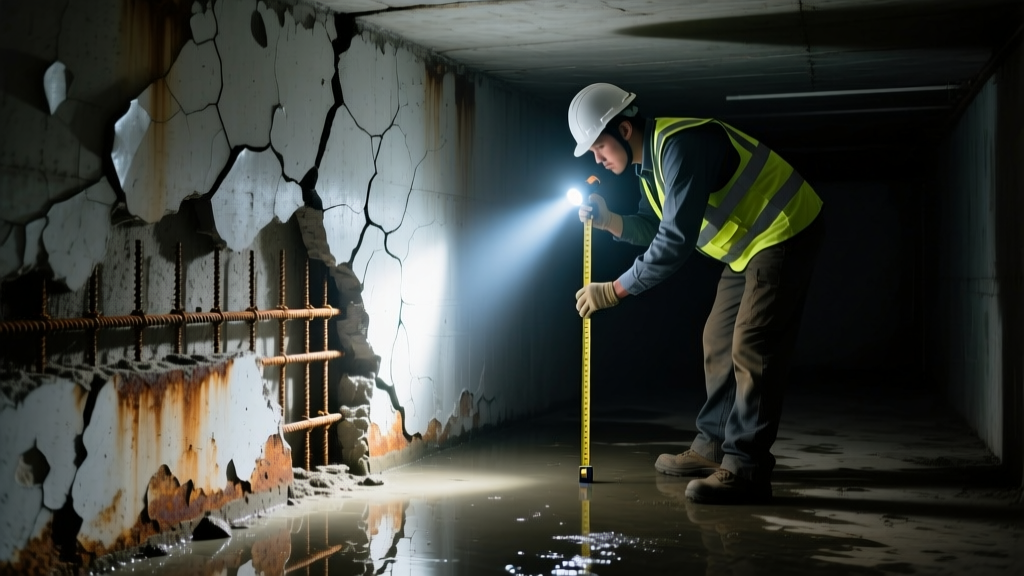
Diagnosing Compromised Foundation Materials: The 3-Point Assessment
When foundation building materials are compromised by chronic moisture intrusion, chemical attack, or soil movement, cosmetic patches will fail. True structural repair requires identifying the exact degradation mechanism before selecting a remediation product. Professional foundation engineers rely on a three-point diagnostic framework to quantify material loss.
1. Acoustic Sounding and Delamination Mapping
For concrete and masonry foundations, technicians use a sounding hammer or a heavy drag chain to detect subsurface delamination. Healthy concrete produces a sharp, high-pitched ring. Compromised concrete with subsurface micro-fractures or rebar corrosion yields a hollow, low-frequency 'drummy' sound. All hollow-sounding areas must be mapped with a lumber crayon to calculate the total square footage of required removal.
2. Quantitative Moisture Profiling
Surface dampness is deceptive. Inspectors use non-destructive impedance meters, such as the Tramex Concrete Encounter, to map moisture gradients up to 2 inches deep. Readings consistently above 5% moisture content by weight in concrete indicate active hydrostatic pressure or a failed vapor barrier. For wood pier-and-beam foundations, a pin-type moisture meter reading above 20% in structural timbers confirms the environment is actively supporting fungal decay.
3. Chemical and Carbonation Testing
Concrete naturally protects embedded steel via a highly alkaline environment (pH 12.5+). When moisture and CO2 penetrate, carbonation lowers the pH, initiating rebar corrosion. Technicians spray a 1% phenolphthalein indicator solution on freshly fractured concrete. A bright pink color confirms healthy alkalinity; a colorless reaction indicates the carbonation front has reached the steel, meaning the foundation building materials are compromised at a chemical level.
Repairing Compromised Concrete and Masonry (Spalling & Sulfate Attack)
Spalling (flaking and peeling) and sulfate attack are the most common failure modes in below-grade concrete. Sulfates in clay-rich soils react with the tricalcium aluminate in Portland cement, forming ettringite, which expands and shatters the concrete matrix from the inside out. The Portland Cement Association notes that mitigating this requires both material removal and chemical isolation.
Step-by-Step Polymer-Modified Repair Protocol
- Hydrodemolition or Mechanical Chipping: Remove all compromised concrete until sound, bright aggregate is exposed. Do not feather-edge the patch; use a diamond blade to saw-cut a clean, 90-degree perimeter at least 1/2 inch deep to prevent the patch from curling and debonding.
- Substrate Saturation: Soak the exposed concrete with clean water for 2 hours prior to patching. Polymer-modified mortars require a damp (but not puddled) substrate to prevent the dry old concrete from stealing moisture out of the new patch, which causes shrinkage cracking.
- Application of Bonding Agent: Brush a slurry coat of a styrene-butadiene rubber (SBR) latex bonding agent onto the damp surface immediately before placing the mortar.
- Patch Placement: Trowel on a high-build, polymer-modified structural repair mortar such as SikaTop Patch Plus or Quikrete Commercial Grade FastSet Repair Mortar. These products contain micro-silica and polymers that resist future sulfate penetration and achieve compressive strengths exceeding 4,500 psi within 24 hours.
Addressing Steel Reinforcement Oxidation (Rebar Corrosion)
When the concrete cover is lost and the steel reinforcement is exposed, rust occupies up to six times the volume of the original steel. This expansive force (rust jacking) cracks the surrounding sound concrete. Simply covering rusted rebar with mortar guarantees a callback within 18 months, as the active corrosion will continue beneath the patch.
Galvanic Anodes vs. Zinc-Rich Primers
For minor surface rust (less than 20% section loss), mechanical wire brushing followed by a two-part zinc-rich epoxy primer (meeting ASTM A780 standards) halts oxidation. However, for heavily compromised rebar in high-chloride or high-moisture environments, passive primers are insufficient.
Structural engineers increasingly specify embedded galvanic anodes, such as the Vector Patch Anode. These small zinc-based units are wire-tied directly to the existing rebar grid before the concrete patch is poured. Because zinc is more electronegative than steel, the anode sacrifices itself to the corrosion process, actively protecting the surrounding steel reinforcement for 10 to 15 years without requiring external power. If rebar section loss exceeds 30%, the compromised steel must be severed and spliced with new ASTM A615 Grade 60 rebar using mechanical couplers.
Salvaging Compromised Wood Pilings and Beams in Pier-and-Beam Systems
In older pier-and-beam foundations, wood posts and girders are highly susceptible to brown rot and termite damage when crawl space ventilation fails or ground clearance drops below 18 inches. The American Wood Protection Association (AWPA) standards dictate that structural timbers in ground contact must be heavily treated, but legacy foundations often feature untreated or under-treated heart pine or oak.
Two-part epoxy wood consolidants (like Abatron WoodEpox) can restore the compressive strength of decayed timber ends resting on concrete piers. However, epoxy consolidants should NEVER be used to repair the mid-span of a load-bearing girder where tensile and shear forces are highest. Mid-span decay requires full sistering with LVL (Laminated Veneer Lumber) or complete replacement.
The Helical Pier Integration Method
When wooden foundation pilings are compromised beyond salvage, excavating and pouring new concrete footings in a tight, wet crawl space is often cost-prohibitive and structurally risky due to soil disturbance. The modern repair standard involves bypassing the compromised wood entirely. Contractors install galvanized steel helical piers (such as Chance Helical Piers) directly adjacent to the failing wooden post. The helical pier is driven via hydraulic motor to a depth of 15 to 25 feet until it reaches load-bearing strata or achieves a specific torque-to-capacity ratio. A new steel bracket is then used to transfer the girder load from the rotting wood onto the permanent steel helical pier, effectively isolating the foundation from future ground moisture.
Cost, Material, and Methodology Comparison Matrix
The following matrix outlines the expected costs, material requirements, and structural outcomes for the primary repair methods discussed.
| Repair Method | Primary Materials Used | Estimated Cost (2026) | Curing / Set Time |
|---|---|---|---|
| Concrete Spall Patching | Polymer-modified mortar, SBR bonding agent | $18 - $35 per sq. ft. | 24 hours to structural strength |
| Rebar Galvanic Anode | Zinc galvanic anode, titanium tie wire | $120 - $180 per anode unit | Immediate (embedded in patch) |
| Wood Epoxy Consolidation | Liquid wood hardener, 2-part structural epoxy | $45 - $75 per linear ft. | 8 - 12 hours depending on temp |
| Helical Pier Underpinning | Galvanized steel shafts, L-brackets | $1,800 - $2,800 per pier | Immediate load transfer |
Critical Thresholds: When Repair Fails and Underpinning is Required
Not all compromised foundation building materials can be patched. According to guidelines published by the American Concrete Institute (ACI), structural repair is only viable if the underlying cause of the degradation is mitigated. If a foundation wall exhibits diagonal stair-step cracking wider than 1/4 inch, or if a slab-on-grade foundation shows a differential settlement exceeding 1 inch across a 20-foot span, the structural integrity of the entire system is in question.
In these scenarios, patching spalled concrete or treating rusted rebar is merely addressing the symptom of soil failure, not the root cause. The only engineered solution is full structural underpinning—using driven steel resistance piers or deep helical piles to transfer the structural load of the building past the unstable, moisture-fluctuating active soil zone and into competent bedrock or dense load-bearing strata. Attempting material-level repairs on a foundation that is actively subsiding will result in the new patches shearing and failing within a single freeze-thaw or wet-dry seasonal cycle.
Written by
James ThorntonJames Thornton is a construction industry veteran with 25 years of hands-on experience in wood framing, lumber grading, and residential building codes. He started as a framing carpenter in rural Oregon, earned his ICC Residential Building Inspector certification, and eventually became a senior plan reviewer for the City of Portland Bureau of Development Services. James holds a B.S. in Wood Science & Technology from Oregon State University and is a certified lumber grader through the West Coast Lumber Inspection Bureau (WCLIB). He has inspected over 3,000 residential construction sites and authored the city's internal guide on advanced framing techniques (2x6 at 24" O.C.). James lives in Bend, OR, where he builds custom timber-frame cabins and competes in lumberjack sports.
More from James Thornton
View all
Insulation
Best Home Insulation Materials: Complete 2026 Guide
Compare top home insulation materials for 2026. Find R-values, installed costs per square foot, and best uses for fiberglass, spray foam, and mineral wool.
Aug 4, 2026

Sustainable Building
Certify Your Green Building Material for LEED and WELL
Step-by-step guide to certifying a green building material for LEED v5 and WELL v2. Master EPDs, HPDs, and VOC limits for 2026 project specifications.
Aug 4, 2026

Stone & Masonry
Veneer Stacked Stone Panels: Interior Design & Style Showcase
Discover how veneer stacked stone panels transform interiors. Explore modern design profiles, material pairings, and technical installation specs.
Aug 4, 2026