Specifying National Sanitation Foundation Certified Water Filters
Compare performance ratings, flow specs, and NSF/ANSI standards for whole-house national sanitation foundation certified water filters at the main entry.
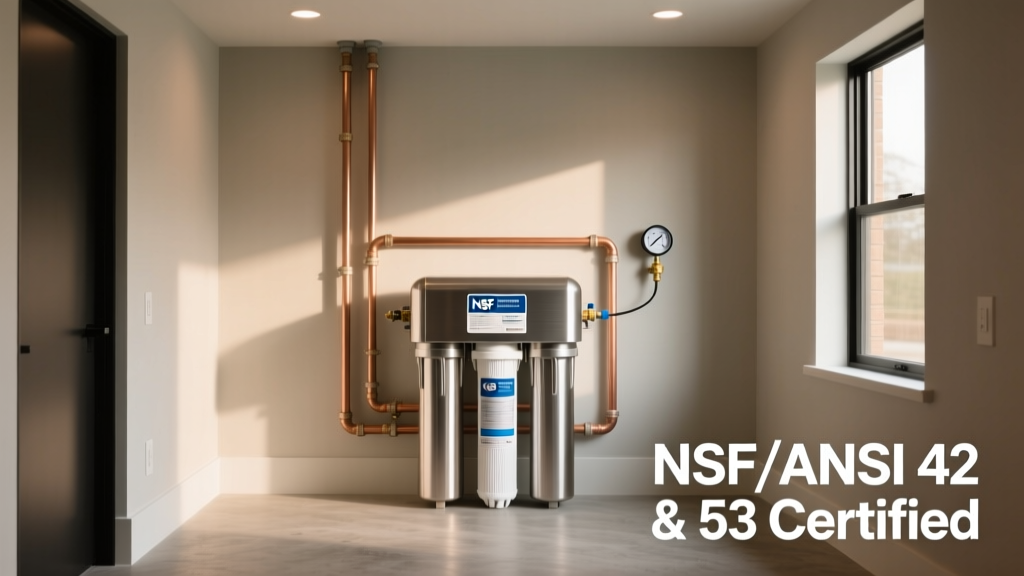
Point-of-Entry Integration in Foundation Plumbing
Integrating whole-house water filtration at the point-of-entry (POE) requires precise coordination during the foundation plumbing rough-in phase. For homes built on slab-on-grade foundations, the main water service line typically penetrates the concrete footing or slab edge, making the immediate post-penetration zone the critical installation point for national sanitation foundation certified water filters. Specifying the correct unit is not merely about contaminant removal; it requires rigorous alignment with the home's hydraulic demands, service line diameter, and physical clearance constraints inherent to crawlspace or slab-edge mechanical rooms.
When plumbers and builders fail to account for the pressure drop introduced by POE filtration, homeowners experience severe flow restriction at peak demand. To prevent this, specifications must prioritize units that maintain adequate gallons-per-minute (GPM) throughput while holding structural certifications for burst pressure and material safety. Below is a comprehensive technical breakdown of performance ratings, hydraulic specifications, and physical sizing metrics required for modern residential construction.
Decoding NSF/ANSI Performance Standards
The term 'certified' is frequently misused in the water treatment industry. True validation requires testing against specific NSF/ANSI standards administered by independent laboratories. When specifying national sanitation foundation certified water filters for new construction, you must match the local municipal water report's contaminant profile to the exact NSF standard the filter is rated to reduce.
• Standard 42: Aesthetic effects. Validates reduction of chlorine taste and odor, and particulate matter (Class I to IV).
• Standard 53: Health effects. Validates reduction of volatile organic compounds (VOCs), lead, mercury, and cysts like Cryptosporidium.
• Standard 401: Emerging compounds. Validates reduction of trace pharmaceuticals, herbicides, and chemical solvents.
• Standard 55 (Class A/B): Ultraviolet microbiological water treatment systems for bacteria and virus inactivation.
• Protocol P477: Specific validation for microcystin reduction (toxic algae byproducts increasingly relevant in surface-water municipalities).
For 2026 municipal water profiles, a combination of Standard 53 (for VOCs and heavy metals) and Standard 401 (for emerging organic compounds) represents the baseline specification for high-performance catalytic carbon tanks. Always verify the specific model number on the WQA or NSF directory, as manufacturers often certify the replacement cartridge media, not just the outer housing.
Hydraulic Performance: Flow Rate and Pressure Drop
The most common failure mode in POE filtration specification is undersizing the porting and media bed, leading to unacceptable pressure drops. According to the International Plumbing Code (IPC), residential systems must deliver adequate flow to meet simultaneous fixture demands. A standard 3-bathroom home requires a peak flow capacity of 12 to 15 GPM. If a filter housing introduces a 10 PSI drop at 12 GPM, third-floor showers and tankless water heaters will fail to operate correctly.
| Port Size | Media Type | Peak Flow (GPM) | Pressure Drop (PSI) | Service Line Match |
|---|---|---|---|---|
| 1-inch | Extruded Carbon Block | 10 - 12 GPM | 4 - 7 PSI | 3/4' to 1' Copper/PEX |
| 1.5-inch | Granular Catalytic Carbon | 15 - 20 GPM | 2 - 4 PSI | 1' to 1.25' Copper/PEX |
| 2-inch | KDF-55 / Carbon Blend | 25 - 32 GPM | 3 - 5 PSI | 1.5'+ Main Service |
Specification Rule: Never install a 1-inch ported filter on a 1.25-inch or 1.5-inch municipal service line, even if the home's internal branching is reduced to 3/4-inch PEX. The bottleneck at the filter housing will create velocity-induced turbulence and premature media channeling.
Sizing Framework: Calculating Peak Demand via WSFU
To accurately specify national sanitation foundation certified water filters, builders must calculate the Water Supply Fixture Units (WSFU) rather than relying on generic 'square footage' recommendations. The WSFU method, detailed in the IPC, converts the probabilistic demand of all plumbing fixtures into a standardized GPM requirement.
Step-by-Step Sizing Protocol
- Tally Fixture Units: Assign WSFU values to all fixtures (e.g., standard flush valve toilet = 10 WSFU; standard lavatory faucet = 1 WSFU; outdoor hose bibb = 2.5 WSFU).
- Convert to GPM: Use the Hunter's Curve conversion chart. A typical 2,500 sq ft home with 3.5 baths and dual laundry zones yields approximately 45-50 WSFU, translating to a peak demand of 14-16 GPM.
- Apply Media Depth Multiplier: Granular carbon requires a minimum 12-inch media bed depth for adequate contact time (Empty Bed Contact Time, or EBCT). If the peak flow exceeds 12 GPM, you must specify a 1.5-inch bypass valve and a larger diameter tank (e.g., 12x52 instead of 10x54) to maintain the necessary EBCT without increasing the pressure drop.
Physical Clearances and Rough-In Constraints
Foundation layouts dictate the physical footprint of POE systems. For slab foundations with interior mechanical closets, spatial planning is critical. A standard 2.5 cubic foot carbon tank (12x52 dimensions) requires a physical footprint of 12 inches in diameter, but installation and maintenance demand a minimum 18-inch lateral clearance for bypass valve operation and cartridge extraction.
If specifying an automatic backwashing carbon filter (which extends media life by flushing trapped sediment), the foundation plumbing rough-in must include a dedicated 3/4-inch or 1-inch standpipe drain line with an air gap, terminating at an exterior dry well or interior floor drain. Backwashing cycles discharge 40 to 80 gallons of water over 10 minutes. Routing this to a standard 1/2-inch condensate line or undersized utility sink will cause immediate flooding during the regeneration cycle.
Furthermore, modern 2026 smart-valve controllers require a dedicated 110V GFCI-protected outlet within 4 feet of the unit. Ensure the electrical rough-in includes this circuit on a breaker that is not tied to the home's primary lighting circuits, preventing a loss of filtration telemetry during minor electrical faults.
Media Lifespan and Maintenance Metrics
Performance ratings degrade as the adsorption sites on the carbon media become saturated. When comparing national sanitation foundation certified water filters, examine the manufacturer's stated capacity in both gallons treated and time in service. High-quality catalytic carbon blends (such as those utilizing Centaur or Norit media) are rated for 1,000,000 to 1,500,000 gallons, which equates to roughly 7 to 10 years for a family of four consuming 300 gallons daily.
However, if the local water supply exhibits high levels of tannins or sediment exceeding 5 NTUs, the media bed will foul mechanically before chemical exhaustion occurs. In these edge cases, specifying a dual-stage system with a 5-micron pleated sediment pre-filter (housed in a 20-inch big blue housing) is mandatory to protect the primary NSF-certified carbon tank and maintain the validated flow rates.
Validating Third-Party Testing
Always cross-reference manufacturer claims with the EPA's National Primary Drinking Water Regulations to ensure the filter's reduction claims align with the maximum contaminant levels (MCLs) enforced in your municipality. A filter certified to reduce lead to below 15 ppb (NSF 53) is useless if the home's internal PEX or copper soldering introduces contaminants downstream of the POE installation point. Proper specification requires viewing the POE filter as the first line of defense, complemented by point-of-use (POU) validation at the kitchen tap.