Types of Deep Foundation: 2026 Cost & Pricing Guide
Analyze the 2026 costs for types of deep foundation, including driven piles, drilled shafts, and micropiles, with real pricing and soil-matching frameworks.

Selecting among the various types of deep foundation is fundamentally an exercise in risk transfer and geotechnical optimization. When surface soils lack the bearing capacity to support structural loads, or when settlement criteria dictate bypassing compressible strata, deep foundations transfer loads to competent bearing layers via skin friction and end bearing. In 2026, the financial delta between choosing a driven steel H-pile versus a drilled shaft can swing a commercial project's substructure budget by hundreds of thousands of dollars, driven by fluctuating steel indices, specialized rig mobilization fees, and localized labor shortages for certified crane operators.
This cost analysis breaks down the four primary deep foundation systems, providing actionable unit pricing, hidden cost variables, and a geotechnical decision framework for structural engineers and project managers.
Primary Types of Deep Foundation & 2026 Unit Costs
1. Driven Piles (Steel H-Piles & Precast Concrete)
Driven piles are displacement piles installed by impacting them into the ground using hydraulic or diesel hammers. Steel H-piles (e.g., HP12x53 to HP14x117) are the industry standard for heavy vertical and lateral loads, particularly in bridge abutments and high-rise cores. Precast prestressed concrete piles (14-inch to 24-inch square) dominate in marine environments and coastal regions due to their superior corrosion resistance.
- Material Cost: $95 – $160 per linear foot (LF) for HP14 sections, based on 2026 structural steel indices averaging $1.15/lb.
- Installation Cost: $35 – $65 per LF, heavily dependent on driving resistance and refusal depth.
- Total Installed Cost: $130 – $225 per LF.
- Mobilization: $25,000 – $45,000 (requires heavy crawler cranes and lead rigs).
2. Drilled Shafts (Caissons)
Drilled shafts are large-diameter (typically 36 to 120 inches) cast-in-place concrete elements. They rely on massive end-bearing on rock or deep dense strata. The 2026 market sees extensive use of casing oscillators and polymer slurries to maintain hole stability in collapsing soils without the need for temporary steel casings, which reduces extraction costs.
- Material Cost: $120 – $250 per LF (concrete and rebar cages). A 48-inch shaft requires roughly 1.05 cubic yards of concrete per LF.
- Installation Cost: $150 – $300 per LF. Costs spike significantly if rock socketing is required using specialized core barrels.
- Total Installed Cost: $270 – $550+ per LF.
- Mobilization: $50,000 – $90,000 (requires large rotary drilling rigs like the Bauer BG series).
3. Helical Piles
Helical piles consist of a central steel shaft with one or more helical bearing plates. They are screwed into the ground using rotary hydraulics, and their capacity is verified in real-time via the torque-to-capacity empirical relationship. Systems like the Hubbell/Chance SS-150 (square shaft) or RS-2875 (round shaft) are prevalent in 2026 for mid-rise structures, solar farms, and underpinning retrofits.
- Material Cost: $25 – $60 per LF.
- Installation Cost: $15 – $40 per LF (can be installed with compact equipment like skid steers or mini-excavators).
- Total Installed Cost: $40 – $100 per LF.
- Mobilization: $5,000 – $15,000.
4. Micropiles
Micropiles are small-diameter (5 to 12 inches), heavily reinforced, cast-in-place elements capable of carrying loads up to 400+ tons. They are the definitive solution for low-headroom environments, seismic retrofits, and sites with severe subsurface obstructions. According to the Federal Highway Administration (FHWA) guidelines, micropiles are classified by their grouting method, with Type D (pressure grouted) offering the highest skin friction in granular soils.
- Material Cost: $60 – $110 per LF (includes high-strength 150 ksi threadbar, e.g., Dywidag, and steel casing).
- Installation Cost: $70 – $140 per LF (requires specialized track-mounted drill rigs).
- Total Installed Cost: $130 – $250 per LF.
- Mobilization: $20,000 – $40,000.
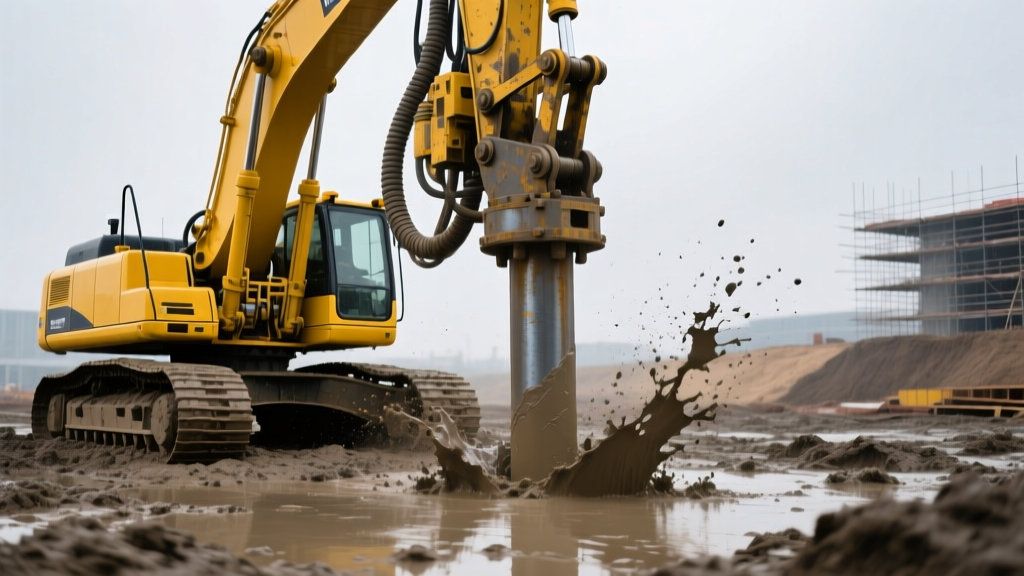
2026 Cost Comparison Matrix
The following matrix synthesizes baseline costs for standard commercial applications. Actual pricing will vary based on regional labor rates, site access, and specific geotechnical profiles.
| Foundation Type | Avg. Cost per LF | Mobilization Range | Ideal Soil Profile | Max Typical Load | Noise/Vibration |
|---|---|---|---|---|---|
| Driven Steel H-Pile | $130 - $225 | $25k - $45k | Dense sands, stiff clays, glacial till | 400 - 800 tons | High / High |
| Drilled Shaft (48" Dia.) | $270 - $550 | $50k - $90k | Stable clays, rock socketing required | 1,000 - 3,000+ tons | Low / Low |
| Helical Pile (RS-2875) | $40 - $100 | $5k - $15k | Soft to medium clays, loose sands | 50 - 200 tons | Low / None |
| Micropile (Type D) | $130 - $250 | $20k - $40k | Obstructed sites, rock, low headroom | 200 - 450 tons | Low / Low |
Hidden Cost Variables That Derail Substructure Budgets
Unit pricing per linear foot rarely tells the complete financial story. Project managers must account for the following secondary cost drivers when evaluating the types of deep foundation for a specific site.
When drilled shafts or micropiles must penetrate bedrock to achieve end-bearing, contractors deploy down-the-hole hammers (DTH) or core barrels. Rock socketing can increase the per-LF installation cost by 40% to 70%. Always require a detailed geotechnical baseline report (GBR) defining the exact rock elevation and unconfined compressive strength (UCS) to prevent change orders.
Drilled shafts generate massive volumes of spoil. A 48-inch shaft drilled to 80 feet yields approximately 85 cubic yards of excavated material. In 2026, environmental tipping fees and transport costs for contaminated or wet spoils can add $15,000 to $30,000 per pier. Conversely, driven piles and helical piles generate zero spoil, eliminating this line item entirely.
Geotechnical Decision Framework
Use this conditional logic to narrow down the optimal deep foundation system based on site constraints and subsurface conditions, aligning with best practices outlined by the Deep Foundations Institute (DFI).
- IF the site has severe overhead obstructions (e.g., interior building retrofits, low bridges) AND requires high capacity: Select Micropiles. Standard rotary rigs require 25+ feet of headroom; micropile rigs can operate in spaces as low as 8 feet.
- IF the soil profile contains thick layers of soft, compressible clay AND the structure is sensitive to differential settlement: Select Drilled Shafts or Driven Piles. Helical piles may lack sufficient skin friction in deep soft clays unless designed with exceptionally large helix diameters, which increases torque requirements beyond standard equipment limits.
- IF the site is adjacent to sensitive historical structures OR has strict municipal noise ordinances: Select Drilled Shafts or Helical Piles. The dynamic impact and ground vibration from driving steel H-piles can exceed the peak particle velocity (PPV) thresholds that cause cosmetic damage to unreinforced masonry.
- IF the project requires immediate load testing and rapid mobilization for a light-to-medium load application: Select Helical Piles. The torque-to-capacity relationship allows the engineer to verify design loads instantly during installation, bypassing the 7-to-14 day curing wait required for static load testing on concrete piles.
2026 Market Trends: Equipment and Labor Dynamics
The macroeconomic environment in 2026 heavily influences deep foundation pricing. While structural steel prices have largely stabilized following the volatility of the early 2020s, the cost of specialized geotechnical labor has surged. Certified crane operators and drill rig mechanics are in short supply, driving up prevailing wage requirements and equipment rental premiums.
'The shift toward automated drilling assists and digital pile driving analyzers (PDA) has improved installation accuracy and reduced material waste, but the capital expenditure for this technology is now being passed down to the project level through higher baseline mobilization fees.' — U.S. Army Corps of Engineers (USACE) Geotechnical Publications
Furthermore, the push for sustainable construction has increased demand for helical piles, which can be unscrewed and reused at the end of a structure's lifecycle, offering a lower embodied carbon footprint compared to cast-in-place concrete shafts. When evaluating the types of deep foundation, project teams must look beyond the immediate substructure contract and consider the total lifecycle cost, including future removal, site remediation, and carbon taxation implications.
Written by
Marcus ChenMarcus Chen is a licensed structural engineer (PE) and building materials analyst with over 12 years of experience across residential, commercial, and industrial construction. He holds a Master of Science in Civil Engineering from UC Berkeley and spent six years at Thornton Tomasetti before transitioning to independent consulting and technical writing. Marcus specializes in material selection for seismic-prone regions, concrete reinforcement strategies, and lifecycle cost analysis. His work has been cited by the American Concrete Institute (ACI) and the Structural Engineers Association of California (SEAOC). When he is not on a job site or at his desk, you will find him hiking the Sierra Nevada or restoring a 1920s craftsman bungalow in Oakland, CA.
More from Marcus Chen
View all
Construction Cost
How Much Did the Eiffel Tower Cost to Build?
How much did the Eiffel Tower cost to build in 1889? We adjust for inflation and compare its budget to modern skyscraper construction.
Aug 4, 2026

Fire Resistance
What Is a Fire Resistant Material? Testing & Certification Guide
Discover what is a fire resistant material through ASTM and UL testing. Learn how fire ratings, certifications, and assemblies work in construction.
Aug 4, 2026

Construction Cost
How Much Did the Burj Khalifa Cost to Build?
How much did the Burj Khalifa cost to build? We break down the $1.5B project and extract 5 money-saving strategies for your next build.
Jul 30, 2026