How to Detect Foundation Building Materials Fraud on Site
Learn how to identify and prevent foundation building materials fraud, from rebar substitution to concrete slump manipulation, with 2026 field protocols.
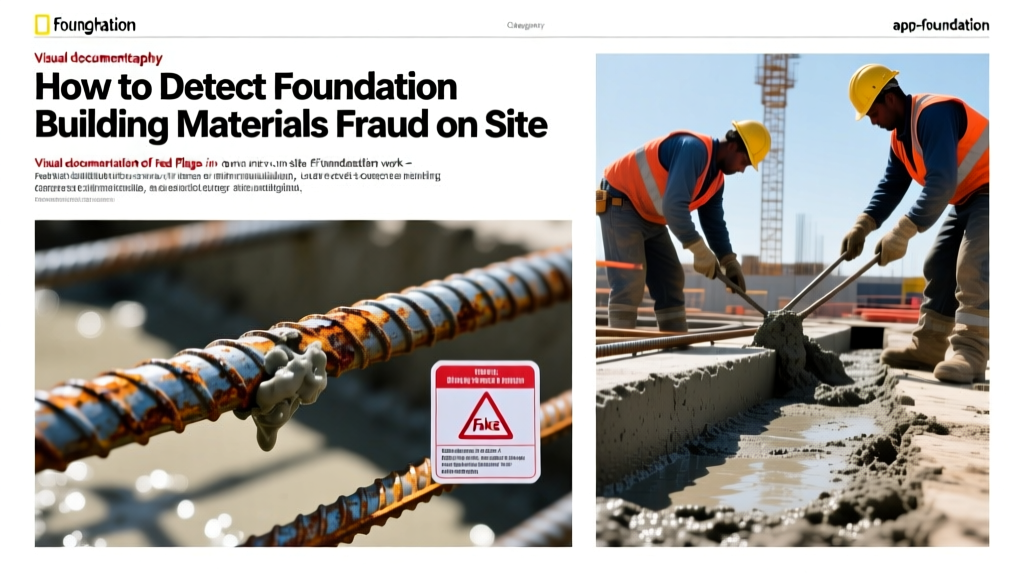
The Anatomy of Foundation Building Materials Fraud
Foundation building materials fraud extends far beyond simple theft or billing inflation. In the modern construction landscape, it predominantly manifests as the deliberate substitution of specified structural components with substandard, non-compliant, or counterfeit alternatives. As supply chain pressures and material costs fluctuate through 2026, unscrupulous suppliers and rogue subcontractors increasingly exploit blind spots in field verification. When a foundation fails due to material substitution, the structural liability falls squarely on the general contractor and the engineer of record, making rigorous on-site auditing a non-negotiable protocol.

High-Risk Materials and Verification Protocols
Detecting foundation building materials fraud requires moving beyond visual checks and implementing forensic verification protocols tailored to the specific failure modes of each material class.
Ready-Mix Concrete and Slump Manipulation
The most pervasive form of foundation building materials fraud occurs inside the transit mixer. Ready-mix concrete is designed with a strict water-cement (w/c) ratio to achieve the specified compressive strength (typically 3,000 to 4,000 psi for residential and light commercial foundations). When a truck arrives on-site and the concrete is too stiff for the pump, drivers frequently add water to increase the 'slump' (workability) without the site superintendent's authorization.
According to data referenced by the American Concrete Institute (ACI), adding just one gallon of water per cubic yard of concrete increases the slump by approximately one inch but reduces the final compressive strength by 200 to 400 psi. A 3,000 psi foundation wall diluted on-site may cure at 2,200 psi, drastically reducing its load-bearing capacity and increasing its permeability to groundwater. Field superintendents must enforce ASTM C143 slump testing on every truck and reject loads that fall outside the ±1-inch tolerance of the mix design.
Rebar Grade Substitution and Epoxy Fraud
Rebar substitution is highly lucrative for fraudulent suppliers. The most common tactic is delivering ASTM A615 Grade 40 rebar (40,000 psi yield strength) while billing for Grade 60 (60,000 psi yield strength). Because the physical dimensions and rib patterns are nearly identical to the untrained eye, this fraud routinely bypasses casual site inspections.
Verification requires checking the mill marks rolled into the steel. As detailed in the Concrete Reinforcing Steel Institute (CRSI) Bar Markings Guide, Grade 60 rebar will feature a continuous longitudinal rib or specific grade marks (such as the number '60' or a single continuous line running the length of the bar). Furthermore, if the design specifies epoxy-coated rebar (ASTM A775) for corrosion resistance in high-water-table environments, fraudulent applicators often spray a 5-mil coating instead of the required 7 to 12 mils. Inspectors must use a magnetic coating thickness gauge on-site before the steel is tied and poured.
Helical Pier Shaft and Plate Counterfeiting
Deep foundation systems, particularly helical piers, are increasingly targeted. Fraudulent manufacturers produce piers using A36 steel (36,000 psi yield) instead of the specified A500 Grade B (42,000 psi) or high-strength alloy shafts. Additionally, the helical plates may be cut thinner than the engineered 0.5-inch requirement, or welded with inadequate penetration. Genuine helical piers must comply with ICC Evaluation Service Acceptance Criteria (AC358). Inspectors must demand the manufacturer's ICC-ES evaluation report and verify the heat numbers stamped on the steel shaft against the Mill Test Reports (MTRs) provided at delivery.
Material Fraud Comparison Matrix
The following matrix outlines the most common substitution tactics and the exact field testing methods required to expose them.
| Material | Specified Standard | Common Fraud Tactic | Field Verification Method |
|---|---|---|---|
| Ready-Mix Concrete | ASTM C94 (3,000+ psi) | Unauthorized water addition to increase slump | Slump cone test (ASTM C143) and cylinder break tests at 7/28 days |
| Reinforcing Steel | ASTM A615 Grade 60 | Substituting Grade 40 or imported non-compliant steel | Visual mill mark inspection and MTR heat-number cross-referencing |
| Epoxy-Coated Rebar | ASTM A775 (7-12 mils) | Under-applying epoxy (3-5 mils) to save material costs | Magnetic coating thickness gauge testing on random samples |
| Bentonite Waterproofing | ASTM D5893 | Cutting sodium bentonite with cheap calcium fillers | Reviewing independent lab swell-index certifications prior to install |
| Helical Piers | ICC-ES AC358 | Using A36 steel shafts and undersized helical plates | Ultrasonic thickness testing and verifying ICC-ES listing numbers |
Field Documentation and Chain of Custody Framework
Preventing foundation building materials fraud requires establishing an unbroken chain of custody from the batch plant or mill to the foundation trench. Implement the following step-by-step verification framework on every project:
- Mandate Mill Test Reports (MTRs): Require the supplier to provide MTRs for all structural steel, rebar, and helical piers 48 hours before delivery. The MTR must detail the chemical composition and yield strength of the specific heat batch.
- Verify Delivery Tickets: The site superintendent must cross-reference the concrete delivery ticket with the approved mix design. Ensure the ticket explicitly lists the w/c ratio, admixtures, and maximum slump. Refuse any ticket showing 'water added at site' unless authorized and documented by the structural engineer.
- Conduct Random Dimensional Audits: Use digital calipers to measure the core diameter and rib height of rebar bundles upon offloading. Counterfeit or substituted metric rebar often fails to meet the exact imperial dimensional tolerances required by ACI 318.
- Implement Third-Party Special Inspections: For commercial or high-load residential foundations, contract an independent geotechnical and structural testing agency (e.g., Intertek, SGS, or local equivalents) to perform unannounced field audits and material sampling.
- Secure the Laydown Area: Once materials are verified, restrict access to the rebar and waterproofing laydown yards. Material swapping often occurs overnight when verified, high-grade materials are replaced with inferior stock from a secondary, unverified supplier.
'In construction litigation, the general contractor is presumed to have accepted the materials upon placement. If you cannot produce a documented chain of custody and verified MTRs for the steel in your foundation, the liability for structural failure defaults to you, regardless of the supplier's deceit.' — Senior Construction Defect Litigator, 2025 Industry Risk Report
Frequently Asked Questions
Can ground-penetrating radar (GPR) detect rebar fraud after the concrete is poured?
GPR can accurately map the location, depth, and spacing of embedded rebar, but it cannot determine the steel's yield strength or grade. If Grade 40 rebar was substituted for Grade 60, GPR will not reveal the fraud. Post-pour verification of steel grade requires destructive testing (chipping away concrete to extract a sample for tensile testing) or relying on pre-pour MTR documentation.
How do I verify the authenticity of bentonite waterproofing membranes?
Authentic sodium bentonite membranes must meet ASTM D5890 (Swell Index) and ASTM D5891 (Fluid Loss) standards. Fraudulent products often use calcium bentonite, which does not swell adequately in the presence of groundwater. Require the manufacturer to provide a batch-specific Certificate of Analysis (CoA) from an independent laboratory, and verify the geotextile carrier fabric's grab tensile strength (ASTM D4632) before backfilling.
What are the legal consequences for a supplier caught committing material fraud?
Suppliers caught committing foundation building materials fraud face severe consequences, including breach of contract, civil fraud penalties, and potential criminal charges for wire fraud or falsification of structural documents. In 2026, many jurisdictions also mandate the immediate revocation of the supplier's contractor or material provider licenses, alongside mandatory restitution for the complete demolition and replacement of the compromised foundation.
Written by
Priya KapoorPriya Kapoor is a real estate market analyst and construction economics researcher with expertise in housing affordability, development feasibility, and infrastructure investment. She holds a Master of Regional Planning from Cornell University and previously worked as a senior analyst at CBRE's Investment Properties group, where she modeled returns for $4B in mixed-use development pipelines. Priya now runs an independent research practice advising developers, municipalities, and REITs on construction cost forecasting and market timing. She publishes the quarterly "BuildMat Market Pulse" report tracking material price indices across 12 commodity categories. Based in Austin, TX, Priya serves on the board of Habitat for Humanity Austin and is a marathon runner.
More from Priya Kapoor
View all
Construction Cost
Cost to Build a 1600 Sq Ft Home in 2026: Full Breakdown
Accurate 2026 cost to build a 1600 sq ft home—material, labor, and regional pricing breakdowns included. Plan your budget with real-time estimates.
Aug 11, 2026

Wood & Lumber
Name the Types of Wood for Pressure Treatment and Preservation
Learn how to name the types of wood best suited for pressure treatment. Compare species treatability, chemical retention levels, and 2026 preservation costs.
Aug 4, 2026

Stone & Masonry
Stone Veneer Suppliers Lindenhurst: 2026 Cost Analysis
Analyze 2026 stone veneer costs in Lindenhurst, NY. Compare local supplier pricing, delivery fees, and Suffolk County installation labor rates.
Aug 4, 2026