Foundation Building Materials Fraud Phishing & Structural Risks
Learn how foundation building materials fraud phishing compromises structural integrity and how engineers can verify ASTM compliance to prevent failure.
The Intersection of Cybersecurity and Structural Analysis
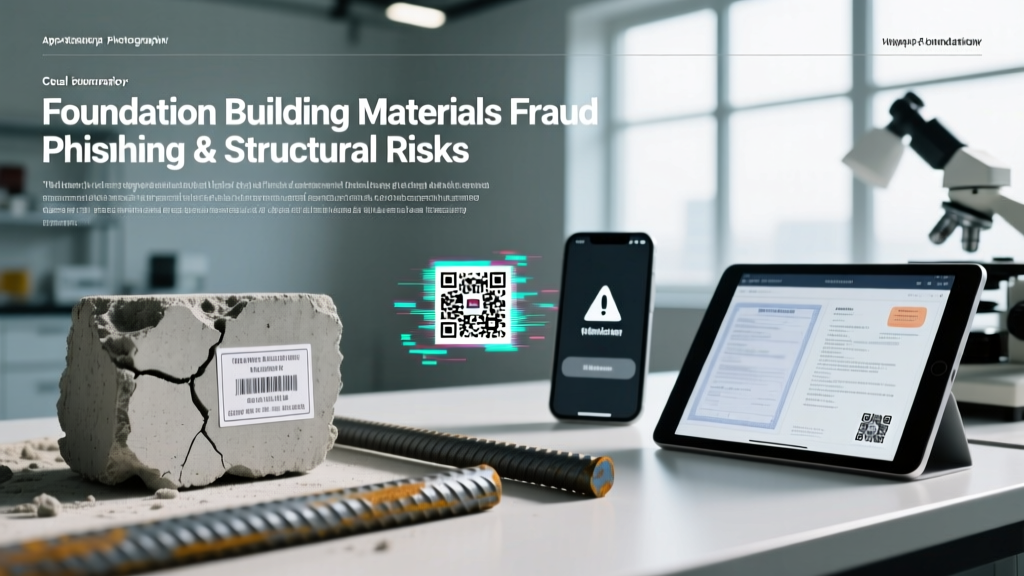
Structural analysis relies entirely on the predictability of material properties. When designing deep foundations, mat slabs, or retaining walls, the Engineer of Record (EOR) assumes specific values for concrete compressive strength ($f'_c$), steel yield strength ($f_y$), and elastic modulus ($E$). However, a sophisticated and growing threat vector known as foundation building materials fraud phishing actively undermines these assumptions. In this attack model, cybercriminals do not merely steal funds; they spoof major material suppliers to deliver counterfeit or substandard structural materials accompanied by falsified digital Mill Test Reports (MTRs). When procurement is compromised, the assumed material properties become invalid, leading to unconservative designs, undetected vulnerabilities, and catastrophic foundation failures.
Anatomy of Foundation Building Materials Fraud Phishing
Unlike generic corporate phishing, attacks targeting structural procurement are highly specialized. Threat actors conduct extensive reconnaissance on large-scale commercial and infrastructure projects. They identify the specific concrete batch plants, steel mills, and post-tensioning suppliers contracted for the foundation work.
Business Email Compromise (BEC) in Material Procurement
The primary mechanism is Business Email Compromise (BEC). Attackers register lookalike domains (e.g., @nucor-steel-us.com instead of @nucor.com) and intercept Request for Quote (RFQ) email threads between the general contractor and the supplier. According to the FBI Internet Crime Complaint Center (IC3), BEC attacks in the construction sector frequently result in both wire fraud and the physical delivery of non-conforming materials. The attacker, posing as the supplier, sends falsified MTRs and batch tickets directly to the project's QA/QC manager and structural engineer, effectively bypassing physical material verification.
- Sudden changes in wire transfer instructions for large foundation pours (e.g., $150,000+ for 500 cubic yards of high-strength mix).
- MTRs delivered as flattened PDFs or JPEGs rather than secure, digitally signed documents or direct API portal access.
- Urgent requests to approve material substitutions due to 'supply chain shortages' without formal structural review.

Structural Failure Modes from Counterfeit Materials
When foundation building materials fraud phishing results in the delivery of counterfeit materials, the structural consequences are severe. The failure modes manifest differently depending on the substituted material.
1. Rebar Substitution and Seismic Ductility Loss
In seismic zones, foundation walls and grade beams require ASTM A706 rebar due to its strict limits on yield strength and high elongation requirements, which allow for plastic hinging. Fraudulent suppliers often substitute A706 with ASTM A615 Grade 40 or counterfeit Grade 60 rebar that lacks a defined yield plateau. During a seismic event, the foundation wall experiences sudden, brittle shear failure rather than ductile flexural yielding, completely invalidating the structural analysis models used for the design.
2. Post-Tensioning (PT) Strand Fraud
For post-tensioned slab-on-grade foundations, the PT strands must undergo specific stress-relieving processes to prevent hydrogen embrittlement. Counterfeit PT cables sourced through phished procurement channels often skip this manufacturing step. Under long-term sustained loads, these strands suffer from delayed stress rupture. Structurally, this leads to a progressive loss of compressive prestress, resulting in excessive long-term deflection, punching shear failures at columns, and severe slab cracking.
3. Adulterated Concrete Admixtures
Mass concrete foundation elements (like pile caps or thick mats) require specific retarders and supplementary cementitious materials (SCMs) like slag or fly ash to control the heat of hydration. Phished suppliers may substitute SCMs with cheap, high-early-strength Portland cement and counterfeit non-chloride accelerators that actually contain high chloride levels. The structural analysis impact is twofold: thermal gradients exceed the concrete's early tensile capacity, causing through-cracking, while the introduced chlorides initiate rapid rebar corrosion, destroying bond strength and structural capacity within a few years.
Material Specification vs. Fraudulent Substitute Matrix
The following table outlines common material substitutions facilitated by procurement fraud and their direct impact on structural analysis parameters.
| Specified Material | Fraudulent Substitute | Structural Analysis Impact |
|---|---|---|
| ASTM A706 Grade 60 Rebar | ASTM A615 Grade 40 / Unmarked | Reduces nominal moment capacity ($M_n$); eliminates ductility; causes brittle shear failure in foundation walls. |
| 6000 psi Concrete with 50% Slag | Type III Portland Cement (No Slag) | Increases heat of hydration; induces thermal cracking; compromises shear friction at construction joints. |
| Low-Relaxation PT Strand (ASTM A416) | Standard-Relaxation / Non-Stress-Relieved | Increases long-term prestress losses by up to 15%; risks hydrogen embrittlement and sudden strand rupture. |
| Non-Chloride Accelerator | Calcium Chloride based substitute | Accelerates reinforcement corrosion; reduces long-term bond strength; causes concrete spalling. |
Digital Verification Protocols for Structural Engineers
To mitigate the risks of foundation building materials fraud phishing, structural engineers and QA/QC teams must implement rigorous digital verification protocols. Relying on emailed PDFs for material certification is no longer acceptable for critical structural elements. The Cybersecurity and Infrastructure Security Agency (CISA) emphasizes the need for multi-factor verification in high-value supply chains.
- Direct Portal Verification: Never accept MTRs via email attachments. Require suppliers to provide read-only access to their secure customer portals where batch and heat numbers can be verified directly against the mill's database.
- Cryptographic Hashing: For large-scale foundation projects, specify in the contract documents that all digital MTRs must include a cryptographic hash or digital signature that can be verified against the manufacturer's public key.
- Independent Third-Party Testing: Mandate independent, owner-funded testing for all foundation steel and post-tensioning cables. This includes tensile testing, bend testing, and chemical composition analysis (via spectrometer) to verify the material matches the ASTM standard, regardless of the provided paperwork.
- Domain and Communication Audits: Train procurement staff to inspect email headers and domain registrations. A simple WHOIS lookup can reveal if a supplier's domain was registered only days before sending a $500,000 invoice for foundation post-tensioning materials.
Financial and Professional Liability Implications
The intersection of cybersecurity and structural engineering creates complex liability scenarios. If a foundation fails due to counterfeit materials introduced via a phishing attack, the EOR may face severe professional liability claims. Courts and arbitration panels increasingly expect engineers to anticipate modern procurement risks. If the EOR signed off on foundation pours based solely on emailed, unverified MTRs that were later proven to be part of a phishing scheme, their Errors and Omissions (E&O) insurance may be contested due to negligence in QA/QC oversight.
'Structural integrity is not solely a function of mathematical analysis; it is fundamentally dependent on the physical reality of the materials installed. When the digital supply chain is compromised, the structural assumptions collapse.' — Industry Guidelines on Construction Cybersecurity and Material Verification
Furthermore, organizations like the American Institute of Steel Construction (AISC) maintain strict certification programs precisely to ensure material traceability. Bypassing certified suppliers in favor of unverified, low-bid vendors contacted via email drastically increases the probability of receiving fraudulent materials. By treating foundation building materials fraud phishing as a critical structural risk rather than just an IT problem, engineering firms can protect both the physical structures they design and their professional standing.
Written by
David NakamuraDavid Nakamura is a licensed architect (AIA) and construction technology writer focused on sustainable building methods, mass timber engineering, and high-performance building envelopes. He holds a Master of Architecture from the University of Washington and is a certified Passive House Consultant (CPHC). David spent eight years at the Seattle firm Mithun, where he led the design of three LEED Platinum projects, before founding his own practice specializing in net-zero residential design. He serves on the editorial advisory board of GreenBuilder Magazine and has authored peer-reviewed papers on cross-laminated timber (CLT) connections for the Journal of Structural Engineering. In his spare time, David teaches woodworking at Pratt Fine Arts Center and kayaks the Puget Sound.
More from David Nakamura
View all
Construction Cost
Labor Cost to Build a Deck Per Sq Ft: 2026 Installation Guide
Discover the exact labor cost to build a deck per sq ft in 2026. This installation guide breaks down contractor rates, complexity factors, and hidden fees.
Aug 4, 2026

Construction Cost
How Much Does It Cost to Build a 3 Bedroom House? Financing Guide
Learn exactly how much it costs to build a 3 bedroom house and explore 2026 financing options, construction loan types, and budget frameworks for your build.
Aug 4, 2026

Construction Cost
Cost to Build a Tennis Court: 2026 Guide
How much does it cost to build a tennis court in 2026? Breakdowns for asphalt, concrete, and synthetic surfaces plus fencing and lighting.
Jul 30, 2026