Foundation Building Materials Lake Worth Beach: Coastal Repair Guide
Discover the best foundation building materials Lake Worth Beach contractors use for coastal repairs, including helical piers, marine foam, and FBC codes.

Key Takeaways
- Marine-grade concrete (5,000 PSI) and epoxy-coated rebar are mandatory for resisting saltwater corrosion.
- Helical piers provide superior load transfer in Lake Worth Beach's sandy, high-water-table soil.
- The 2026 Florida Building Code requires enhanced chloride ingress protection for coastal foundations.
- Always conduct a geotechnical soil analysis before selecting a deep foundation system.
The most effective foundation building materials for Lake Worth Beach coastal repair include marine-grade concrete with a minimum 5,000 PSI compressive strength, hot-dipped galvanized steel helical piers, and epoxy-coated reinforcing bar. This guide is specifically written for Lake Worth Beach homeowners, property managers, and local contractors seeking durable structural solutions. Coastal properties face unique threats from saltwater intrusion, high water tables, and hurricane-force winds. Selecting the correct coastal foundation repair materials ensures structural longevity and compliance with the 2026 Florida Building Code. By prioritizing corrosion-resistant components and deep-load transfer systems, property owners can mitigate the severe environmental degradation common to Florida barrier islands.
Core Foundation Materials for Lake Worth Beach Coastal Repair
Marine-Grade Concrete and Corrosion Inhibitors
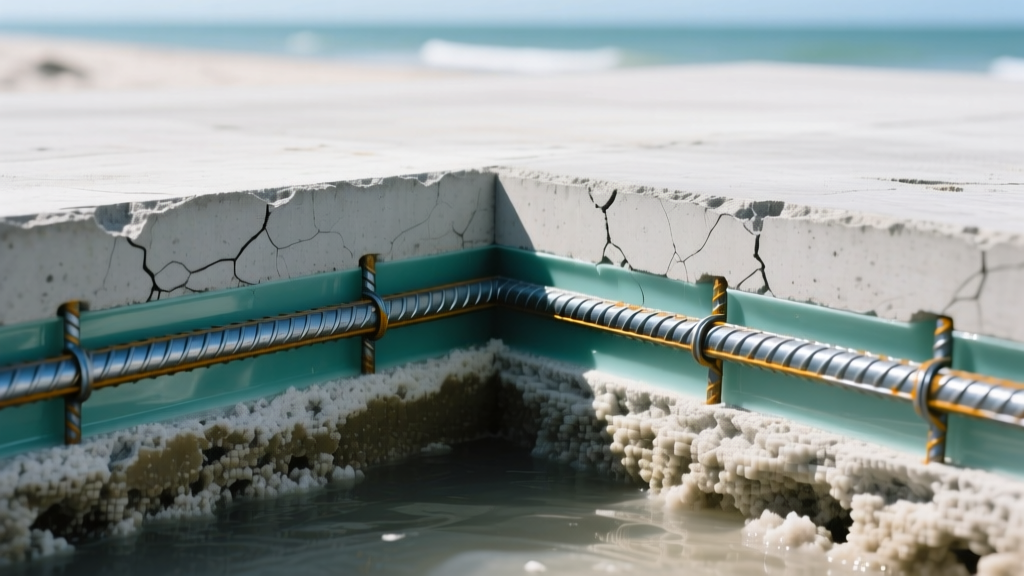
Standard concrete mixes deteriorate rapidly when exposed to the chloride-rich environment of the Atlantic coast. Marine-grade concrete utilizes a low water-to-cement ratio and supplementary cementitious materials like fly ash or slag. This dense matrix physically blocks saltwater from reaching the internal steel reinforcement.
Contractors must pair this concrete with epoxy-coated reinforcing bar. The 3/8-inch epoxy coating acts as a dielectric barrier, preventing the electrochemical reaction that causes rebar to rust and expand. This expansion, known as spalling, is the primary cause of foundation failure in coastal Florida.
Helical Piers and Galvanized Steel
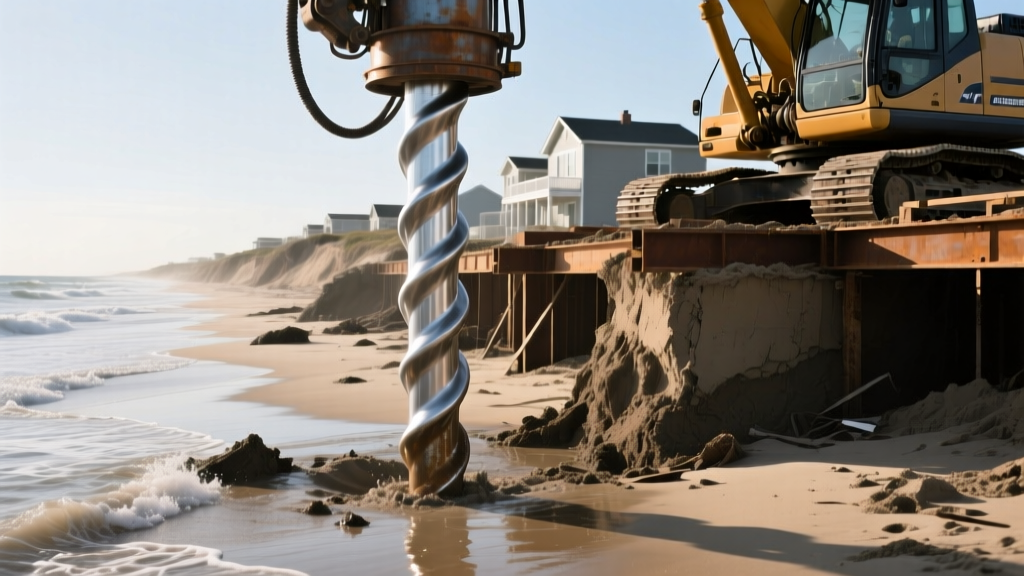
Shallow spread footings often fail in Lake Worth Beach due to the loose, sandy soil profile. Helical piers bypass this unstable top layer, transferring the structural load deep into competent bedrock or dense sand strata. These steel shafts feature helical bearing plates that screw into the ground, providing immediate load-bearing capacity.
For coastal applications, the American Concrete Institute and local engineers mandate hot-dipped galvanized steel. The zinc coating sacrifices itself to protect the underlying steel from salt spray and soil acidity. Properly installed galvanized helical piers offer a verified 50-year lifespan in aggressive marine environments.
Overcoming Lake Worth Beach Environmental Challenges
High Water Table and Hydrostatic Pressure
Hydrostatic Pressure: The lateral and upward force exerted by groundwater against below-grade foundation walls. In coastal environments with high water tables, this pressure can cause severe cracking, bowing, and water intrusion if foundations lack proper drainage and structural reinforcement.
Lake Worth Beach sits on a narrow barrier island where the water table frequently rests just inches below the surface. Foundations must incorporate perimeter French drains and sump pump systems to relieve this pressure. Using waterproofing membranes on the exterior of concrete foundation walls prevents moisture migration into the living space.
Salt Spray and Chloride Ingress
Airborne salt from the ocean accelerates the corrosion of exposed structural metals. The 2026 Florida Building Code designates Lake Worth Beach as a High-Velocity Hurricane Zone, requiring structures to withstand 150 mph wind loads while resisting severe salt spray. All exposed foundation hardware, including anchor bolts and tie-downs, must be manufactured from 316-grade stainless steel or feature heavy-duty marine coatings.
Material Comparison Matrix
Use this decision framework to select the appropriate foundation building materials Lake Worth Beach coastal repair projects demand.
| Material | Best Use Case | Corrosion Resistance | Estimated Lifespan |
|---|---|---|---|
| Marine-Grade Concrete (5,000 PSI) | New poured footings and seawall caps | High (when mixed with slag) | 75+ years |
| Epoxy-Coated Rebar | Internal reinforcement for concrete walls | Very High | 50-75 years |
| Galvanized Helical Piers | Lifting and stabilizing sinking foundations | High (zinc sacrificial layer) | 50+ years |
| 316 Stainless Steel Anchors | Surface tie-downs and exposed hardware | Extreme | 100+ years |
| Standard Portland Cement | Interior, non-coastal applications only | Low | 15-20 years (coastal) |
Florida Building Code 2026 Compliance
The Florida Building Code enforces strict guidelines for construction within 1,500 feet of the coastline. Section 1808 addresses foundations in flood hazard areas, mandating that all structural components resist flotation, collapse, and lateral movement. Engineers must calculate scour depths and design foundations with a minimum 48-inch embedment depth below the anticipated scour line.
Furthermore, the Federal Emergency Management Agency outlines specific material requirements in their coastal construction guidelines. These federal recommendations align with state codes, emphasizing the use of flood-damage-resistant materials below the Base Flood Elevation. Any material used below this line must withstand direct, prolonged contact with saltwater without significant degradation.
Frequently Asked Questions
What is the best foundation for coastal Florida homes?
Deep foundation systems, specifically galvanized helical piers or driven concrete piles, are the best options for coastal Florida. They anchor the structure below the unstable, water-logged surface sand, providing stability against both settlement and hurricane-induced uplift forces.
How do you repair a sinking foundation near the beach?
Contractors repair sinking coastal foundations by installing helical piers beneath the existing footings. Hydraulic jacks lift the structure back to its original elevation, and the piers are locked into place to permanently halt settlement. This method avoids the massive excavation required for traditional concrete underpinning.
What concrete mix is used in Lake Worth Beach?
Engineers specify a high-performance marine concrete mix with a minimum 5,000 PSI compressive strength. This mix typically includes a low water-to-cement ratio of 0.40 and incorporates supplementary cementitious materials to reduce permeability and block chloride ion penetration.
Next Steps for Coastal Foundation Projects
Securing the structural integrity of a coastal property requires precise material selection and adherence to local environmental realities. The combination of marine-grade concrete, epoxy-coated steel, and deep-driven helical piers provides the necessary defense against Lake Worth Beach's harsh coastal elements. To begin your coastal foundation repair or new build, schedule a comprehensive geotechnical soil test with a licensed Florida engineering firm to determine the exact load-bearing strata beneath your property.
Written by
Priya KapoorPriya Kapoor is a real estate market analyst and construction economics researcher with expertise in housing affordability, development feasibility, and infrastructure investment. She holds a Master of Regional Planning from Cornell University and previously worked as a senior analyst at CBRE's Investment Properties group, where she modeled returns for $4B in mixed-use development pipelines. Priya now runs an independent research practice advising developers, municipalities, and REITs on construction cost forecasting and market timing. She publishes the quarterly "BuildMat Market Pulse" report tracking material price indices across 12 commodity categories. Based in Austin, TX, Priya serves on the board of Habitat for Humanity Austin and is a marathon runner.
More from Priya Kapoor
View all
Construction Cost
Cost to Build a 1600 Sq Ft Home in 2026: Full Breakdown
Accurate 2026 cost to build a 1600 sq ft home—material, labor, and regional pricing breakdowns included. Plan your budget with real-time estimates.
Aug 11, 2026

Wood & Lumber
Name the Types of Wood for Pressure Treatment and Preservation
Learn how to name the types of wood best suited for pressure treatment. Compare species treatability, chemical retention levels, and 2026 preservation costs.
Aug 4, 2026

Stone & Masonry
Stone Veneer Suppliers Lindenhurst: 2026 Cost Analysis
Analyze 2026 stone veneer costs in Lindenhurst, NY. Compare local supplier pricing, delivery fees, and Suffolk County installation labor rates.
Aug 4, 2026