Foundation Building Materials Phishing: Scam Types Compared
Compare types of foundation building materials phishing scams targeting contractors. Learn to spot fake ICF, rebar, and concrete invoice fraud.
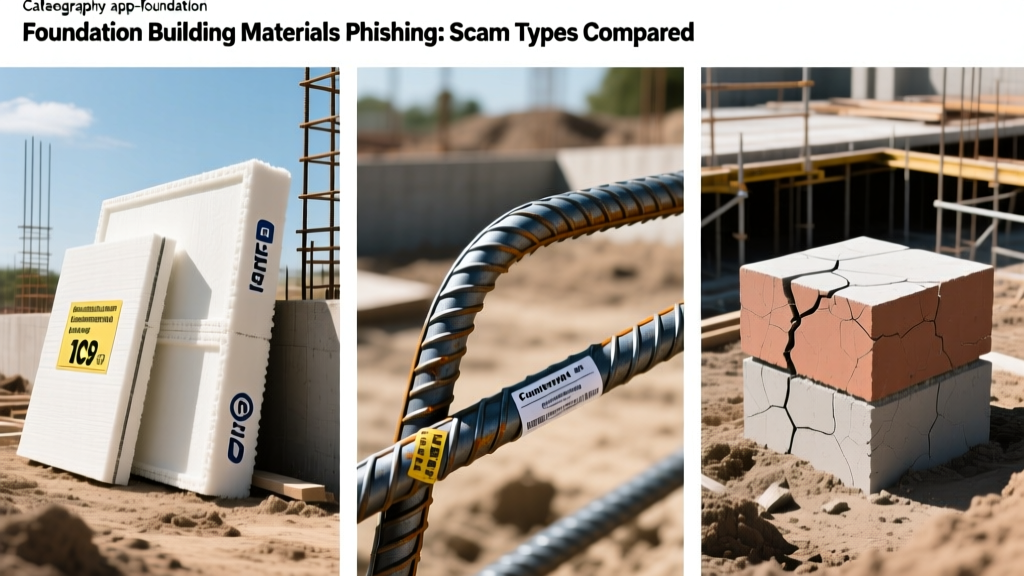
The Rise of Procurement Fraud in Foundation Contracting
When commercial foundation contractors procure materials for large-scale mat slabs, deep pile systems, or insulated concrete form (ICF) builds, a single purchase order can easily exceed $250,000. Cybercriminals have recognized this high-value vulnerability. The term foundation building materials phishing refers to a specialized subset of Business Email Compromise (BEC) and procurement fraud targeting the construction supply chain. Rather than stealing consumer credit cards, attackers intercept wire transfers meant for rebar fabricators, ready-mix plants, and helical pier manufacturers.
To protect your firm's capital, you must understand the distinct mechanics of these attacks. Below, we compare the three primary phishing vectors currently targeting foundation material procurement departments.
Type Comparison: Phishing Attacks Targeting Foundation Orders
Not all phishing attempts look the same. Attackers tailor their approach based on the specific foundation material being ordered and the typical workflow of the contractor's accounts payable (AP) team.
| Attack Vector | Targeted Materials | Primary Red Flag | Avg. Financial Impact |
|---|---|---|---|
| Domain Spoofing | ICF Blocks (e.g., NUDURA, Fox Blocks), Post-Tension Cables | Slight URL variations (e.g., @foxblocks-orders.com) | $80,000 - $150,000 |
| Invoice Modification | Ready-Mix Concrete, Aggregate Base, Steel Rebar | Last-minute ACH routing number changes via email | $120,000 - $400,000+ |
| Portal Harvesting | Helical Piles, Micropiles, Drilled Shaft Casings | Fake login screens mimicking BlueBook or BuildingConnected | Data breach / Extortion |
1. Domain Spoofing (The Lookalike Vendor)
Domain spoofing is the most common entry point for foundation building materials phishing. Attackers register a domain that visually mimics a major foundation supplier. If your firm regularly orders insulated concrete forms, an attacker might register insulatingconcreteforms-supply.com or nudura-direct.com.
The attacker initiates contact by sending a highly accurate, unsolicited quote for an upcoming project they found via public building permits. Because the pricing is often 5% to 8% below market rate—a deliberate tactic to entice procurement managers—the contractor awards the PO. The materials never arrive, and the wire transfer is sent to an offshore mule account.
2. Invoice Modification (The ACH Swap)
This is the most financially devastating attack. Instead of faking a vendor, the attacker compromises the actual email account of a regional rebar fabricator or ready-mix dispatcher. They silently monitor the inbox for weeks, waiting for a massive foundation pour invoice to be generated.
Moments before the invoice is sent to your AP department, the attacker intercepts it, alters the PDF to replace the legitimate bank routing and account numbers with their own, and releases the email. Because the email comes from the trusted vendor's actual address, and the material pricing matches the original estimate, AP processes the wire. The Cybersecurity and Infrastructure Security Agency (CISA) emphasizes that invoice modification accounts for the vast majority of construction BEC losses.
3. Bidding Portal Credential Harvesting
Foundation subcontractors frequently use platforms like BuildingConnected, Procore, or The Blue Book to bid on deep foundation and shoring packages. Attackers send phishing emails disguised as 'Action Required: New Bid Invitation for Downtown High-Rise Mat Slab.' The link directs the estimator to a pixel-perfect clone of the bidding portal. Once the estimator enters their credentials, the attacker gains access to the contractor's entire bid pipeline, allowing them to submit fraudulent change orders or intercept future material procurement communications.
Anatomy of a Spoofed Foundation Material Invoice
Identifying a fraudulent invoice requires looking beyond the logo and the material line items. Attackers use psychological triggers specific to construction timelines to force rushed payments.
- The 'Hold at Plant' Threat: The email will often state, 'Due to current steel mill shortages, your #8 and #11 rebar bundle will be released to another buyer if payment is not received by 3:00 PM EST.' This artificial urgency bypasses standard AP verification protocols.
- The 'New Remittance' Attachment: Look for updated W-9 forms or 'Vendor Banking Update' PDFs attached to the email. Legitimate foundation suppliers rarely change their primary corporate banking institutions mid-project without a formal, multi-channel notification process.
- Generic Sign-offs: While the email thread may contain historical names, the final invoice delivery might be signed by a generic 'Accounts Receivable Team' or a newly introduced dispatcher name that cannot be verified on LinkedIn or the company directory.
The 2026 Verification Framework: Securing Your Supply Chain
Because AI voice cloning can now mimic a trusted supplier's dispatcher over the phone, the traditional 'call the number on the invoice' rule is obsolete. Foundation contractors must implement Out-of-Band (OOB) Authentication combined with secondary verification channels.
Step 1: Establish the 'Known-Good' Directory
Before a project breaks ground, your procurement team must build a secure directory of primary contacts for your concrete, steel, and geotechnical material suppliers. This directory must include phone numbers sourced directly from the vendor's official, verified website—not from email signatures or invoices.
Step 2: Implement the 'Dual-Key' Wire Release
For any foundation material order exceeding $25,000 (which covers most commercial micropile, helical pier, and post-tensioning orders), require a dual-key approval. The project manager must verify the material delivery schedule, while the AP manager must independently verify the banking details via a video call or a secure vendor portal.
Step 3: Utilize Cryptographic Vendor Portals
By 2026, leading construction financial management associations strongly recommend migrating away from PDF invoices sent via email. Instead, require your foundation material suppliers to submit invoices through encrypted, SSO-protected procurement portals (such as Procore's ERP integrations or Textura). These platforms eliminate the email interception vector entirely.
FAQ: Foundation Material Procurement Security
What should I do if I suspect a wire transfer for foundation materials was sent to a phishing scammer?
Time is the most critical factor. Immediately contact your bank's wire fraud department to request a SWIFT recall. You must do this within 24 to 48 hours to have any chance of freezing the funds at the receiving mule bank. Simultaneously, file a complaint with the FBI's IC3 Recovery Asset Team (RAT), which specializes in freezing fraudulent domestic and international wire transfers.
Are smaller residential foundation contractors targeted by these phishing scams?
Yes. While commercial mat slabs and deep foundation systems offer larger payouts, attackers frequently target residential foundation contractors ordering $15,000 to $40,000 in standard rebar and concrete pump services. The volume of residential transactions makes it easier for attackers to slip smaller, fraudulent invoices past overwhelmed AP staff.
How can I verify if a new foundation material supplier is legitimate?
Beyond checking their contractor's license and insurance certificates, verify their physical yard location via satellite imagery, request a video tour of their rebar bending facility or ICF warehouse, and check their standing with the American Concrete Institute (ACI) or the Deep Foundations Institute (DFI). Legitimate suppliers will easily accommodate these verification requests.
Written by
David NakamuraDavid Nakamura is a licensed architect (AIA) and construction technology writer focused on sustainable building methods, mass timber engineering, and high-performance building envelopes. He holds a Master of Architecture from the University of Washington and is a certified Passive House Consultant (CPHC). David spent eight years at the Seattle firm Mithun, where he led the design of three LEED Platinum projects, before founding his own practice specializing in net-zero residential design. He serves on the editorial advisory board of GreenBuilder Magazine and has authored peer-reviewed papers on cross-laminated timber (CLT) connections for the Journal of Structural Engineering. In his spare time, David teaches woodworking at Pratt Fine Arts Center and kayaks the Puget Sound.
More from David Nakamura
View all
Construction Cost
Labor Cost to Build a Deck Per Sq Ft: 2026 Installation Guide
Discover the exact labor cost to build a deck per sq ft in 2026. This installation guide breaks down contractor rates, complexity factors, and hidden fees.
Aug 4, 2026

Construction Cost
How Much Does It Cost to Build a 3 Bedroom House? Financing Guide
Learn exactly how much it costs to build a 3 bedroom house and explore 2026 financing options, construction loan types, and budget frameworks for your build.
Aug 4, 2026

Construction Cost
Cost to Build a Tennis Court: 2026 Guide
How much does it cost to build a tennis court in 2026? Breakdowns for asphalt, concrete, and synthetic surfaces plus fencing and lighting.
Jul 30, 2026