Epoxy Foundation Crack Repair Cost: 2026 Structural Analysis
Analyze epoxy foundation crack repair cost through a structural lens. Learn 2026 pricing, load-bearing implications, and when injection fails.
The Structural Reality of Epoxy Crack Injection
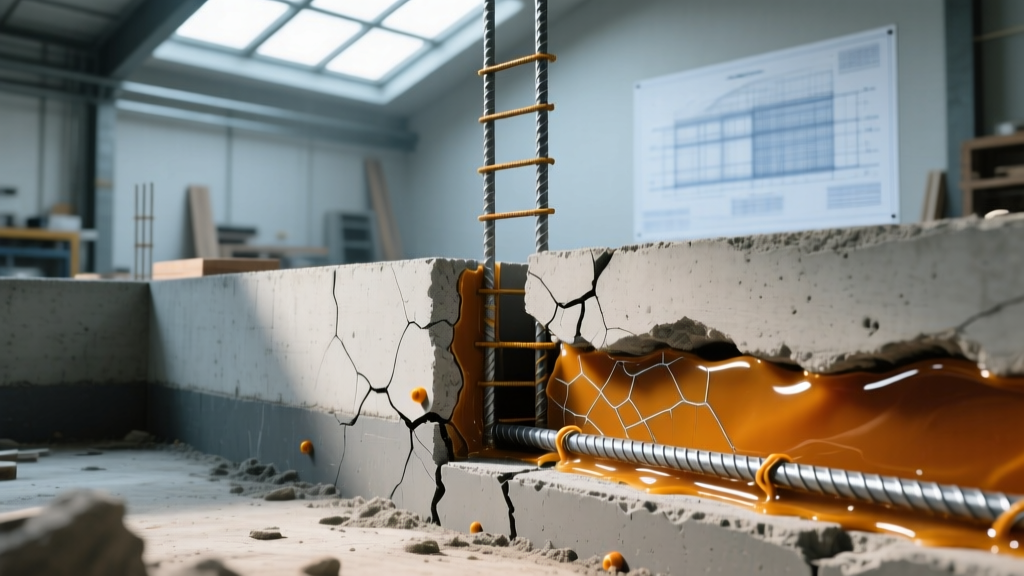
Evaluating the true epoxy foundation crack repair cost requires distinguishing between cosmetic sealing and structural restoration. From a structural engineering perspective, epoxy injection is not merely a waterproofing measure; it is a method of restoring the monolithic integrity of a fractured concrete matrix. When a foundation wall cracks, its ability to transfer lateral earth loads and vertical dead loads is compromised. Epoxy, when correctly specified and injected, achieves a bond strength that often exceeds the tensile strength of the surrounding concrete (typically 2,500 to 4,000 psi).
However, the financial investment varies drastically based on the crack's morphology, moisture content, and structural role. A standard handyman might quote a flat rate per linear foot to pump low-grade resin into a damp crack, resulting in imminent failure. A structural retrofit using ASTM C881-compliant, moisture-tolerant epoxy requires precise port spacing, pressure regulation, and surface preparation, fundamentally altering the project's economics. Understanding the 2026 pricing landscape requires dissecting the material science and labor protocols that dictate long-term structural viability.
2026 Epoxy Foundation Crack Repair Cost Breakdown
The epoxy foundation crack repair cost is rarely a single flat fee. It scales based on the viscosity of the resin required, the depth of the foundation wall, and the necessity of moisture-tolerant chemical formulations. Below is a structural cost matrix for residential and light-commercial foundation retrofits.
| Repair Scope & Crack Profile | Material Specification | Labor & Method | Average Cost (2026) |
|---|---|---|---|
| Hairline (<0.005 in.) / Dormant | Ultra-Low Viscosity (ASTM C881 Grade 1) | High-pressure micro-injection, tight port spacing (4-6 in.) | $65 - $95 / linear ft. |
| Standard (0.005 - 0.030 in.) / Dry | Standard Structural Epoxy (e.g., SikaDur 35 LV) | Standard surface seal, 8-12 in. port spacing, 20-40 psi | $45 - $70 / linear ft. |
| Standard / Damp or Weeping | Moisture-Tolerant Epoxy (e.g., SikaDur 35 Hi-Mod LV) | Surface drying, moisture-tolerant paste seal, standard injection | $75 - $110 / linear ft. |
| Wide (>0.030 in.) / Structural Shear | High-Modulus Epoxy + Carbon Fiber Stitching | Routing, structural stitching, gravity/pressure hybrid fill | $120 - $180 / linear ft. |
| Structural Engineering Assessment | N/A | Crack mapping, load analysis, repair specification | $450 - $850 flat fee |
Material Specifications & The Cost of Compliance
Cheap epoxy kits found in retail stores typically utilize unmodified bisphenol-A resins with high viscosity, preventing deep penetration into the capillary network of a concrete crack. Professional structural repairs rely on formulations that meet American Concrete Institute (ACI) Committee 224 guidelines for cracking. Specifically, structural epoxies must meet ASTM C881 Type I (for use above and below grade), Grade 1 (low viscosity), and Class B or C (bonding agent). A 1.5-gallon kit of professional-grade, moisture-tolerant structural epoxy costs between $140 and $190 in 2026, compared to $35 for a non-structural polyurethane foam kit. This material premium is non-negotiable for load-bearing walls.
Structural Triage: When Epoxy is the Wrong Choice
A critical component of cost analysis is recognizing when epoxy injection is structurally contraindicated. Epoxy cures to a rigid, high-modulus solid. It restores structural continuity but possesses zero elasticity. If the underlying geotechnical issue causing the crack remains unresolved, the foundation will continue to move, and the concrete will simply crack adjacent to the epoxy repair.
Structural Engineer's Decision Matrix: Epoxy vs. Polyurethane
- Active Differential Settlement: Do NOT use epoxy. The wall is still moving. Use flexible polyurethane for water sealing and address the subgrade with helical piers or underpinning first.
- Hydrostatic Pressure (Weeping Cracks): Standard epoxy will fail to bond to wet concrete matrices. If structural restoration is required, use a moisture-tolerant epoxy. If only water-stopping is needed, use hydrophilic polyurethane.
- Thermal Expansion/Contraction Joints: Do NOT use epoxy. Rigid bonding will cause spalling. Use elastomeric sealants.
- Dormant Shrinkage Cracks: IDEAL for epoxy. The concrete has finished its initial curing shrinkage, and the epoxy will permanently restore the structural cross-section.
For a comprehensive understanding of how different crack patterns indicate specific structural failures, the InterNACHI Foundation Crack Guide provides excellent visual diagnostics for inspectors and engineers to correlate crack orientation (vertical, diagonal, horizontal) with their root causes.
The Injection Protocol: Engineering vs. Handyman Approaches
The labor component of the epoxy foundation crack repair cost is driven by the rigor of the injection protocol. A structural repair is not simply 'filling a hole.' It requires a systematic approach to ensure the resin reaches the back of the wall (the soil-facing side), not just the interior surface.
- Crack Mapping and Routing: The crack is cleaned using a wire brush and compressed air. For cracks wider than 0.015 inches, a mechanical router is used to create a shallow 'V' groove (typically 1/4 inch deep by 1/4 inch wide) to facilitate the surface seal.
- Port Placement: Injection ports are adhered to the crack. The structural rule of thumb is that port spacing should equal the thickness of the wall or the depth of the crack. For an 8-inch thick basement wall, ports are spaced 8 inches apart. Incorrect spacing leads to voids and incomplete structural bonding.
- Surface Sealing: A high-viscosity epoxy paste is applied over the crack and the base of the ports. This creates a pressure vessel. If the paste fails during injection, the resin blows out onto the basement floor, resulting in a loss of hydrostatic pressure and an incomplete fill.
- Pressure Injection: Using a calibrated dual-cartridge gun or a mechanical pump, the low-viscosity epoxy is injected starting from the lowest port. Injection pressure must be strictly maintained between 20 and 40 psi. Exceeding 50 psi can induce secondary micro-cracking in the surrounding concrete matrix due to localized hydraulic pressure.
- Sequential Valving: As epoxy emerges from the port directly above the injection point, the lower port is capped, and the gun is moved up. This ensures the crack is filled from bottom to top, pushing air out ahead of the resin.

Long-Term Structural Performance & Failure Modes
When calculating the lifetime value of the repair, one must consider the failure modes of epoxy in below-grade environments. The International Concrete Repair Institute (ICRI) outlines several mechanisms that can compromise an epoxy injection if not properly specified.
Modulus Mismatch and Creep
Concrete has a modulus of elasticity ranging from 3 to 5 million psi. Structural epoxies can range from 400,000 to over 1.5 million psi. If a low-modulus epoxy is used in a high-load shear wall, the resin may exhibit 'creep' (slow deformation under sustained load) over decades, transferring stress back to the concrete edges and causing spalling. Specifying a high-modulus epoxy (like Sika SikaDur 32 Hi-Mod) costs approximately 15% more upfront but eliminates long-term creep deformation in load-bearing scenarios.
Alkaline Degradation
Concrete is highly alkaline (pH 12-13). Standard epoxies can undergo saponification (chemical breakdown) when exposed to high alkalinity in the presence of moisture. If a foundation crack is subject to continuous capillary moisture draw, a standard epoxy will eventually turn into a soft, gel-like substance, losing all structural bond. This is why moisture-tolerant, alkali-resistant novolac or modified bisphenol-A epoxies are mandatory for below-grade structural repairs, directly influencing the material cost tier.
Summary: Investing in Structural Certainty
The epoxy foundation crack repair cost is a direct reflection of the chemical and mechanical rigor applied to the project. A $50 per linear foot repair using standard resins on a damp, active crack is a sunk cost that will fail within 24 months. A $95 per linear foot structural retrofit utilizing moisture-tolerant, ASTM C881-compliant resins, injected at precise pressures into a dormant shrinkage crack, restores the monolithic integrity of the foundation for the lifespan of the structure. Always pair the injection process with a geotechnical evaluation to ensure the soil-structure interaction is stable, guaranteeing that your financial investment yields permanent structural results.
Written by
David NakamuraDavid Nakamura is a licensed architect (AIA) and construction technology writer focused on sustainable building methods, mass timber engineering, and high-performance building envelopes. He holds a Master of Architecture from the University of Washington and is a certified Passive House Consultant (CPHC). David spent eight years at the Seattle firm Mithun, where he led the design of three LEED Platinum projects, before founding his own practice specializing in net-zero residential design. He serves on the editorial advisory board of GreenBuilder Magazine and has authored peer-reviewed papers on cross-laminated timber (CLT) connections for the Journal of Structural Engineering. In his spare time, David teaches woodworking at Pratt Fine Arts Center and kayaks the Puget Sound.
More from David Nakamura
View all
Construction Cost
Labor Cost to Build a Deck Per Sq Ft: 2026 Installation Guide
Discover the exact labor cost to build a deck per sq ft in 2026. This installation guide breaks down contractor rates, complexity factors, and hidden fees.
Aug 4, 2026

Construction Cost
How Much Does It Cost to Build a 3 Bedroom House? Financing Guide
Learn exactly how much it costs to build a 3 bedroom house and explore 2026 financing options, construction loan types, and budget frameworks for your build.
Aug 4, 2026

Construction Cost
Cost to Build a Tennis Court: 2026 Guide
How much does it cost to build a tennis court in 2026? Breakdowns for asphalt, concrete, and synthetic surfaces plus fencing and lighting.
Jul 30, 2026