Foundation Repair Average Cost: 2026 Pricing Guide
Discover the true foundation repair average cost in 2026. Compare pricing for piers, polyurethane foam, carbon fiber, and hidden variables that impact quotes.

The Real Numbers Behind Foundation Repair Average Cost
Searching for the foundation repair average cost often yields a single, misleading number—typically cited around $5,000 to $8,000. In reality, this average is statistically useless because it lumps together a $400 epoxy crack injection with a $35,000 structural piering job. To budget accurately in 2026, you must evaluate costs based on the specific failure mode of your foundation and the engineered repair method required to stabilize it.
The final invoice is dictated by three primary factors: the structural system (slab-on-grade, crawl space, or full basement), the geotechnical profile of your soil, and the extent of differential settlement. According to industry data aggregated by Angi, minor settling repairs start as low as $1,500, while severe structural stabilization involving deep foundation underpinning routinely exceeds $25,000.
2026 National Cost Snapshot
- Minor Crack Repair (Epoxy/Polyurethane): $300 – $900
- Slabjacking / Foam Lifting: $1,500 – $4,500
- Basement Wall Stabilization (Carbon Fiber): $4,000 – $8,000
- Deep Foundation Underpinning (Piers): $12,000 – $35,000+
Cost Breakdown by Repair Method
Foundation repair is not a one-size-fits-all industry. Contractors utilize distinct technologies depending on whether the issue is a sinking concrete slab, a bowing basement wall, or a settling perimeter footer. Here is the technical and financial breakdown of the primary repair methods used in 2026.
Slabjacking and Polyurethane Foam Lifting
When a concrete slab foundation sinks due to poorly compacted fill soil or erosion, lifting it back to grade is the standard protocol. While traditional mudjacking uses a cementitious slurry weighing over 100 lbs per cubic foot, modern foundation engineers prefer high-density polyurethane foam.
Closed-cell polyurethane foam (typically 3.0 to 4.0 lbs/cu ft density) is injected through 5/8-inch holes drilled into the slab. The foam expands rapidly, compacting loose soils and lifting the concrete with pinpoint precision. Crucially, it cures in 15 minutes, is entirely hydro-insensitive (it will not wash away during heavy rains), and adds negligible weight to the underlying soil. Expect to pay between $15 and $25 per square foot, or $150 to $250 per injection pier. A standard 200-square-foot sunken driveway or patio section will cost between $3,000 and $5,000.
Steel Push Piers and Helical Piers
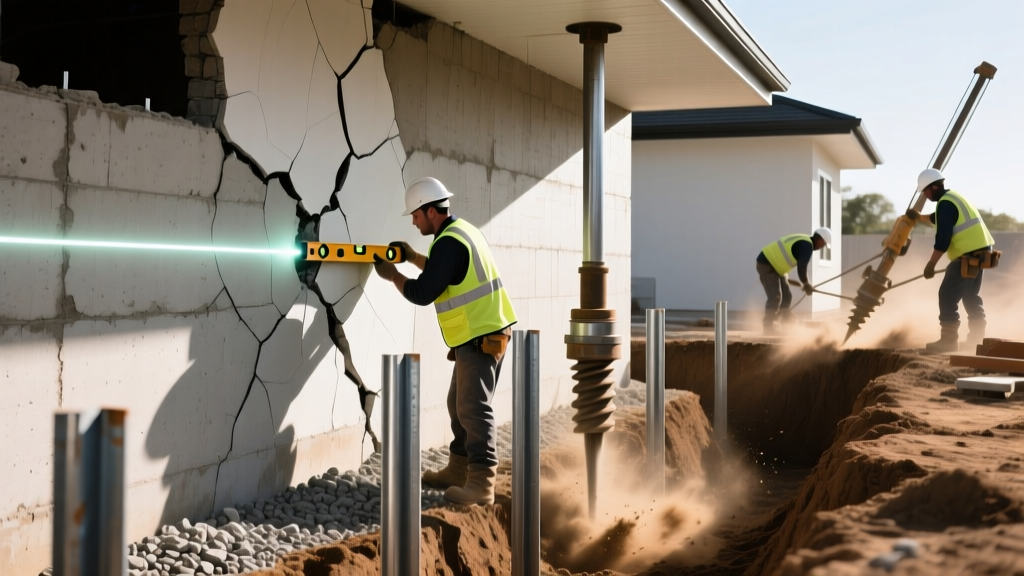
If your home's perimeter footer is sinking due to expansive clay or shifting load-bearing strata, surface-level repairs will fail. You must bypass the active soil zone and transfer the structural load to stable bedrock or a highly compacted soil layer. This requires underpinning via steel piers.
- Steel Push Piers: These are hydraulically driven through the soil using the actual weight of the house as resistance. They are installed until they reach 'refusal' (bedrock) or a specified load-bearing capacity (e.g., 10,000 PSI). Cost: $1,800 to $2,800 per pier.
- Helical Piers: These feature helical bearing plates (like giant screws) and are mechanically torqued into the ground. They are ideal for lighter structures, new construction, or situations where the house cannot provide enough downward weight to drive push piers. Cost: $1,500 to $2,200 per pier.
A typical residential underpinning project requires 8 to 15 piers, placing the total foundation repair average cost for structural settlement between $14,400 and $35,000.
Carbon Fiber Straps and Earth Anchors
Basement walls subjected to lateral hydrostatic pressure often bow inward and develop horizontal or stair-step cracking. Carbon fiber straps, boasting a tensile strength up to 10 times greater than steel, are epoxy-bonded directly to the concrete to halt further movement. At $800 to $1,200 per strap, a 40-foot wall requiring straps every 4 feet will cost roughly $8,000 to $12,000.
Critical Engineering Caveat: Carbon fiber only stabilizes static walls. If your wall has already bowed inward more than 2 inches, carbon fiber cannot pull it back. For deflection exceeding 2 inches, you must use helical tieback anchors or steel channel braces, which cost $500 to $900 per anchor point and require exterior excavation.
Method Comparison Matrix
| Repair Method | Best Application | 2026 Unit Cost | Expected Lifespan |
|---|---|---|---|
| Epoxy Injection | Dry, non-moving structural cracks | $300 - $800 per crack | Permanent (if soil is stable) |
| Polyurethane Foam | Sinking slabs, void filling | $15 - $25 per sq. ft. | 50+ years (hydro-insensitive) |
| Steel Push Piers | Heavy structural settlement (footers) | $1,800 - $2,800 per pier | 100+ years (galvanized steel) |
| Carbon Fiber Straps | Bowing basement walls (<2" deflection) | $800 - $1,200 per strap | Permanent (tensile stabilization) |
| Helical Tiebacks | Severe wall bowing (>2" deflection) | $500 - $900 per anchor | 75+ years |
Hidden Variables That Spike Your Final Invoice
The foundation repair average cost is highly sensitive to site-specific variables. When evaluating contractor bids, look for how they account for the following multipliers:
- Soil Plasticity Index (PI): As noted by Colorado State University Extension, soils with a PI greater than 25 are highly expansive. These soils require deeper pier installations to reach below the active moisture zone, increasing steel material costs by 15% to 30%.
- Access and Excavation Constraints: If a contractor must hand-dig through a concrete patio, remove HVAC units, or navigate narrow side-yards to reach the footer, labor costs will surge. Machine excavation is vastly cheaper than manual labor.
- Interior Finishes: Repairing a slab under a finished hardwood floor or lifting a basement floor covered in expensive tile requires demolition and replacement, which is rarely included in the base structural repair quote.
- Drainage Corrections: Stabilizing a foundation without fixing the water intrusion that caused the soil failure is a wasted investment. Expect to add $2,000 to $6,000 for exterior French drains, gutter extensions, and regrading.
Decision Framework: Patch vs. Stabilize
Use this diagnostic flow to determine the likely scope of your repair before calling a structural engineer:
IF you see vertical cracks less than 1/8-inch wide in a poured concrete wall, and they are dry...
THEN the concrete simply shrank during the curing process. Use a polyurethane or epoxy injection kit. Estimated Cost: Under $500.
IF your concrete driveway or patio has sunk 1 to 3 inches, creating a trip hazard or pooling water...
THEN the subgrade has washed out or compacted. Require high-density polyurethane foam jacking. Avoid mudjacking, which adds excessive weight to already weak soil. Estimated Cost: $2,000 - $4,500.
IF you see exterior stair-step cracking in brick masonry, interior drywall cracks radiating from door frames, and doors that stick...
THEN your perimeter footer is experiencing differential settlement. Surface patches will tear open again within months. You require a geotechnical evaluation and likely steel underpinning piers. Estimated Cost: $15,000 - $30,000+.
Insurance and Financing Realities
Homeowners insurance almost universally excludes foundation repair caused by soil settlement, expansive clay, or poor original construction. Insurance will only cover foundation damage if it is the direct result of a covered peril, such as a sudden plumbing leak beneath the slab or a vehicle striking the home. For comprehensive details on what policies cover, refer to the Bob Vila foundation repair guide, which outlines the strict boundaries of residential insurance claims.
Because the foundation repair average cost for major structural work frequently exceeds $15,000, most reputable contractors partner with specialized lending institutions. Look for contractors offering unsecured home improvement loans with terms ranging from 5 to 15 years. Always demand a transferable, lifetime warranty on any steel pier or helical anchor installation. If the contractor goes out of business, a third-party backed warranty ensures the structural integrity of your home remains protected.
Written by
Priya KapoorPriya Kapoor is a real estate market analyst and construction economics researcher with expertise in housing affordability, development feasibility, and infrastructure investment. She holds a Master of Regional Planning from Cornell University and previously worked as a senior analyst at CBRE's Investment Properties group, where she modeled returns for $4B in mixed-use development pipelines. Priya now runs an independent research practice advising developers, municipalities, and REITs on construction cost forecasting and market timing. She publishes the quarterly "BuildMat Market Pulse" report tracking material price indices across 12 commodity categories. Based in Austin, TX, Priya serves on the board of Habitat for Humanity Austin and is a marathon runner.
More from Priya Kapoor
View all
Construction Cost
Cost to Build a 1600 Sq Ft Home in 2026: Full Breakdown
Accurate 2026 cost to build a 1600 sq ft home—material, labor, and regional pricing breakdowns included. Plan your budget with real-time estimates.
Aug 11, 2026

Wood & Lumber
Name the Types of Wood for Pressure Treatment and Preservation
Learn how to name the types of wood best suited for pressure treatment. Compare species treatability, chemical retention levels, and 2026 preservation costs.
Aug 4, 2026

Stone & Masonry
Stone Veneer Suppliers Lindenhurst: 2026 Cost Analysis
Analyze 2026 stone veneer costs in Lindenhurst, NY. Compare local supplier pricing, delivery fees, and Suffolk County installation labor rates.
Aug 4, 2026