Slab Foundation Repair Services Cost: Method Comparison Guide
Compare slab foundation repair services cost by method. Discover 2026 pricing for mudjacking, piering, and polyurethane foam to fix your settling slab.

The True Cost of Slab Foundation Repair: Why Methods Matter
When evaluating the slab foundation repair services cost for a settling or cracked concrete slab, homeowners and property managers frequently encounter a massive variance in contractor quotes. This discrepancy rarely stems from price gouging; rather, it reflects fundamentally different engineering approaches to the underlying soil failure. A $4,000 mudjacking estimate and a $35,000 steel push pier proposal are not competing solutions for the same problem—they address entirely different structural failure modes.
To make an informed capital allocation, you must first distinguish between uniform settlement (the entire slab sinking due to subgrade voids) and differential settlement (one section of the slab sinking faster than another, inducing shear stress and structural rotation). The former requires void-filling and slab-lifting; the latter requires deep load-transfer to stable strata. Below is a comprehensive technical and financial comparison of the primary repair methodologies available in 2026.
Comparative Analysis: Slab Foundation Repair Services Cost by Method
The following matrix outlines the baseline pricing, material specifications, and optimal use cases for the four dominant slab repair techniques. Note that regional labor rates and soil conditions (e.g., expansive clays vs. loose fill) will shift these ranges by 15% to 30%.
| Repair Method | Best Application | Average Cost Range | Material Weight / Specs | Expected Lifespan |
|---|---|---|---|---|
| Polyurethane Foam Jacking | Voids, uniform settlement, interior floors | $5 - $25 per sq. ft. | 2-4 lbs/cu ft (Closed-cell) | 20+ Years |
| Cementitious Mudjacking | Exterior flatwork, driveways, sidewalks | $3 - $8 per sq. ft. | 100-120 lbs/cu ft (Slurry) | 5 - 10 Years |
| Steel Push Piers | Heavy structural differential settlement | $1,500 - $3,000 per pier | 2.875" OD Steel Pipe | Lifetime (75+ Years) |
| Helical Piers | Lightweight structures, high water tables | $1,800 - $3,500 per pier | 1.5" to 2.5" Square Shaft | Lifetime (75+ Years) |
Deep Dive: Method-by-Method Performance and Pricing
1. Polyurethane Foam Jacking (Polyjacking)
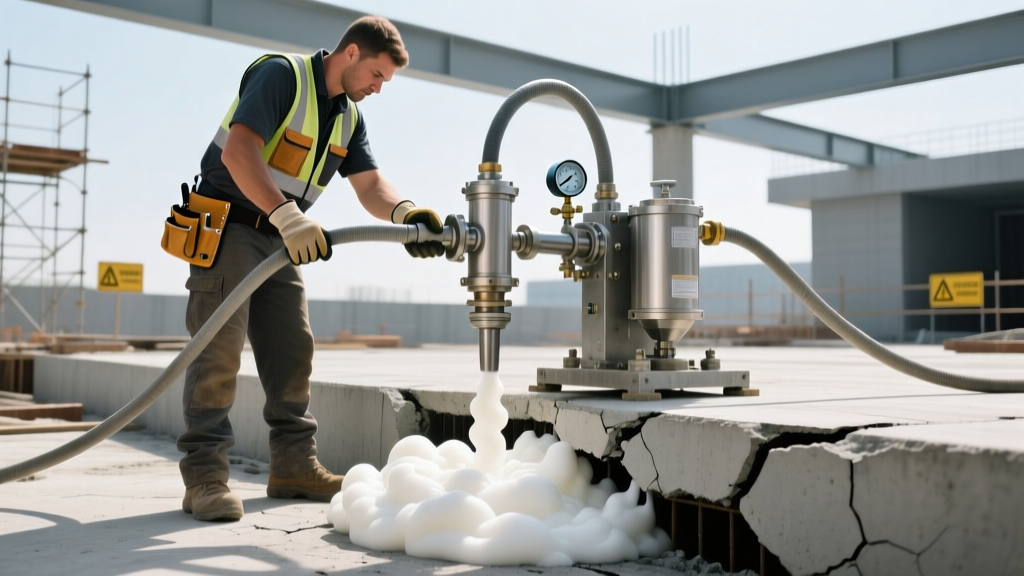
Polyjacking utilizes a two-part, high-density, closed-cell polyurethane resin injected through 5/8-inch drill holes. Upon mixing beneath the slab, the chemical reaction causes the foam to expand 20 to 30 times its liquid volume, generating up to 6,000 pounds per square foot (PSF) of lifting pressure.
- The Cost Reality: While the per-square-foot cost ($5-$25) appears higher than mudjacking, polyjacking requires significantly less material due to its expansion ratio. A 100-square-foot sunken living room floor typically costs between $1,200 and $2,500 fully installed.
- Structural Advantage: The cured foam is impervious to water and will not wash out or degrade in high-moisture environments. Its negligible weight (approx. 3 lbs/cu ft) adds virtually zero dead load to the compromised subgrade.
- Limitations: Polyjacking cannot bypass deep, unstable soil layers. If the slab is failing because the top 15 feet of soil are expansive clay, foam will only lift the slab temporarily before the clay shrinks again during drought cycles.
2. Traditional Mudjacking (Slabjacking)
Mudjacking pumps a slurry of topsoil, sand, water, and Portland cement through 1.5-inch to 2-inch holes drilled into the concrete. Hydraulic pressure lifts the slab, and the slurry hardens to form a new sub-base.
- The Cost Reality: At $3 to $8 per square foot, this is the most economical choice for large, non-critical exterior slabs like municipal sidewalks or warehouse aprons.
- Structural Advantage: Excellent for filling massive, deep subgrade voids (such as washed-out culverts) where polyurethane foam would be cost-prohibitive due to the sheer volume required.
- Limitations: The slurry weighs over 100 lbs per cubic foot. Injecting thousands of pounds of heavy mud onto an already failing soil matrix often accelerates secondary settlement. Furthermore, the material is water-soluble; if the drainage issue that caused the void isn't fixed, the mudjack material will wash away within a few years.
3. Steel Push Piers and Helical Piers (Deep Underpinning)
When a slab-on-grade foundation experiences severe differential settlement—evidenced by stair-step cracking in exterior masonry, binding doors, and drywall tears—surface lifting is insufficient. Underpinning transfers the structural load past the active soil zone to load-bearing strata or bedrock.
- The Cost Reality: Pricing is calculated per pier, not per square foot. A standard residential slab foundation requiring 15 push piers spaced 6 feet apart along the failing perimeter will cost between $22,500 and $45,000. This includes excavation, bracket installation, hydraulic driving, and slab lifting.
- Structural Advantage: This is the only permanent solution for structural failure caused by deep soil consolidation or expansive clay shrinkage. High-strength steel piers (typically yielding 50,000 PSI) provide a verified load-bearing capacity far exceeding residential dead and live loads.
Decision Matrix: Matching the Failure to the Fix
Do not allow a contractor to dictate the repair method before diagnosing the specific failure mode. Use this diagnostic framework to align your symptoms with the correct engineering solution:
Symptom: Isolated Sunken Slab
Condition: A single section of a driveway or garage floor has dropped 1-3 inches, but the structural perimeter walls remain level.
Prescription: Polyurethane Foam Jacking.
Symptom: Perimeter Rotation
Condition: Exterior walls are leaning, interior doors are binding, and slab cracks are wider than 1/4 inch with vertical displacement.
Prescription: Steel Push Piers (Underpinning).
Symptom: Shrinkage Cracking
Condition: Hairline cracks (less than 1/16 inch) that do not exhibit vertical displacement, common in slabs poured within the last 3 years.
Prescription: Epoxy or Polyurethane Crack Injection ($500 - $1,200 total).
Symptom: Voids Under Flatwork
Condition: Hollow sound when tapping concrete; soil erosion visible at the slab edge due to poor gutter drainage.
Prescription: Cementitious Mudjacking (if budget is primary concern) or Polyjacking (if longevity is required).
Hidden Variables That Inflate Slab Foundation Repair Services Cost
The per-square-foot or per-pier metrics rarely represent the final invoice. When budgeting for slab foundation repair, you must account for the following ancillary costs that frequently blindside property owners:
- Independent Structural Engineering Report ($600 - $1,500): Never rely solely on a foundation repair contractor's "free inspection." Contractors are incentivized to sell their proprietary repair systems. An independent, licensed structural engineer will perform a floor elevation survey and soil analysis to prescribe the exact number and depth of piers required, preventing over-selling.
- Interior Demolition and Restoration ($2,000 - $8,000+): If interior push piers are required, the contractor must jackhammer through your finished flooring and concrete slab to access the grade beam. The repair quote almost never includes replacing the destroyed tile, hardwood, or drywall.
- Plumbing and Utility Relocation ($1,500 - $5,000): Slab foundations encapsulate primary sewer lines and water mains. Lifting a slab can shear cast-iron or PVC plumbing joints. A pre-repair hydrostatic plumbing test and subsequent trenchless pipe relining may be mandatory.
- Root Pruning and Landscaping ($500 - $2,500): Exterior underpinning requires a 3-foot trench along the foundation perimeter. Mature trees and shrubs will likely need aggressive root pruning or total removal to access the grade beam.
Expert Insights: Soil Mechanics and Long-Term Maintenance
Repairing the slab without addressing the soil moisture equilibrium is a guaranteed path to secondary failure. According to research on expansive soils from Colorado State University Extension, soils with high clay content (such as montmorillonite) can exert upward swelling pressures exceeding 15,000 PSF when hydrated, and shrink drastically during droughts. This cyclic heaving and shrinking is the primary enemy of slab-on-grade foundations.
Ultimately, the true slab foundation repair services cost is defined not just by the initial invoice, but by the longevity of the intervention. Polyurethane and deep steel underpinning represent higher upfront capital expenditures but offer permanent stabilization, whereas mudjacking serves as a temporary, budget-conscious triage for non-structural flatwork. Always mandate an independent engineering specification before signing any repair contract.
Written by
Elena RodriguezElena Rodriguez is a civil engineer and technical writer specializing in concrete technology, masonry systems, and ASTM/ACI compliance. She earned her B.S. in Civil Engineering from Texas A&M University and spent a decade at a materials testing laboratory, performing over 2,000 concrete compressive strength tests and masonry prism evaluations. Elena is an ACI-certified Field Testing Technician (Grade I) and a member of ASTM Committee C12 on Natural Building Stone. She currently consults on forensic engineering cases involving concrete failures and moisture intrusion. Based in San Antonio, TX, Elena is a proud member of the Society of Women Engineers (SWE) and coaches her daughter's FIRST Robotics team.
More from Elena Rodriguez
View all
Walls & Panels
Cost Analysis: Light Gauge Steel Framing Advantages and Disadvantages
Evaluate light gauge steel framing advantages and disadvantages through a strict cost analysis lens, comparing material, labor, and lifecycle expenses.
Aug 4, 2026

Walls & Panels
Gypsum Board Types: Exact Specifications, Thickness & Dimensions
Compare standard, Type X, and moisture-resistant gypsum board types. Get exact specifications, thicknesses, dimensions, and ASTM standards for your project.
Aug 4, 2026

Fire Resistance
Best Fire-Resistant Outdoor Decking Materials: 2026 Buyer Guide
Discover the best fire-resistant outdoor decking materials for 2026. Compare Class A PVC, aluminum, and hardwood options for WUI compliance and safety.
Aug 4, 2026