How Much Does It Cost to Repair a Foundation? 2026 Price Guide
Discover exactly how much it costs to repair a foundation in 2026. Breakdowns for piering, polyjacking, carbon fiber, and hidden structural expenses.

The True Cost of Foundation Repair in 2026: Beyond the Surface Quote
When homeowners ask, "how much does it cost to repair foundation damage?", the answer is rarely a single flat rate. Foundation repair pricing is dictated by the failure mechanism, the soil profile, and the structural load of the building. In 2026, the national average for residential foundation stabilization ranges from $5,500 to $18,000, but severe structural underpinning on expansive clay soils frequently exceeds $35,000. According to structural engineering guidelines published by the American Society of Civil Engineers (ASCE), addressing the root cause of soil subsidence or hydrostatic pressure is mandatory; otherwise, cosmetic repairs will fail within 24 to 36 months.
Never sign a foundation repair contract without allocating a 20% contingency fund. Lifting a settled foundation shifts the entire structural envelope. This movement frequently causes secondary damage to HVAC ductwork, cast-iron plumbing stacks, and brick veneer ties. Budgeting for these secondary realignments from day one prevents project stall-outs.
Repair Method Cost Matrix: Matching the Symptom to the Solution
Contractors utilize distinct stabilization techniques depending on whether the issue is a sinking slab, a settling perimeter footing, or a bowing basement wall. The table below outlines the 2026 unit economics for primary repair methodologies.
| Foundation Symptom | Primary Repair Method | Unit Cost (2026) | Typical Project Total |
|---|---|---|---|
| Perimeter Footing Settlement | Steel Push Piers | $1,500 - $2,200 / pier | $12,000 - $25,000 |
| Light Structure / Deck Settlement | Helical Piers | $1,800 - $2,600 / pier | $8,000 - $18,000 |
| Sunken Interior/Exterior Slab | Polyurethane Jacking | $10 - $22 / sq. ft. | $2,500 - $6,500 |
| Bowing Basement Wall (< 2 inches) | Carbon Fiber Straps | $800 - $1,300 / strap | $4,000 - $9,000 |
| Active Structural Crack Leaks | High-Pressure Epoxy Injection | $500 - $900 / crack | $1,500 - $3,500 |
Deep Dive: Piering Systems for Structural Settlement
When a home's perimeter beam or continuous footing drops due to soil consolidation or drought-induced clay shrinkage, underpinning is required to transfer the structural load to stable bedrock or load-bearing strata.
Steel Push Piers vs. Helical Piers
Steel Push Piers are driven hydraulically into the ground using the actual weight of the structure as resistance. They are ideal for heavy, multi-story masonry buildings. A standard 2-7/8 inch outer diameter (OD) push pier system rated for 65,000 lbs typically requires 10 to 15 piers spaced 6 to 8 feet apart along a failing wall. The primary cost driver here is depth; if load-bearing strata is 40 feet down, the material cost for pier extensions significantly increases the per-pier price.
Helical Piers, featuring helical bearing plates welded to a central steel shaft, are mechanically screwed into the soil like a wood screw. Because they do not rely on the structure's weight for installation resistance, they are the mandatory choice for lighter structures (porches, chimneys, single-story additions) or new construction pre-stabilization. The installation requires heavy-duty hydraulic torque motors, and the contractor must monitor torque-to-capacity ratios (typically 10:1) to verify the load-bearing capacity in real-time, which adds to the labor premium.
Slab Jacking: Polyurethane vs. Cementitious Mudjacking
For non-structural slab-on-grade foundations (garage floors, patios, and interior slab sections) that have lost subgrade support, slab jacking fills the void and lifts the concrete. The industry has largely shifted away from traditional mudjacking toward high-density polyurethane.
- Traditional Mudjacking: Uses a slurry of topsoil, fly ash, and Portland cement. The cured density is roughly 100 to 120 lbs per cubic foot. This massive weight can exacerbate subgrade sinking over time. Installation requires drilling 1.5 to 2-inch holes, which are difficult to patch invisibly. Cost: $5 to $12 per square foot.
- Polyurethane Foam Jacking: Uses a two-part, closed-cell high-density polyurethane resin. The cured foam weighs only 2.5 to 4.0 lbs per cubic foot, adding negligible dead load to the subgrade. Injection requires only 5/8-inch ports, and the foam cures to 90% of its ultimate compressive strength within 15 minutes, allowing immediate foot traffic. Cost: $10 to $22 per square foot.
Neither polyjacking nor mudjacking will last if the underlying soil remains saturated. Before injecting any slab lifting material, ensure French drains or surface grading corrections are implemented. The Federal Emergency Management Agency (FEMA) strongly advises that managing surface water runoff is the most cost-effective method of preventing recurring slab settlement.
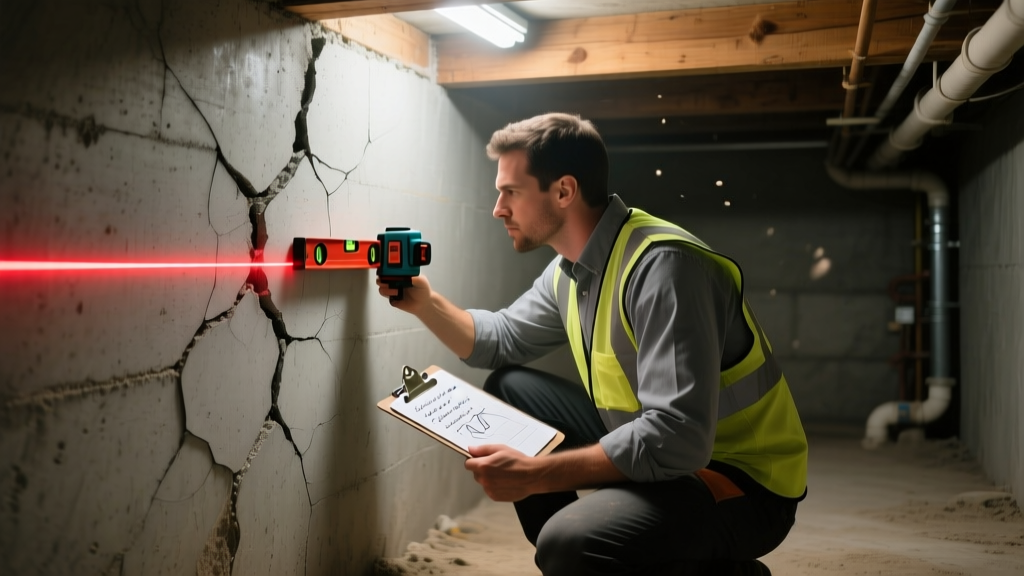
Bowing Walls and Shear Cracks: Carbon Fiber and Epoxy Solutions
Basement walls constructed of CMU (Concrete Masonry Units) or poured concrete frequently succumb to lateral hydrostatic pressure from saturated exterior soils, resulting in inward bowing or horizontal shear cracks.
Carbon Fiber Reinforcement: For walls bowing inward less than 2 inches, unidirectional carbon fiber sheets or Kevlar-reinforced grids are bonded to the interior surface using a 100% solids structural epoxy saturant. These systems boast an ultimate tensile strength exceeding 90,000 psi—roughly 10 times stronger than structural steel by weight. Straps are typically installed vertically every 48 inches on center. Crucially, the top of the carbon fiber strap must be anchored directly into the floor joist rim board, and the bottom must be anchored into the slab, transferring the lateral load to the home's structural framing.
Structural Epoxy Injection: For static (non-moving) cracks that compromise the wall's shear capacity, high-modulus epoxy injection restores the monolithic integrity of the concrete. Unlike flexible polyurethane foams used merely for water-stopping, structural epoxies cure to a compressive strength of 5,000 to 8,000 psi, effectively welding the concrete back together. Ports are drilled and anchored every 6 to 10 inches along the crack path, and the resin is injected at pressures up to 3,000 psi to ensure deep penetration.
The Pre-Repair Phase: Why You Need a Geotechnical Engineer
A common and expensive mistake is hiring a repair contractor to diagnose the issue without an independent third-party assessment. Foundation repair companies are incentivized to sell their proprietary piering systems, even if the issue could be resolved with simple drainage corrections.
Before signing a repair contract, invest $800 to $1,500 in an independent Geotechnical Engineer's Report. The engineer will perform soil borings (per ASTM D1586 standards) to determine the soil stratigraphy, identify the depth of bedrock, and measure the plasticity index (PI) of expansive clays. This data dictates exactly how many piers are needed and how deep they must be driven, preventing contractors from over-engineering the solution to inflate the invoice. According to building science research supported by the National Association of Home Builders (NAHB), independent engineering oversight reduces long-term foundation warranty claims by ensuring the repair design matches the actual soil mechanics.
5 Hidden Cost Triggers That Inflate Your Final Invoice
When calculating how much it costs to repair foundation damage, the structural stabilization is only part of the equation. Prepare your budget for these inevitable secondary expenses:
- Hydrostatic Plumbing Testing ($350 - $600): Lifting a settled slab foundation places immense shear stress on embedded PVC and cast-iron drain lines. Most municipalities and structural engineers require a post-lift hydrostatic pressure test to ensure no sewer lines were fractured during the jacking process.
- HVAC Ductwork Realignment ($800 - $2,500): If your home utilizes a central plenum system embedded in or directly beneath the slab, lifting the foundation will misalign the duct boots. An HVAC technician must cut, extend, and reseal the flex duct transitions.
- Landscaping and Hardscape Demolition ($1,500 - $4,000): Installing perimeter push piers requires excavating a 3-foot wide trench down to the footing. Concrete walkways, AC condenser pads, and deep-rooted shrubbery in the work zone must be demolished and removed prior to equipment staging.
- Masonry Veneer Tie-Offs ($1,000 - $2,000): As the foundation settles, brick veneer often pulls away from the wood framing. When the foundation is lifted, the brick may not lift evenly. Helical wall ties must be installed to re-secure the brick veneer to the structural studs.
- Interior Drywall and Trim Repair ($2,000 - $5,000): Re-leveling a foundation intentionally induces minor stress cracks in interior drywall and separates baseboards from the floor. The repair contract covers the exterior structural work; interior cosmetic finishing is almost always the homeowner's responsibility.
Written by
Marcus ChenMarcus Chen is a licensed structural engineer (PE) and building materials analyst with over 12 years of experience across residential, commercial, and industrial construction. He holds a Master of Science in Civil Engineering from UC Berkeley and spent six years at Thornton Tomasetti before transitioning to independent consulting and technical writing. Marcus specializes in material selection for seismic-prone regions, concrete reinforcement strategies, and lifecycle cost analysis. His work has been cited by the American Concrete Institute (ACI) and the Structural Engineers Association of California (SEAOC). When he is not on a job site or at his desk, you will find him hiking the Sierra Nevada or restoring a 1920s craftsman bungalow in Oakland, CA.
More from Marcus Chen
View all
Construction Cost
How Much Did the Eiffel Tower Cost to Build?
How much did the Eiffel Tower cost to build in 1889? We adjust for inflation and compare its budget to modern skyscraper construction.
Aug 4, 2026

Fire Resistance
What Is a Fire Resistant Material? Testing & Certification Guide
Discover what is a fire resistant material through ASTM and UL testing. Learn how fire ratings, certifications, and assemblies work in construction.
Aug 4, 2026

Construction Cost
How Much Did the Burj Khalifa Cost to Build?
How much did the Burj Khalifa cost to build? We break down the $1.5B project and extract 5 money-saving strategies for your next build.
Jul 30, 2026