Fixing a Sinking Foundation: Top Piering Brands Compared
Compare top piering brands like CHANCE, ECP, and Supportworks to fix a sinking foundation. Includes 2026 costs, load capacities, and soil matching.
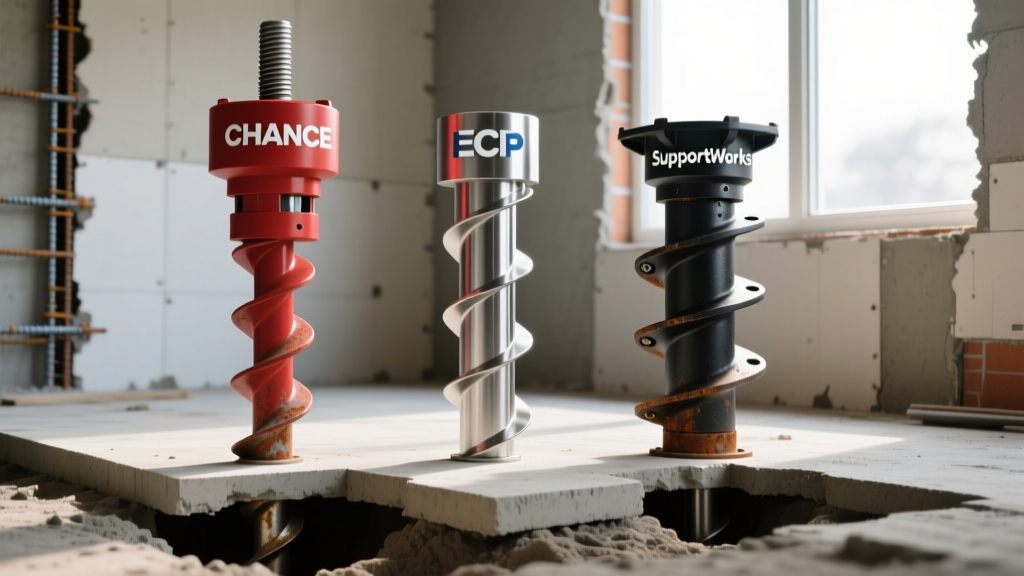
The Mechanics Behind a Sinking Foundation
When a structure experiences differential settlement, the resulting cracks, sticking doors, and sloping floors are merely symptoms. The root cause of a sinking foundation almost always traces back to the underlying soil profile. Expansive clays—specifically those rich in montmorillonite minerals—swell when saturated and shrink during droughts, creating a destructive heave-and-settle cycle. According to Colorado State University Extension, expansive soils cause more financial damage to property owners annually than floods, tornadoes, and earthquakes combined.
Do not attempt to fix a sinking foundation with surface-level concrete mudjacking if the settlement exceeds 1.5 inches or if structural shear cracks (stair-step cracking in masonry) are present. Mudjacking only addresses slab voids; it does not bypass unstable active soil zones to reach load-bearing strata.
To permanently arrest settlement, structural engineers specify deep foundation underpinning. This involves driving steel piers past the active soil layer into stable bedrock or a highly compacted load-bearing stratum. However, not all piering systems are engineered equally. Below is a deep dive into the premier product lines dominating the 2026 underpinning market.
Brand Deep-Dive: Hubbell CHANCE Helical Piers
Hubbell CHANCE is the oldest and most widely specified name in helical foundation technology. Their systems are governed by the rigorous ICC-ES Acceptance Criteria (AC358) for helical foundation systems. CHANCE relies on the empirical torque-to-capacity relationship, meaning the installation torque directly correlates to the pier's ultimate axial load capacity.
Product Line Spotlight: SS-5 and RS-2875
- Type SS (Solid Square Shaft): The SS-5 features a 1.5-inch solid square steel shaft. Because it lacks a hollow void, it offers superior torsional strength and is highly resistant to buckling in deep, soft soil applications. It is the go-to choice for high-capacity commercial loads or deep residential underpinning (depths exceeding 40 feet).
- Type RS (Round Shaft): The RS-2875 utilizes a 2.875-inch diameter hollow round shaft. While it has lower torsional strength than the solid square shaft, its larger diameter provides excellent column buckling resistance in shallower installations (under 25 feet) and offers higher lateral load resistance.
Brand Deep-Dive: Earth Contact Products (ECP)
Earth Contact Products (ECP) specializes in resistance push piers, which are hydraulically driven using the weight of the structure itself as resistance. ECP's engineering focuses heavily on minimizing skin friction during the driving process, allowing their piers to reach deeper load-bearing strata with less hydraulic pressure.
Product Line Spotlight: ECP Resistance Pier Model 150
The ECP Model 150 push pier system utilizes high-strength, hot-rolled seamless steel tubing (meeting ASTM A500 Grade B standards). The standout feature of the ECP line is their patented friction-reduction collar. This exterior collar creates a slight annular gap in the soil as the pier is driven, reducing soil drag by up to 30%. This is a critical advantage when driving piers through dense, over-consolidated clay or gravelly till, where standard smooth-shaft piers often experience "false refusal"—prematurely halting before reaching true bedrock.
Brand Deep-Dive: Foundation Supportworks
Foundation Supportworks operates primarily through a massive network of authorized dealers. Their proprietary push pier and helical pier systems are heavily integrated with their specialized hydraulic manifolds and synchronized lifting equipment.
"The true value of the Supportworks ecosystem isn't just the steel; it's the standardized lifting protocol. Their synchronized hydraulic manifolds allow contractors to lift a sinking foundation uniformly at a rate of 1/16th of an inch per minute, drastically reducing the risk of inducing new shear cracks during the recovery phase."
Their standard push pier system utilizes a 2.875-inch OD steel tube with a reinforced drive head. Supportworks places a heavy emphasis on their 25-year transferable warranty, which is backed by the manufacturer rather than solely relying on the local installer's solvency—a crucial factor for long-term property value retention.
2026 Product Comparison Matrix
| Brand / Product | Pier Type | Ultimate Capacity | Shaft Specification | Best Soil Application | Avg. Installed Cost (2026) |
|---|---|---|---|---|---|
| CHANCE SS-5 | Helical | 70,000 lbs | 1.5" Solid Square | Deep soft clays, high water tables | $2,200 - $2,800 / pier |
| CHANCE RS-2875 | Helical | 90,000 lbs | 2.875" Hollow Round | Shallow bedrock, lateral loads | $1,900 - $2,400 / pier |
| ECP Model 150 | Push Pier | 100,000+ lbs | 2.875" Seamless Tube | Dense glacial till, hardpan | $1,800 - $2,300 / pier |
| Supportworks Push Pier | Push Pier | 85,000 lbs | 2.875" Steel Tube | Standard expansive clay profiles | $2,000 - $2,600 / pier |
Cost Realities and Project Scoping
Addressing a sinking foundation is a significant capital expenditure. In 2026, due to sustained steel tariffs and increased diesel costs for heavy rigging equipment, the national average for fully installed underpinning ranges from $1,800 to $2,800 per pier.
A typical residential project requiring the stabilization of one settling corner of a house will require 6 to 10 piers, placing the total project cost between $12,000 and $26,000. If the entire perimeter of a 2,500-square-foot home is experiencing differential settlement, the project may require 30+ piers, pushing costs well past $60,000. Always demand a geotechnical soil report or a thorough structural engineer's assessment before authorizing a contractor to drive piers; unscrupulous contractors may over-sell pier counts by spacing them at 4-foot intervals when 7-foot intervals are structurally sufficient for the specific load calculations.
Decision Framework: Matching the Pier to the Profile
Selecting the correct product line requires understanding the specific failure mode of your site. Use this framework to guide your specification:
- Scenario A: High Water Table & Deep Unstable Soil. If soil borings indicate soft, saturated soils extending beyond 35 feet, avoid hollow push piers. The skin friction and buoyancy can cause hollow shafts to buckle or refuse prematurely. Specification: CHANCE SS-5 Solid Square Helical Pier. The solid shaft eliminates internal soil plugging and provides maximum torsional yield strength for deep driving.
- Scenario B: Shallow Bedrock (Under 20 feet). If bedrock or a highly competent load-bearing stratum is shallow, helical piers may struggle to achieve the required installation torque without the helical plates bearing directly on the rock, which can damage the plates. Specification: ECP Model 150 Push Pier. Push piers are designed to seat directly onto bedrock, utilizing the rock's compressive strength rather than soil friction.
- Scenario C: Light Structural Loads (Porches, Sunrooms). If the sinking foundation is isolated to a lightweight additive structure, heavy-duty commercial push piers are overkill and lack the necessary structural weight to drive them. Specification: CHANCE RS-2875 Helical Pier. Helical piers are screwed into the ground using hydraulic motors, meaning they do not rely on the structure's weight for installation resistance.
Ultimately, resolving a sinking foundation requires marrying accurate geotechnical data with precision-manufactured steel. By specifying ICC-ES evaluated products from established manufacturers like CHANCE, ECP, or Supportworks, you ensure the structural integrity of the underpinning system will outlast the structure it supports.