Foundation Settlement Repair Cost: 2026 Method Comparison
Compare 2026 foundation settlement repair costs across push piers, helical piers, and polyjacking. Get exact pricing, material specs, and decision frameworks.

The True Economics of Foundation Settlement Repair
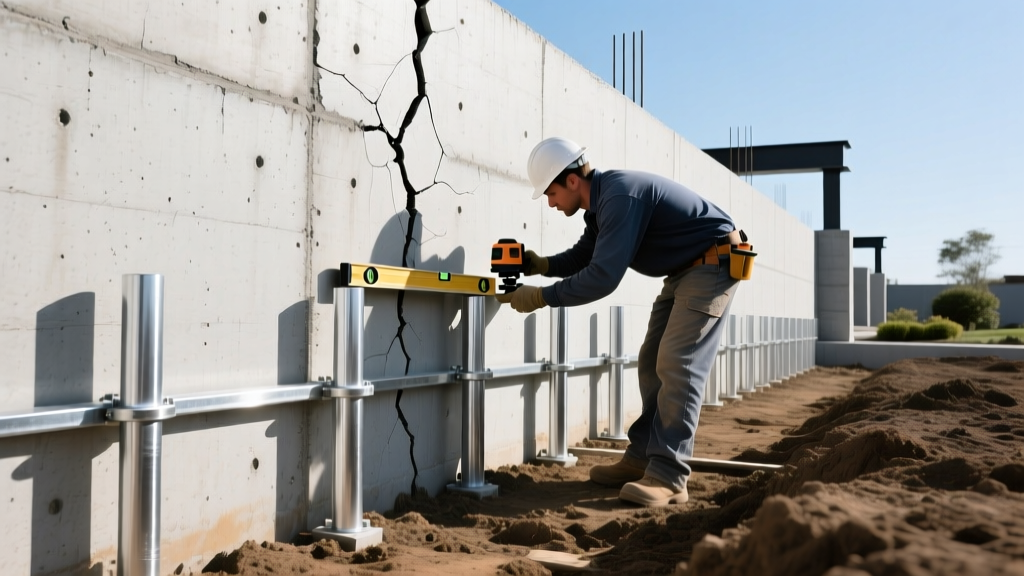
Foundation settlement occurs when the soil beneath a structure can no longer support the applied loads, leading to differential sinking, drywall fractures, and compromised structural integrity. In 2026, the foundation settlement repair cost varies wildly—from $3,500 for localized slab lifting to over $45,000 for full-perimeter deep foundation underpinning. The final invoice depends entirely on the geotechnical failure mode, the depth of load-bearing strata, and the specific repair methodology deployed.
According to the Geo-Institute of the American Society of Civil Engineers, expansive clays and poorly compacted fill soils account for over 75% of residential foundation distress in North America. Selecting the wrong repair method for your specific soil profile not only inflates costs but guarantees recurrent failure. This guide breaks down the exact material specifications, 2026 market pricing, and engineering applications for the four primary settlement repair systems.
Ignoring early-stage differential settlement (stair-step cracking in masonry, doors binding on frames) increases repair costs by an average of 18% to 24% annually. As the structure racks, secondary damage to plumbing lines, roof trusses, and exterior cladding compounds the primary geotechnical repair bill.
Deep Foundation Underpinning: Push Piers vs. Helical Piers
When a structural foundation (stem wall, basement footing, or grade beam) settles due to inadequate soil bearing capacity, surface-level fixes are useless. The load must be transferred past the active soil zone to stable bedrock or a highly compacted load-bearing stratum. This requires deep foundation underpinning.
Steel Push Piers: The End-Bearing Standard
Push piers are hydraulically driven through unstable soil using the weight of the existing structure as resistance. They are the industry standard for heavy masonry and multi-story residential buildings where bedrock is reachable (typically 20 to 60 feet deep).
- Material Specs: High-strength carbon steel tubing, typically 2-7/8 inches outside diameter (OD) with a 0.276-inch wall thickness, featuring a minimum yield strength of 75 ksi.
- Installation Mechanism: A hydraulic ram drives the pier sections sequentially until 'refusal' is achieved—meaning the pier hits bedrock or a stratum capable of supporting 2 to 3 times the current structural load.
- 2026 Cost Breakdown: $1,800 to $2,800 per pier installed. An average 1,200 sq. ft. home requiring 12 piers along one settling wall will cost between $21,600 and $33,600.
Helical Piers: The Expansive Clay Specialist
Helical piers feature a steel shaft with helical bearing plates (flights) welded to the lead section. Instead of being driven, they are mechanically torqued into the ground, much like a screw into wood. They are ideal for lighter structures (single-story wood-frame, porches) or sites where bedrock is too deep (>80 feet) for push piers.
- Material Specs: Type SS (Square Shaft) designs, commonly 1.5-inch solid square steel. The lead section typically features 8-inch, 10-inch, and 12-inch helices.
- Engineering Advantage: Helical piers utilize a verified torque-to-capacity correlation. Installers monitor hydraulic torque; using the empirical equation Q = kT (where Q is capacity, k is the empirical factor, and T is torque), engineers can verify the exact load capacity in real-time without waiting for soil rest periods.
- 2026 Cost Breakdown: $2,200 to $3,500 per pier installed. The higher material and machinery costs make them roughly 15% to 20% more expensive than push piers per linear foot of depth.
Both deep foundation systems must comply with local building codes regarding footing reinforcement and bracket connections. The International Residential Code (IRC) Chapter 4 mandates that all underpinning brackets and pier depths be approved by a licensed structural or geotechnical engineer based on site-specific soil borings.
Slab Settlement Solutions: Polyjacking vs. Mudjacking
When a concrete slab-on-grade floor, driveway, or patio settles uniformly or experiences minor differential sloping (without compromising the structural stem walls), underpinning is overkill. Slab jacking lifts the existing concrete back to grade by injecting material beneath it.
| Feature | Polyurethane Foam Jacking | Traditional Mudjacking |
|---|---|---|
| Material Injected | Two-part closed-cell high-density polyurethane resin | Cementitious slurry (topsoil, sand, cement, water) |
| Cured Density | 3.5 to 5.0 lbs per cubic foot | 100 to 120 lbs per cubic foot |
| Compressive Strength | 60 to 80 psi | 250 to 400 psi |
| Injection Hole Size | 5/8 inch (penny-sized) | 1.5 to 2 inches (golf ball-sized) |
| Cure / Use Time | 15 to 30 minutes | 24 to 48 hours |
| 2026 Cost per Sq. Ft. | $15 to $25 | $8 to $12 |
The Verdict: While mudjacking is cheaper upfront, the heavy slurry adds massive weight to already failing subgrades, often causing secondary settlement within 3 to 5 years. Polyurethane foam (such as Alchemy-Spetec AP Lift 4.3) expands up to 20 times its liquid volume, filling micro-voids and creating a waterproof, inert base that will not wash away or degrade. For interior floors and high-traffic exterior slabs, polyjacking is the superior long-term investment.
Bowing Walls and Lateral Settlement: Carbon Fiber & Anchors
Sometimes settlement is accompanied by lateral soil pressure, causing basement walls to bow inward or shear at the mortar joints. If the wall has deflected less than 2 inches, carbon fiber reinforcement is the most cost-effective stabilization method.
- Carbon Fiber Straps: Kevlar-reinforced carbon fiber grids bonded to the wall with structural epoxy. They offer a tensile strength up to 10 times greater than steel at a fraction of the weight. Cost: $800 to $1,200 per strap (installed vertically every 4 feet).
- Helical Tieback Anchors: For walls deflected beyond 2 inches, carbon fiber is insufficient. Helical tiebacks are driven horizontally through the wall into the exterior soil to actively pull the wall back to plumb. Cost: $1,500 to $2,500 per anchor.
2026 Decision Framework: Which Method Do You Need?
Use this diagnostic matrix to align your structural symptoms with the correct repair methodology before soliciting contractor bids:
- Symptom: Interior slab floor is sloping, but exterior stem walls are level and plumb.
Action: Polyurethane slab jacking. (Estimated Cost: $3,000 - $8,000) - Symptom: Exterior brick veneer has stair-step cracking; doors on the ground floor are binding at the top corner; soil is expansive clay.
Action: Helical piers or Push piers along the affected perimeter. (Estimated Cost: $18,000 - $35,000) - Symptom: Basement wall is bowing inward with horizontal cracking; water intrusion is present.
Action: Helical tieback anchors combined with exterior French drain remediation. (Estimated Cost: $12,000 - $22,000)
Hidden Costs: Engineering, Permitting, and Restoration
Contractor bids for foundation settlement repair cost rarely include the prerequisite engineering and subsequent site restoration. Budget for the following ancillary expenses:
- Geotechnical Soil Report: $2,500 to $4,500. Required to determine the depth of the active soil zone and bedrock elevation. Never approve a deep foundation bid without one.
- Structural Engineering Letter: $800 to $1,500. Required by the local municipality to stamp the underpinning design and issue a permit.
- Landscaping and Hardscape Restoration: $2,000 to $6,000. Installing push or helical piers requires excavating a 3x4 foot working pit at every pier location, which destroys adjacent concrete walkways, irrigation lines, and landscaping.
For comprehensive guidelines on mitigating soil-related hazards and ensuring structural longevity, property owners should consult the FEMA Foundation Safety Guidelines, which outline critical soil-structure interaction principles applicable to both seismic and settlement-related retrofits.
Frequently Asked Questions
Does homeowners insurance cover foundation settlement repair?
In 95% of cases, no. Standard HO-3 policies explicitly exclude earth movement, soil expansion, and gradual settlement. Coverage is typically only triggered if the settlement was the direct, immediate result of a covered peril, such as a sudden burst underground plumbing line washing away the subgrade.
How long does a push pier or helical pier installation take?
An experienced crew of three can install 6 to 10 piers per day. A standard 15-pier residential underpinning project takes 2 to 3 days for installation, plus 1 to 2 days for concrete patching, bracket concealment, and site cleanup.
Can I sell my house with an unrepaired settled foundation?
You can, but you are legally required to disclose the known defect in most states. Unrepaired foundation issues typically reduce the final sale price by 1.5 to 2 times the actual cost of the repair, as buyers factor in the risk, inconvenience, and financing hurdles associated with distressed properties.
Written by
Sarah WhitfieldSarah Whitfield is a chartered quantity surveyor (MRICS) and construction cost analyst with 15 years of experience in material pricing, procurement strategy, and project budgeting. She earned her degree in Construction Management from the University of Reading (UK) and has worked on projects ranging from $2M custom homes to $180M mixed-use developments across North America and Europe. Sarah currently leads cost estimating for BuildMat Insight, maintaining a proprietary database of 4,000+ material price points updated quarterly. She is a frequent contributor to RSMeans cost data panels and has presented at the International Cost Engineering Council (ICEC) congress. Based in Denver, CO, Sarah is an avid trail runner and volunteer mentor for Women in Construction.
More from Sarah Whitfield
View all
Wood & Lumber
What Are the Different Types of Wood? A Builder's Guide
Compare structural softwoods, finish hardwoods, and engineered lumber. Analyze Janka ratings, MOE values, and 2026 pricing for construction.
Aug 4, 2026

Walls & Panels
Steel Framing vs Wood Framing: Corrosion and Moisture Defense
Compare steel framing vs wood framing for moisture resistance. Learn about galvanized coatings, condensation risks, and corrosion protection strategies.
Jul 21, 2026

Stone & Masonry
How to Cut Stone Veneer: Wet Saw vs Grinder Comparison
Compare the best tools for cutting stone veneer. We review wet saws, angle grinders, and chop saws to help you achieve clean, chip-free cuts.
Jul 21, 2026