Foundation Repair Houston Cost Guide: 2026 Pricing & Methods
Analyze the 2026 foundation repair Houston cost landscape. Compare pier methods, soil impacts, and hidden fees for slab and pier-and-beam homes.

The Houston Soil Factor: Why Local Costs Defy National Averages
When evaluating the foundation repair Houston cost landscape, national averages are virtually useless. Houston sits atop the Beaumont and Montgomery geological formations, characterized by highly expansive clay soils with a Plasticity Index (PI) frequently exceeding 45. According to data referenced by the American Society of Civil Engineers, expansive soils cause more structural damage to residential buildings annually than hurricanes and earthquakes combined. In Houston, the 'active zone'—the depth of soil that swells with spring rains and shrinks during severe summer droughts—extends 15 to 22 feet below grade.
Because of this extreme active zone depth, foundation piers in Houston must be installed significantly deeper than in cities like Austin or Dallas, where bedrock or stable strata are shallower. This requirement for extra steel, concrete, and drilling time is the primary driver behind the premium pricing in the Greater Houston area. A standard 2,000-square-foot slab-on-grade home experiencing differential settlement on one elevation typically requires 15 to 25 piers, pushing total project costs well beyond the national median.
2026 Foundation Repair Houston Cost Breakdown by Method
The choice of underpinning method dictates the bulk of your expense. Below is the current 2026 pricing matrix for the most common repair systems utilized by structural contractors in Harris, Fort Bend, and Montgomery counties.
| Repair Method | Cost Per Unit (2026) | Avg. Depth Required | Best Application |
|---|---|---|---|
| Drilled Bell-Bottom Concrete Piers | $1,200 - $1,600 / pier | 25 - 35 feet | Heavy slab loads; relies on skin friction in deep clay. |
| Steel Push Piers | $1,800 - $2,400 / pier | 40 - 60+ feet | Reaching deep load-bearing strata; high-capacity lifting. |
| Helical Piers | $2,200 - $2,800 / pier | 20 - 30 feet | Lighter structures, new construction, or tension anchors. |
| Polyurethane Foam Slabjacking | $8 - $14 / sq. ft. | N/A (Surface) | Correcting minor slab voids and flatwork; not for structural lifting. |
The Engineering Edge: Bell-Bottom vs. Push Piers
Drilled bell-bottom piers are uniquely suited to Houston's geology. Contractors drill a 10-inch shaft down 25+ feet and ream the base into a 22-inch 'bell' shape. Concrete is poured with a steel rebar cage. Because Houston's bedrock is often hundreds of feet deep, these piers do not rest on rock (end-bearing); instead, they rely on the immense skin friction of the dense, compacted clay gripping the concrete shaft.
Conversely, steel push piers are hydraulically driven through the soil until they reach 'refusal' (a dense sand or rock layer). In parts of Houston, reaching refusal requires 50+ feet of steel, which drastically inflates the foundation repair Houston cost due to material weight and hydraulic equipment requirements.
⚠️ Warning: The 'Lifetime Warranty' TrapMany Houston contractors offer 'lifetime warranties' on piers. Read the fine print. These warranties almost universally exclude damage caused by poor surface drainage, plumbing leaks, or tree root moisture extraction. If your yard lacks proper grading, your warranty is void the moment the soil shifts. Always pair pier installation with a comprehensive drainage plan.
Hidden Costs: Drainage, Root Barriers, and Permits
Underpinning the foundation is only half the battle. The Houston Public Works department enforces strict grading and drainage codes to manage the region's flat topography and heavy Gulf rainfall. Ignoring water management will cause newly installed piers to fail.
- Surface Grading and French Drains: Houston code requires a minimum 1% slope (1 inch of fall per 8 feet) away from the foundation. Regrading a yard and installing a 100-foot French drain system with a pop-up emitter typically costs $2,500 to $4,500.
- Root Barriers: Houston's mature Live Oaks and Willow Oaks have aggressive, moisture-seeking root systems. Installing a 3-foot deep high-density polyethylene (HDPE) root barrier costs $60 to $90 per linear foot.
- City Permits and Engineering: The City of Houston requires a permit for foundation repair, which mandates a structural plan stamped by a Texas-licensed Professional Engineer (PE). Expect to pay $150 to $300 for the permit and $800 to $1,500 for an independent third-party PE report.
- Plumbing Leak Testing: Before lifting a slab, a hydrostatic plumbing test is mandatory to ensure no underground supply or sewer lines are leaking and softening the subgrade. Budget $350 to $500 for this test.
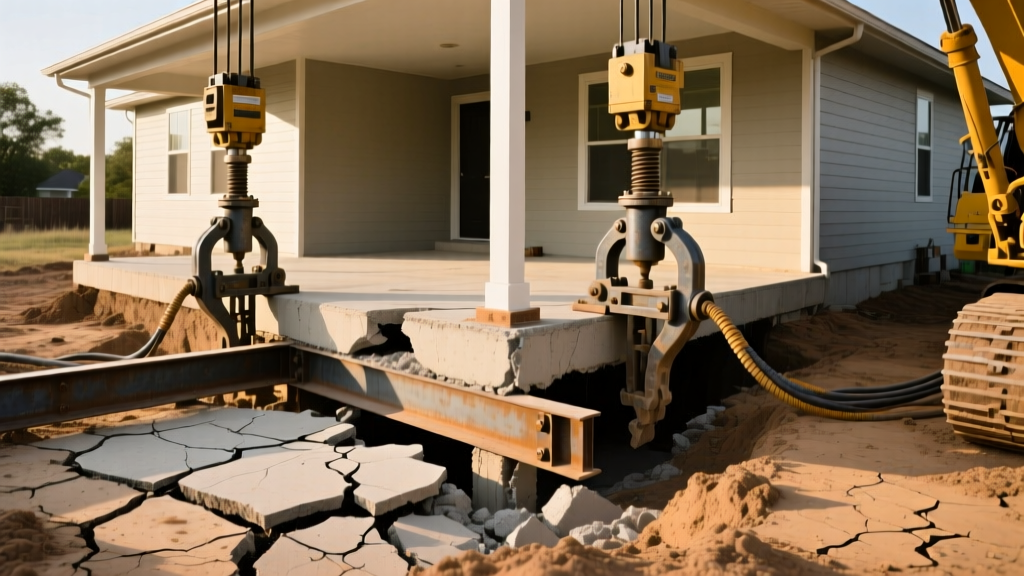
Pier and Beam vs. Slab: Houston-Specific Scenarios
Older neighborhoods like The Heights, Montrose, and Riverside feature pier-and-beam construction, which presents a completely different cost structure than modern slab-on-grade homes.
Pier and Beam Repair Costs
Instead of deep underpinning, pier-and-beam repairs usually involve replacing rotted wooden sill plates, shimming existing wooden piers, or installing new pre-cast concrete pads in the crawl space.
- Wooden Shim Adjustment: $150 - $250 per pier.
- Concrete Pad and Block Replacement: $400 - $700 per pier.
- Sill Plate / Beam Sistering: $80 - $120 per linear foot (requires pressure-treated lumber or steel I-beams to resist Houston's high humidity and termite pressure).
While the per-unit cost is lower, crawl space access issues, mold remediation, and vapor barrier installation (recommended by the Texas A&M AgriLife Extension to control moisture evaporation) can add $2,000 to $4,000 to the total project.
Step-by-Step: Navigating Houston Foundation Inspections
Do not accept the first estimate you receive. Follow this protocol to ensure structural integrity and financial protection:
- Hire an Independent PE First: Spend $500-$800 to have an independent structural engineer assess the home. They will provide a spec sheet detailing exactly how many piers are needed and at what depth.
- Bid the Spec Sheet: Hand the engineer's spec sheet to three licensed foundation repair companies. This ensures you are comparing apples-to-apples pricing rather than letting contractors upsell unnecessary piers.
- Verify the 'Mudline' Clause: Ensure the contract specifies that the contractor is responsible for drilling through the 'mudline' (the soft, unstable topsoil layer) to reach competent load-bearing clay.
- Schedule the Hydrostatic Test: Never allow a contractor to pump concrete or drive steel until a licensed plumber has cleared the sub-slab plumbing system.
Frequently Asked Questions
Does homeowners insurance cover foundation repair in Houston?
Standard HO-3 policies explicitly exclude foundation damage caused by soil expansion, contraction, or settling. Insurance will only cover foundation repair if the damage is the direct result of a covered peril, such as a sudden, accidental plumbing leak beneath the slab. Even then, coverage is usually limited to the cost of tearing out and replacing the slab to access the pipe, not the structural underpinning itself.
How long does a 20-pier foundation repair take?
For a standard 20-pier drilled bell-bottom installation, expect the physical drilling and pouring to take 4 to 6 days. However, the concrete requires a minimum of 7 to 14 days to cure to sufficient compressive strength (typically 3,000 PSI) before the hydraulic jacks can be used to lift the structure. Total project time, including landscaping restoration and masonry crack stitching, is usually 3 to 4 weeks.
Will repairing the foundation crack my brick veneer?
Yes, lifting a settled foundation will almost certainly alter the stress points on exterior brick veneer and interior drywall. While contractors attempt to lift the slab slowly (a process called 'floating'), existing mortar joints will pop. Budget an additional $1,500 to $3,000 for a mason to perform tuckpointing and crack stitching after the structural lift is complete.
Written by
Marcus ChenMarcus Chen is a licensed structural engineer (PE) and building materials analyst with over 12 years of experience across residential, commercial, and industrial construction. He holds a Master of Science in Civil Engineering from UC Berkeley and spent six years at Thornton Tomasetti before transitioning to independent consulting and technical writing. Marcus specializes in material selection for seismic-prone regions, concrete reinforcement strategies, and lifecycle cost analysis. His work has been cited by the American Concrete Institute (ACI) and the Structural Engineers Association of California (SEAOC). When he is not on a job site or at his desk, you will find him hiking the Sierra Nevada or restoring a 1920s craftsman bungalow in Oakland, CA.
More from Marcus Chen
View all
Construction Cost
How Much Did the Eiffel Tower Cost to Build?
How much did the Eiffel Tower cost to build in 1889? We adjust for inflation and compare its budget to modern skyscraper construction.
Aug 4, 2026

Fire Resistance
What Is a Fire Resistant Material? Testing & Certification Guide
Discover what is a fire resistant material through ASTM and UL testing. Learn how fire ratings, certifications, and assemblies work in construction.
Aug 4, 2026

Construction Cost
How Much Did the Burj Khalifa Cost to Build?
How much did the Burj Khalifa cost to build? We break down the $1.5B project and extract 5 money-saving strategies for your next build.
Jul 30, 2026