Warning Signs & Thrasher Foundation Repair Cost Breakdown
Spot foundation warning signs early. Explore our detailed Thrasher foundation repair cost breakdown for piers, wall anchors, and slab leveling.

Decoding Foundation Distress: The Diagnostic Phase
When drywall cracks appear above door frames or basement walls begin to bow inward, the immediate concern for homeowners shifts from structural anxiety to financial reality. Understanding the true thrasher foundation repair cost requires moving past superficial symptoms and diagnosing the underlying soil mechanics and structural failures. Thrasher Foundation Repair, operating as a premier dealer within the Foundation Supportworks network, utilizes proprietary, engineer-designed systems rather than generic contractor-grade fixes. Because their approach relies on patented products like Geo-Lock anchors and PolyLevel foam, pricing is intrinsically tied to the specific diagnostic outcome of the failure mode.
Foundation distress is rarely an isolated event; it is a cascading failure driven by hydrostatic pressure, expansive clay soils, or inadequate load-bearing strata. According to the HUD Residential Foundations Guide, differential settlement accounts for the vast majority of structural callbacks in residential construction. Before a single hydraulic jack is deployed, a comprehensive diagnostic evaluation maps the exact vector of the movement, which directly dictates the engineering solution and the final invoice.
Symptom-to-Solution Matrix: What Your House is Telling You
The cost of foundation repair is not a flat fee; it is a calculated response to specific structural symptoms. The matrix below correlates visible warning signs with their underlying diagnoses and the specific engineered systems Thrasher deploys to remediate them.
| Visible Warning Sign | Underlying Diagnosis | Thrasher Engineered Solution | 2026 Estimated Cost Range |
|---|---|---|---|
| Diagonal drywall cracks at corners | Differential settlement of footing | Resistance Push Piers / Helical Piers | $2,200 - $3,500 per pier |
| Bowing or leaning basement walls | Lateral hydrostatic soil pressure | CarbonArmor Straps / Geo-Lock Anchors | $900 - $2,400 per anchor/strap |
| Sunken driveway or patio slabs | Erosion of subgrade soil base | PolyLevel Polyurethane Injection | $6.00 - $12.00 per sq. ft. |
| Bouncy or sagging first-story floors | Crawl space support post failure | SmartJack Crawl Space Stabilizers | $1,400 - $1,900 per jack |
Deep Dive: Thrasher Foundation Repair Cost by Method
To accurately budget for structural remediation, you must understand the technical specifications and installation requirements of the specific systems proposed in your inspection report. Thrasher’s pricing reflects the use of galvanized, high-yield steel and aerospace-grade composites designed for permanent stabilization.
Foundation Piering: Push Piers and Helical Piers
When a home's footing rests on unstable, compressible soil, the structure will sink unevenly. Thrasher addresses this by bypassing the weak soil entirely and transferring the structural load to deep, load-bearing strata or bedrock.
- Resistance Push Piers: Driven hydraulically through the footing using the weight of the structure itself. These piers feature a rugged steel tube section and can support loads exceeding 70,000 pounds per pier. The average home requires 8 to 14 piers, placing the total project cost between $17,600 and $49,000.
- Helical Piers: Mechanically screwed into the ground like a giant wood screw. These are ideal for lighter structures (like porches or chimneys) or new construction where the weight of the house cannot be used to drive push piers. Costs are comparable, averaging $2,400 to $3,800 per pier, heavily dependent on the torque required to reach competent soil.
Basement Wall Stabilization: CarbonArmor and Geo-Lock
Bowing walls are a critical failure state caused by expansive soils pushing laterally against the foundation. The repair method depends on the severity of the deflection and yard accessibility.
- CarbonArmor: For walls with less than 2 inches of inward movement, Thrasher applies CarbonArmor straps. These carbon fiber strips are bonded to the wall with high-strength structural epoxy. Carbon fiber is 10 times stronger than steel in tension. This low-profile solution costs between $800 and $1,200 per strap, with most walls requiring 4 to 6 straps.
- Geo-Lock Wall Anchors: For severe bowing or when wall straightening is desired, earth anchors are buried in the yard and connected to the interior wall via a galvanized steel rod. This system actively pulls the wall back to plumb over time. Expect to pay $1,500 to $2,500 per anchor. This method requires exterior excavation, which increases labor costs.
Concrete Lifting: PolyLevel Injection
Traditional mudjacking relies on a heavy cementitious slurry that weighs over 100 lbs per cubic foot, often exacerbating the soil compression that caused the sinking in the first place. Thrasher utilizes PolyLevel, a two-part, high-density polyurethane foam that expands upon injection. Weighing merely 4 lbs per cubic foot and curing in 15 minutes, PolyLevel provides a watertight, permanent lift. While material costs are higher than mudjacking, the precision and lack of heavy equipment make it the modern standard. Standard driveway or sidewalk projects typically range from $1,500 to $3,500 total, scaling with the square footage and severity of the void.
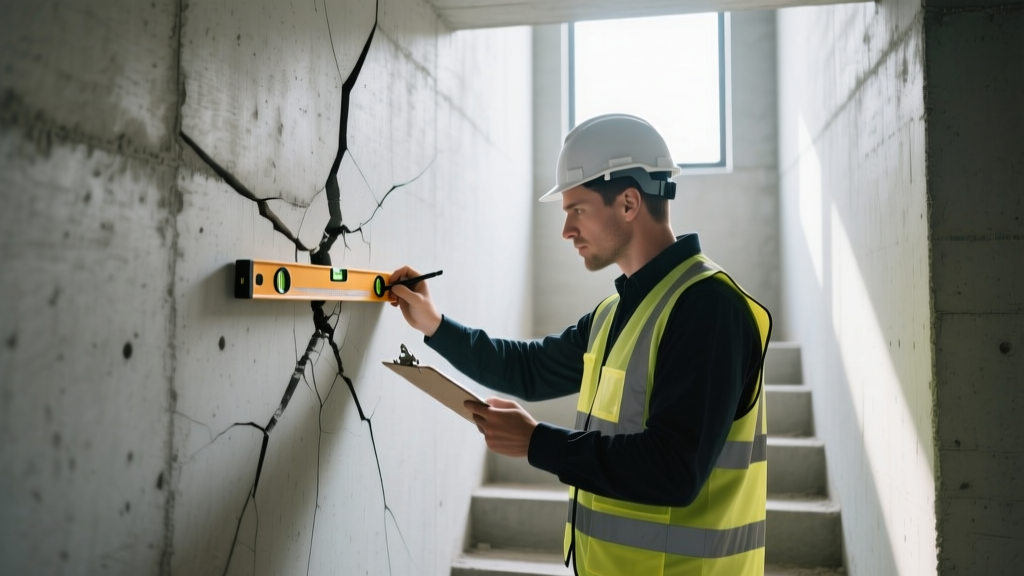
Ignoring horizontal cracks in a block foundation does not pause the structural clock. As the American Concrete Institute (ACI) notes, water infiltration through micro-fractures accelerates rebar oxidation and spalling. A $1,200 carbon fiber strap repair today can easily devolve into a $15,000+ partial wall rebuild if hydrostatic pressure is allowed to compromise the masonry bonds over multiple freeze-thaw cycles.
Variables That Shift the Final Invoice
While the per-unit costs of Thrasher’s engineered products are relatively standardized, the final project scope is heavily influenced by site-specific variables. Homeowners should anticipate adjustments based on the following factors:
- Depth to Load-Bearing Strata: If bedrock or stable clay is located 40 feet below grade rather than 15 feet, the additional steel pier sections and extended hydraulic driving time will increase the per-pier cost.
- Interior vs. Exterior Access: Installing push piers from the interior requires breaking through the basement concrete floor slab, removing the spoil, and repouring the concrete after installation. Exterior access is generally more cost-effective unless landscaping, decks, or HVAC units obstruct the excavation path.
- Municipal Permitting and Engineering Stamps: Depending on local building codes, a licensed structural engineer may need to stamp the repair plan. This administrative requirement typically adds $800 to $1,500 to the project overhead.
- Utility Rerouting: If main water lines, sewer taps, or buried electrical conduits cross the proposed excavation trench, utility locating and temporary rerouting will incur additional labor charges.
How to Prepare for Your Diagnostic Inspection
Thrasher offers comprehensive inspections, but the accuracy of the diagnostic report depends on the data available during the visit. Maximize the value of your inspection by completing these preparatory steps:
- Map the Timeline: Document when cracks first appeared and whether they expand or contract seasonally. This helps the structural specialist differentiate between active differential settlement and historical thermal expansion.
- Clear the Perimeter: Move stored items, shelving units, and drywall insulation away from the interior basement walls to allow for unobstructed laser-level measurements and deflection mapping.
- Identify Water Sources: Note the locations of downspout discharges, grading slopes, and any history of sump pump failures. Foundation repair addresses the structural symptom, but identifying the water management failure is critical for long-term stability.
- Gather Historical Documentation: Provide any existing survey plots, original blueprints, or previous home inspection reports. This baseline data allows the specialist to calculate the exact millimeter-rate of ongoing settlement.
Frequently Asked Questions
Does Thrasher offer financing for extensive piering projects?
Yes, because comprehensive foundation stabilization can exceed $30,000, Thrasher typically partners with specialized home improvement lending networks to offer fixed-rate financing, allowing homeowners to address critical structural failures without delaying for capital accumulation.
Will PolyLevel fix cracks in my concrete driveway?
Written by
Sarah WhitfieldSarah Whitfield is a chartered quantity surveyor (MRICS) and construction cost analyst with 15 years of experience in material pricing, procurement strategy, and project budgeting. She earned her degree in Construction Management from the University of Reading (UK) and has worked on projects ranging from $2M custom homes to $180M mixed-use developments across North America and Europe. Sarah currently leads cost estimating for BuildMat Insight, maintaining a proprietary database of 4,000+ material price points updated quarterly. She is a frequent contributor to RSMeans cost data panels and has presented at the International Cost Engineering Council (ICEC) congress. Based in Denver, CO, Sarah is an avid trail runner and volunteer mentor for Women in Construction.
More from Sarah Whitfield
View all
Wood & Lumber
What Are the Different Types of Wood? A Builder's Guide
Compare structural softwoods, finish hardwoods, and engineered lumber. Analyze Janka ratings, MOE values, and 2026 pricing for construction.
Aug 4, 2026

Walls & Panels
Steel Framing vs Wood Framing: Corrosion and Moisture Defense
Compare steel framing vs wood framing for moisture resistance. Learn about galvanized coatings, condensation risks, and corrosion protection strategies.
Jul 21, 2026

Stone & Masonry
How to Cut Stone Veneer: Wet Saw vs Grinder Comparison
Compare the best tools for cutting stone veneer. We review wet saws, angle grinders, and chop saws to help you achieve clean, chip-free cuts.
Jul 21, 2026