Average Foundation Repair Cost Houston: 2026 Diagnosis Guide
Discover the average foundation repair cost Houston homeowners face in 2026. Learn to diagnose expansive clay damage, compare pier methods, and avoid scams.

The Houston Soil Factor: Why Foundations Fail Here
Houston’s geology is notoriously hostile to concrete slab foundations. The majority of the Greater Houston area sits atop the Beaumont and Montgomery clay formations. These expansive soils possess a high plasticity index (PI), meaning they swell significantly when wet and shrink drastically during droughts. According to soil mapping data from the USDA NRCS Web Soil Survey, these clay layers can exert upward hydrostatic pressure exceeding 5,000 pounds per square foot when fully saturated, easily cracking 4-inch thick post-tensioned or conventionally reinforced concrete slabs.
Furthermore, groundwater withdrawal over the last century has led to localized subsidence, a phenomenon heavily monitored by the Harris-Galveston Subsidence District. This dual threat of seasonal clay heaving and long-term ground subsidence means that foundation settlement in Houston is rarely a matter of 'if', but 'when' and 'how severe'.
Diagnosing the Damage: A Houston-Specific Symptom Checklist
Before calling a contractor, perform a systematic visual inspection. Houston homes exhibit specific failure patterns due to the perimeter moisture fluctuations typical of the Gulf Coast climate.
Exterior Warning Signs
- Frieze Board Separation: Look at the top of your exterior siding where it meets the soffit. A gap here indicates the exterior walls are dropping or the foundation is settling away from the structure.
- Stair-Step Cracks in Brick Veneer: While brick is a veneer and not structural in most Houston homes, stair-step cracking originating from the corners of windows or doors maps directly to underlying slab deflection.
- Perimeter Soil Pull-Away: During Houston's dry summer months (July-October), a gap of more than 1/2 inch between the soil and the grade beam indicates severe clay desiccation.
Interior Warning Signs
- Diagonal Drywall Cracks: Cracks radiating at 45-degree angles from the top corners of interior door frames are classic indicators of differential settlement.
- Cabinet and Countertop Gaps: Pull away from the wall, specifically in the kitchen and bathrooms where plumbing penetrations create slab weak points.
- Floor Sloping: Place a marble on the floor. If it consistently rolls toward the exterior walls or a specific corner, you have a localized drop in the slab elevation.
Breaking Down the Average Foundation Repair Cost Houston Homeowners Face
When researching the average foundation repair cost Houston contractors quote, homeowners often encounter a massive range. This variance is driven by the depth of the unstable clay layer, the accessibility of the property, and the chosen underpinning method. In 2026, material costs for high-carbon steel piers and specialized polyurethane foams have stabilized, but labor and permitting fees in Harris and Fort Bend counties continue to rise.
| Repair Method | Average Cost per Unit | Typical Total Job Cost | Best Application in Houston |
|---|---|---|---|
| Steel Push Piers | $1,600 - $2,400 / pier | $8,000 - $18,000 | Heavy masonry homes; reaching load-bearing strata below 25 ft. |
| Helical Piers | $1,800 - $2,800 / pier | $9,000 - $22,000 | Lighter frame structures; areas with high water tables preventing push pier installation. |
| Polyurethane Foam Jacking | $12 - $18 / sq ft | $3,500 - $8,500 | Correcting interior slab dips; filling voids under post-tension cables. |
| Root Barriers & Drainage | $60 - $90 / linear ft | $2,500 - $6,000 | Preventative measure for homes near large oak or pine trees. |
The Hidden Cost Multiplier: Under-Slab Plumbing Leaks
A critical diagnostic step often skipped by budget contractors is the hydrostatic plumbing test. In Houston, it is incredibly common for a foundation drop to sever the cast-iron or PVC waste lines buried beneath the slab. When a pipe breaks, it washes away the supporting clay soil (a process called piping), creating a void that the slab collapses into.
Actionable Step: Before signing any pier installation contract, hire an independent, licensed master plumber to perform a static hydrostatic water test. This involves plugging the main sewer cleanout and filling the under-slab system with water to check for drops in pressure. If a leak is present, you must budget an additional $3,500 to $7,000 for tunneling or slab penetration to repair the pipe before the foundation can be permanently lifted. Lifting a slab over an active leak will only shear the new plumbing connections.
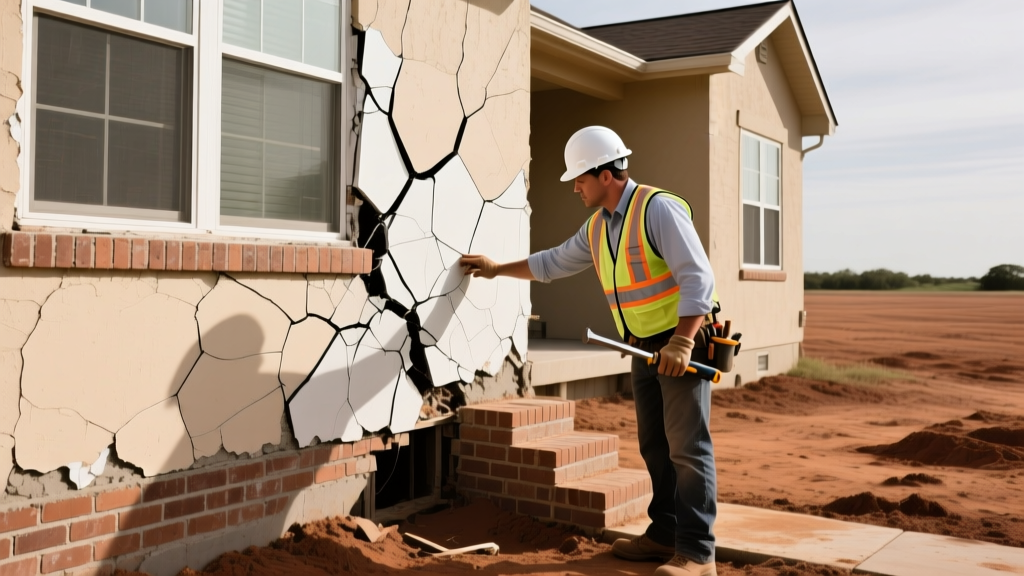
Repair Methods Matched to Houston Soil Conditions
Choosing the right underpinning system requires understanding the depth of the 'active zone'—the layer of soil that expands and contracts with seasonal moisture changes. In Houston, the active zone typically extends 10 to 15 feet deep, but can reach 20 feet during prolonged droughts.
Steel Push Piers vs. Helical Piers
Steel Push Piers are driven hydraulically through the unstable clay until they reach a load-bearing stratum (often the Lissie Formation or deeper Pleistocene sands). They rely on the weight of the house for resistance during driving. If your home is a single-story with a lightweight roof, push piers may not have enough resistance to drive to the required depth.
Helical Piers are screwed into the ground like a giant cork screw. They do not require the weight of the structure to install, making them ideal for lighter Houston ranch-style homes or for lifting detached structures like pool decks and garage slabs. They are also superior in Houston's coastal fringes (like Galveston or Baytown) where the water table is too high for traditional push pier equipment.
Decision Framework: Repair, Mitigate, or Walk Away?
Not every cracked slab requires a $15,000 piering job. Use this framework to determine your next steps:
- Measure the Deflection: Hire a structural engineer (not a contractor salesperson) to perform a floor elevation survey. If the differential settlement is less than 1 inch over a 20-foot span, and the damage is purely cosmetic, invest in moisture mitigation (soaker hoses, French drains, and root barriers) rather than piers.
- Check the Tree Canopy: If a massive Southern Live Oak is within 15 feet of the settling corner, the tree's root system is likely extracting moisture from the clay. Install a 3-foot deep HDPE root barrier before underpinning, or the tree will simply pull the newly lifted slab back down.
- Walk Away Threshold: If you are buying a home and the floor elevation survey shows differential settlement exceeding 3 inches, combined with active under-slab plumbing leaks and structural framing distortion (bowed roof ridges), the repair costs will likely exceed $40,000. In this scenario, renegotiate the purchase price or walk away.
Frequently Asked Questions
Do I need a permit for foundation repair in Houston?
Yes. The City of Houston and surrounding municipalities (like Sugar Land and The Woodlands) require permits for structural underpinning. A licensed structural engineer must stamp the piering plan. Never allow a contractor to bypass permitting, as this will void your home insurance and create massive liabilities during a future real estate transaction.
Should I water my foundation during the summer?
Yes, but strategically. Use a soaker hose placed 12 to 18 inches away from the grade beam. Run it for 30-45 minutes, two to three times a week during dry spells. The goal is not to drown the soil, but to maintain a consistent moisture content in the clay to prevent desiccation and shrinkage.
Written by
Marcus ChenMarcus Chen is a licensed structural engineer (PE) and building materials analyst with over 12 years of experience across residential, commercial, and industrial construction. He holds a Master of Science in Civil Engineering from UC Berkeley and spent six years at Thornton Tomasetti before transitioning to independent consulting and technical writing. Marcus specializes in material selection for seismic-prone regions, concrete reinforcement strategies, and lifecycle cost analysis. His work has been cited by the American Concrete Institute (ACI) and the Structural Engineers Association of California (SEAOC). When he is not on a job site or at his desk, you will find him hiking the Sierra Nevada or restoring a 1920s craftsman bungalow in Oakland, CA.
More from Marcus Chen
View all
Construction Cost
How Much Did the Eiffel Tower Cost to Build?
How much did the Eiffel Tower cost to build in 1889? We adjust for inflation and compare its budget to modern skyscraper construction.
Aug 4, 2026

Fire Resistance
What Is a Fire Resistant Material? Testing & Certification Guide
Discover what is a fire resistant material through ASTM and UL testing. Learn how fire ratings, certifications, and assemblies work in construction.
Aug 4, 2026

Construction Cost
How Much Did the Burj Khalifa Cost to Build?
How much did the Burj Khalifa cost to build? We break down the $1.5B project and extract 5 money-saving strategies for your next build.
Jul 30, 2026