Cinder Block Foundation Repair Cost: A 2026 Regional Guide
Discover the 2026 cinder block foundation repair cost across US regions. Compare pricing for tuckpointing, piering, and waterproofing by climate zone.

The Geology of Foundation Failure: Why Region Dictates CMU Repair Costs
Concrete Masonry Unit (CMU) foundations—commonly referred to as cinder block foundations—are highly susceptible to regional environmental stressors. Unlike poured concrete, which fails in large, monolithic shear cracks, CMU walls fail at the mortar joints and through individual block spalling. When evaluating the cinder block foundation repair cost, homeowners and contractors must look beyond national averages. A $4,000 repair in the freeze-thaw cycles of the Midwest involves entirely different engineering solutions than a $12,000 stabilization project in the expansive clay soils of the American South.
This 2026 regional guide breaks down the exact failure modes, structural interventions, and localized pricing variables for CMU foundation repair, providing a data-driven framework for budgeting and structural triage.
National Baseline: 2026 CMU Foundation Repair Costs
Before adjusting for regional soil mechanics and labor variances, it is critical to understand the baseline costs for standard CMU repair methodologies. The following table reflects current 2026 market rates for materials and professional installation.
| Repair Method | Primary Application | 2026 Cost Range | Expected Longevity |
|---|---|---|---|
| Mortar Tuckpointing (Type N/O) | Superficial joint degradation, minor spalling | $8 - $15 per sq. ft. | 15 - 25 years |
| Epoxy / Polyurethane Injection | Sealing active water leaks in vertical cracks | $350 - $650 per crack | 10 - 15 years |
| Carbon Fiber Straps (e.g., Fortress) | Inward bowing walls (less than 2 inches deflection) | $450 - $850 per strap | Lifetime (Structural) |
| Earth Wall Anchors | Severe lateral bowing, horizontal shear cracking | $650 - $950 per anchor | Lifetime (Adjustable) |
| Helical Piers (e.g., Chance) | Vertical settlement, subsidence, stepped cracking | $1,600 - $2,800 per pier | Lifetime (Structural) |
| Complete Wall Rebuild (Sectional) | Catastrophic shear failure, severe block disintegration | $175 - $260 per sq. ft. | 50+ years |
Regional Cost Drivers & Failure Modes
The Frost Belt (Northeast & Midwest): Freeze-Thaw and Mortar Degradation
In states like Michigan, New York, and Illinois, the primary enemy of CMU foundations is the freeze-thaw cycle. Water infiltrates the porous mortar joints, freezes, and expands by up to 9%, causing the mortar to crumble (spall) and the blocks to shift. This results in 'stair-step' cracking along the mortar beds.
- The Repair Protocol: Structural integrity is rarely compromised unless the wall is bowing. The primary fix is deep tuckpointing. Crucially, contractors must use ASTM C270 Type N or Type O mortar. Using Type S or Type M mortar (which have higher Portland cement content and compressive strength) will cause the rigid new mortar to crush the softer, historic cinder blocks during the next freeze cycle, accelerating wall failure.
- Regional Cost Impact: Labor-intensive repointing in the Northeast commands a premium due to high prevailing wages and short seasonal working windows. Expect cinder block foundation repair cost for comprehensive exterior excavation, waterproofing, and repointing to range between $12,000 and $18,000 for a standard 1,200 sq. ft. footprint.
The Expansive Clay Belt (South & Southeast): Lateral Pressure and Horizontal Shear
From Texas to the Carolinas, highly plastic expansive clays (often with Atterberg Liquid Limits exceeding 50%) swell dramatically during wet seasons. This exerts immense lateral hydrostatic pressure against CMU walls. Because cinder blocks lack the tensile strength of rebar-reinforced poured concrete, this pressure causes the wall to bow inward and crack horizontally at the mid-height mortar joint.
- The Repair Protocol: Carbon fiber straps are the first line of defense if deflection is under 2 inches. For deflection exceeding 2 inches, the wall must be mechanically pushed back toward plumb using hydraulic jacks, followed by the installation of helical tieback anchors driven 15 to 20 feet into the stable soil outside the foundation.
- Regional Cost Impact: Because expansive clay requires aggressive mechanical anchoring rather than just cosmetic sealing, the cinder block foundation repair cost in the South skews higher for structural stabilization. A typical 40-foot bowing wall requiring 8 earth anchors and interior French drain installation will cost between $14,000 and $22,000.
The Arid & Seismic Zones (West & Southwest): Subsidence and Shear Stress
In California, Nevada, and Arizona, foundation issues stem from soil subsidence (consolidation of dry, loose soils) and seismic shear forces. CMU walls in these regions often suffer from severe vertical settlement on one corner of the structure, leading to massive diagonal stair-step cracks that compromise the load-bearing capacity of the sill plate above.
- The Repair Protocol: The solution requires underpinning the foundation to load-bearing strata. Contractors drive helical piers or resistance push piers through the unstable surface soil down to bedrock or highly compacted alluvial layers, then bracket the CMU footing to transfer the structural load.
- Regional Cost Impact: Underpinning is heavy engineering. In the West, permitting, seismic code compliance, and deep pier driving requirements push the cinder block foundation repair cost to $2,500 to $3,500 per pier. A standard corner settlement repair requiring 6 to 8 piers will easily range from $18,000 to $30,000.
⚠️ The Hollow Core Dilemma: A Hidden Cost Trap
Unlike solid poured concrete, CMU blocks are hollow. When exterior hydrostatic pressure forces water through a cracked mortar joint, water pools inside the block cores. Many budget contractors attempt to fix this by applying interior sealants or epoxy directly over the interior block face. This is a catastrophic error.
Sealing the interior traps water inside the hollow cores. During winter, this trapped water freezes, expanding and blowing the interior face off the cinder blocks (spalling). Furthermore, the constant pooling accelerates rebar corrosion if the wall was reinforced. Proper CMU repair mandates the installation of an interior weeping system (drain tile) and potentially drilling weep holes into the bottom course of blocks to allow the cores to drain into the sump pit. Always add $2,500 - $4,500 to your budget for interior drainage retrofitting if hydrostatic pressure is present.
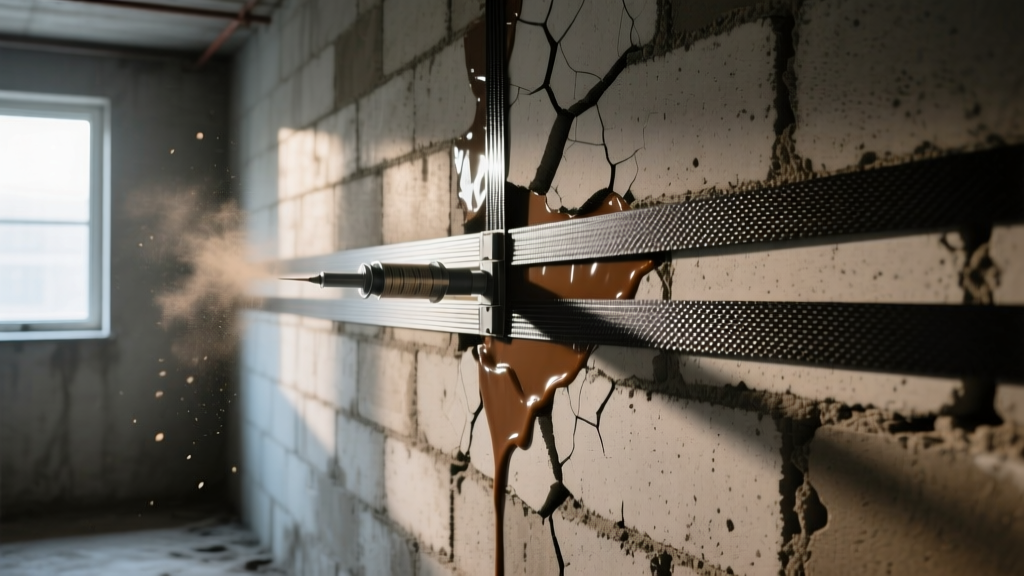
Decision Matrix: When to Repair vs. Rebuild a CMU Wall
Not every damaged cinder block wall can be saved. Use the following structural indicators to determine if your project requires stabilization or a complete sectional teardown.
| Structural Indicator | Threshold Measurement | Recommended Action |
|---|---|---|
| Inward Wall Deflection (Bowing) | Less than 2 inches | Repair: Carbon fiber straps + exterior grading. |
| Inward Wall Deflection (Bowing) | Greater than 2 inches | Repair/Rebuild: Earth anchors if accessible; rebuild if locked in. |
| Horizontal Mortar Joint Shear | Crack width less than 1/2 inch | Repair: Epoxy injection + carbon fiber reinforcement. |
| Horizontal Mortar Joint Shear | Crack width greater than 1/2 inch | Rebuild: Wall has lost structural continuity; requires teardown. |
| Block Spalling / Disintegration | Affecting less than 10% of wall | Repair: Replace individual blocks and repoint. |
| Block Spalling / Disintegration | Affecting more than 20% of wall | Rebuild: Material failure is systemic; replace entire wall section. |
Vetting Contractors and Code Compliance
Because CMU repair involves complex load-transfer mechanics, hiring a general handyman is a severe liability. When soliciting bids, require contractors to provide documentation that their proposed materials carry an ICC-ES (International Code Council Evaluation Service) report. For example, if a contractor proposes carbon fiber straps, ask for the ICC-ES ESR (Evaluation Service Report) number, which proves the specific epoxy and Kevlar/carbon weave has been tested for masonry shear and tensile loads according to ACI 440 standards.
Furthermore, consult authoritative guidelines on masonry behavior. According to the InterNACHI guide on concrete block foundations, inspectors specifically look for horizontal cracking as the primary indicator of imminent structural failure in CMU walls, which requires immediate engineering intervention rather than cosmetic patching. For comprehensive moisture management strategies that must accompany any structural repair, the Building Science Corporation's digest on understanding basements provides critical data on why interior drainage is non-negotiable in high-water-table regions. Finally, understanding the material science behind the cracks is vital; the Portland Cement Association's overview of cracks in concrete details how different stress vectors manifest in masonry assemblies.
Final Budgeting Advice for 2026
When calculating your total cinder block foundation repair cost, always apply a 15% contingency buffer specifically for 'hidden sub-grade conditions.' Once a contractor excavates the exterior soil to access the CMU wall, they may discover failed original footing drains, rotted sill plates, or voids beneath the footing that require polyurethane deep-injection grouting. By understanding the specific geological threats native to your region, you can accurately forecast whether your budget should be allocated toward mortar restoration, lateral anchoring, or deep vertical underpinning.
Written by
Marcus ChenMarcus Chen is a licensed structural engineer (PE) and building materials analyst with over 12 years of experience across residential, commercial, and industrial construction. He holds a Master of Science in Civil Engineering from UC Berkeley and spent six years at Thornton Tomasetti before transitioning to independent consulting and technical writing. Marcus specializes in material selection for seismic-prone regions, concrete reinforcement strategies, and lifecycle cost analysis. His work has been cited by the American Concrete Institute (ACI) and the Structural Engineers Association of California (SEAOC). When he is not on a job site or at his desk, you will find him hiking the Sierra Nevada or restoring a 1920s craftsman bungalow in Oakland, CA.
More from Marcus Chen
View all
Construction Cost
How Much Did the Eiffel Tower Cost to Build?
How much did the Eiffel Tower cost to build in 1889? We adjust for inflation and compare its budget to modern skyscraper construction.
Aug 4, 2026

Fire Resistance
What Is a Fire Resistant Material? Testing & Certification Guide
Discover what is a fire resistant material through ASTM and UL testing. Learn how fire ratings, certifications, and assemblies work in construction.
Aug 4, 2026

Construction Cost
How Much Did the Burj Khalifa Cost to Build?
How much did the Burj Khalifa cost to build? We break down the $1.5B project and extract 5 money-saving strategies for your next build.
Jul 30, 2026