Old House Foundation Repair Cost: 2026 Price Guide
Analyze 2026 old house foundation repair costs. Compare pricing for stone, brick, and early concrete repairs, including underpinning and tuckpointing.

The Unique Structural Realities of Pre-1950 Foundations
Calculating the old house foundation repair cost requires moving beyond standard modern concrete slab metrics. Homes built before 1950 present unique structural challenges because they were constructed before the universal adoption of steel-reinforced footings and modern Portland cement. Instead, these structures rely on lime mortar, rubble stone, unreinforced brick, and shallow frost walls. When evaluating repair estimates for historic properties, contractors must account for material compatibility, restricted basement access, and the sacrificial nature of original masonry joints. A standard foundation repair approach designed for a 1990s poured-concrete basement can cause catastrophic spalling and structural failure when applied to an 1890s fieldstone foundation.
2026 Cost Breakdown by Repair Method
The following table outlines current 2026 market rates for the most common repair techniques utilized in historic and aging residential foundations. Prices reflect national averages and include materials, specialized labor, and standard equipment mobilization.
| Repair Method | Primary Application | 2026 Cost Range | Expected Lifespan |
|---|---|---|---|
| Lime Mortar Tuckpointing | Repointing deteriorated stone/brick joints | $14 - $28 per sq. ft. | 50+ years |
| Helical Pier Underpinning | Stabilizing settling shallow footings | $1,800 - $2,800 per pier | 100+ years |
| Carbon Fiber Grid Straps | Halting inward bowing of unreinforced walls | $900 - $1,400 per strap | 50+ years |
| Sill Plate Replacement | Replacing rotted wood atop masonry walls | $160 - $350 per linear ft. | 75+ years (if treated) |
| Interior French Drain | Managing hydrostatic pressure and water | $90 - $140 per linear ft. | 30 - 50 years |
| Epoxy Crack Injection | Sealing structural cracks in early concrete | $450 - $850 per crack | 20+ years |
Material-Specific Failure Modes and Targeted Fixes
The exact old house foundation repair cost is heavily dictated by the original building material. Each pre-1950 material fails differently and requires highly specific, historically appropriate remediation.
Rubble Stone and Fieldstone (Pre-1900)
Foundations constructed from rubble stone rely on a "rubble trench" design where the mortar acts as a sacrificial buffer rather than a structural adhesive. Over decades, water infiltration dissolves the original lime mortar. The critical error modern contractors make is repointing these walls with rigid Type S or Type N Portland cement. Because Portland cement is harder and less permeable than the soft fieldstone, trapped moisture freezes and expands, causing the historic stones to crack and spall. The correct fix is repointing with Type O lime putty mortar or a natural hydraulic lime (NHL 3.5). Hand-mixing and applying lime mortar requires specialized masons, adding roughly 20% to 30% to standard labor costs, but it prevents tens of thousands of dollars in future stone replacement.
Unreinforced Brick and Clinker (1890-1920)
Brick foundations from this era lack steel rebar, making them highly susceptible to lateral hydrostatic pressure from expansive clay soils. When the soil swells, the unreinforced brick bows inward and steps at the mortar joints. Carbon fiber grid systems (such as Fortress Carbon Fiber or Rhino Carbon Fiber) are the premier solution for walls bowing less than two inches. These grids are bonded with structural epoxy, providing a tensile strength greater than steel without altering the basement's interior footprint. For walls bowing more than two inches, galvanized steel I-beam bracing anchored to the floor joists and slab is required, costing between $600 and $900 per beam installed.
Early Poured Concrete (1900-1940)
Early poured concrete often suffers from "concrete cancer" (alkali-silica reaction) or severe honeycombing due to poor vibration techniques during the original pour. These walls frequently exhibit horizontal shear cracks. High-modulus epoxy injection restores the structural monolith of the concrete, while polyurethane foam is reserved strictly for active water leaks. If the concrete has degraded to the point of exposing oxidized, expanding remnants of early iron ties, a shotcrete overlay or complete wall rebuild is necessary.
Hidden Cost Drivers in Historic Homes
Pre-1950 basements frequently contain asbestos pipe insulation, asbestos-containing mastic on floor tiles, and lead-based paint on structural beams. Excavating interior footings or grinding walls for waterproofing encapsulation will trigger EPA and OSHA abatement protocols. Budget an additional $1,500 to $4,500 for professional testing, containment, and hazardous waste disposal before foundation work begins.
- Hand-Digging Premiums: Modern mini-excavators and skid steers often cannot navigate the narrow 24-inch stairwells or low 6-foot ceiling clearances of historic basements. Manual mucking and hand-digging for interior French drains or underpinning pits adds $45 to $75 per cubic yard in labor premiums.
- Heritage Compliance and Permitting: If the property is located within a designated local historic district, exterior excavation, visible structural alterations, and even window well installations may require architectural review board approval. This process can add $1,500 to $3,000 in permitting fees and cause 30- to 60-day project delays.
- Utility Rerouting: Older homes often have unmarked, abandoned clay sewer lines, cisterns, or early knob-and-tube wiring buried near the foundation perimeter. Ground-penetrating radar (GPR) surveys, costing $400 to $800, are highly recommended before exterior excavation to avoid striking legacy utilities.
Decision Matrix: Repair vs. Complete Rebuild
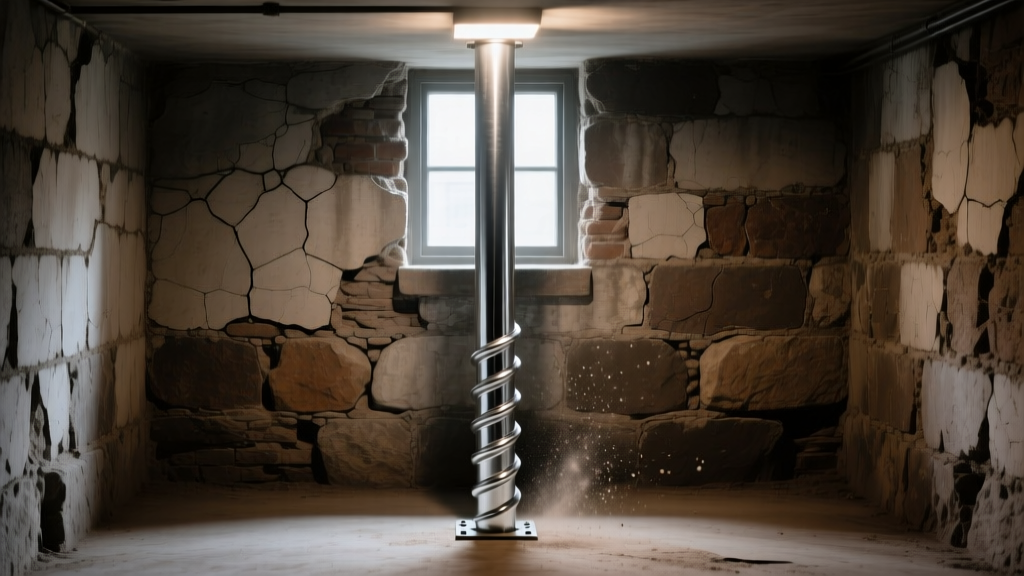
At what point does the old house foundation repair cost exceed the financial logic of salvaging the original structure? Structural engineers generally apply the 40% rule: if the cost of underpinning, rebuilding failing sections, and waterproofing exceeds 40% of the cost to jack the house and pour a entirely new reinforced concrete perimeter, replacement is the superior investment.
2026 Rebuild Benchmark: House lifting and jacking typically costs $18 to $32 per square foot of the home's footprint. For a 1,500 sq. ft. home, lifting costs roughly $27,000 to $48,000. Adding a new 4-foot poured concrete stem wall and footing averages $250 to $400 per linear foot. If your targeted masonry repairs exceed $65,000, pivot to a full structural replacement.
However, complete replacement is rarely an option for homes with historic masonry veneers, intricate brickwork, or protected landmark status, as the lifting process can irreparably damage the original exterior facade. In these cases, piecemeal restoration using helical piers and carbon fiber remains the only viable path.
Financing and Historic Preservation Incentives
Because historic foundation repairs often exceed standard homeowner insurance coverage and conventional renovation loan limits, specialized financing is usually required. The HUD Title I Property Improvement Loan program allows homeowners to borrow up to $25,000 for single-family structural improvements without requiring equity in the home, making it an excellent bridge for urgent stabilization work.
Furthermore, if the property is an income-producing historic structure (such as a rental property or a bed-and-breakfast) listed on the National Register of Historic Places, owners can leverage the National Park Service Historic Preservation Tax Incentives. This program offers a 20% federal income tax credit for the substantial rehabilitation of historic structures, which can significantly offset the premium costs of using historically accurate lime mortars and specialized structural engineers. Many states also offer parallel 10% to 25% state-level tax credits for private, owner-occupied historic residences, effectively subsidizing the high cost of heritage-compliant foundation stabilization.
Written by
Priya KapoorPriya Kapoor is a real estate market analyst and construction economics researcher with expertise in housing affordability, development feasibility, and infrastructure investment. She holds a Master of Regional Planning from Cornell University and previously worked as a senior analyst at CBRE's Investment Properties group, where she modeled returns for $4B in mixed-use development pipelines. Priya now runs an independent research practice advising developers, municipalities, and REITs on construction cost forecasting and market timing. She publishes the quarterly "BuildMat Market Pulse" report tracking material price indices across 12 commodity categories. Based in Austin, TX, Priya serves on the board of Habitat for Humanity Austin and is a marathon runner.
More from Priya Kapoor
View all
Construction Cost
Cost to Build a 1600 Sq Ft Home in 2026: Full Breakdown
Accurate 2026 cost to build a 1600 sq ft home—material, labor, and regional pricing breakdowns included. Plan your budget with real-time estimates.
Aug 11, 2026

Wood & Lumber
Name the Types of Wood for Pressure Treatment and Preservation
Learn how to name the types of wood best suited for pressure treatment. Compare species treatability, chemical retention levels, and 2026 preservation costs.
Aug 4, 2026

Stone & Masonry
Stone Veneer Suppliers Lindenhurst: 2026 Cost Analysis
Analyze 2026 stone veneer costs in Lindenhurst, NY. Compare local supplier pricing, delivery fees, and Suffolk County installation labor rates.
Aug 4, 2026