Maintenance Playbook After Encapsulating Crawl Space Foundations
Protect your foundation with our post-encapsulating crawl space maintenance playbook. Learn cleaning steps, dehumidifier care, and repair costs.
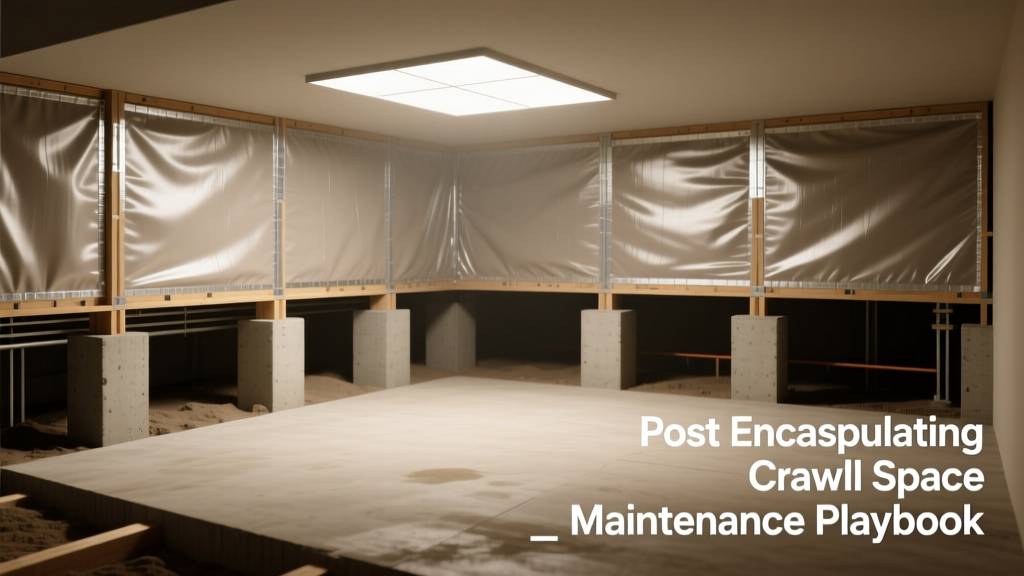
The Hidden Risks of Neglected Encapsulated Crawl Spaces
Encapsulating crawl space environments with a 20-mil polyethylene vapor barrier and a dedicated commercial dehumidifier represents a capital investment ranging from $6,000 to $18,000 in 2026. However, encapsulation is not a 'set-and-forget' solution. Without a rigorous maintenance and cleaning playbook, the sealed environment can trap undetected moisture, leading to concentrated mold growth, structural wood rot, and severe indoor air quality degradation. According to Building Science Corporation's research on unvented crawlspaces, sealing a foundation without conditioning the air simply moves the condensation point, often causing moisture to accumulate behind the liner or on cold HVAC ductwork.
Quarterly Inspection Playbook: What to Look For
Routine inspections prevent minor liner tears from becoming catastrophic groundwater intrusion events. Use this matrix to guide your quarterly crawl space evaluations.
| Component | Inspection Action | Failure Indicator | Estimated Repair Cost |
|---|---|---|---|
| Vapor Barrier Seams | Check overlapping tape and mastic adhesion along foundation walls. | Peeling tape, visible efflorescence, or air gaps. | $150 - $300 (DIY mastic/tape) |
| Dehumidifier Filter | Pull the MERV-8 or MERV-11 filter and inspect for dust buildup. | Thick gray dust layer; reduced airflow from exhaust. | $0 (Clean) or $45 (Replace) |
| Condensate Pump | Pour 1 gallon of water into the pump reservoir to test the float switch. | Pump fails to engage; water overflows the basin. | $85 - $140 (New pump unit) |
| Pest Intrusions | Walk the perimeter checking for rodent chewing on the 20-mil liner. | Torn polyethylene, droppings, or nesting materials. | $250 - $600 (Pest control + patch) |
Cleaning the Vapor Barrier and Structural Components
The 20-mil polyethylene liner (such as Raven Industries VaporGuard or Crawlspace Nexus) is highly durable but susceptible to chemical degradation. Never use chlorine bleach or ammonia-based cleaners on the vapor barrier; these compounds break down the polymer chains, causing the plastic to become brittle and crack within months.
The Safe Cleaning Protocol
- Dry Debris Removal: Use a commercial HEPA-filtered backpack vacuum to remove dust, dead insects, and particulate matter from the surface of the liner. Standard shop-vacs exhaust fine particulates back into the sealed environment.
- Spot Treatment for Organic Stains: For minor surface mold or organic staining on the liner, apply a 3% hydrogen peroxide solution. Let it dwell for 10 minutes, then agitate gently with a soft-bristle brush.
- Wiping Down: Mop the liner using a microfiber pad dampened with warm water and a pH-neutral dish detergent (e.g., Dawn). Avoid soaking the seams, as excess water can compromise the butyl tape adhesion.
- Joist Inspection: While cleaning, inspect the exposed wooden floor joists above. Look for dark, sunken patches indicating active dry rot or white, cotton-like growth signaling active mycelium.
Dehumidifier and Condensate Pump Maintenance
The mechanical heart of an encapsulated foundation is the dehumidifier. Units like the AprilAire E070 or the Santa Fe Advance2 are engineered for continuous, high-load operation. Neglecting the condensate removal system is the leading cause of post-encapsulation water damage.
Biannual Dehumidifier Servicing
- Filter Maintenance: Rinse the intake filter with low-pressure water every 90 days. If the filter media is torn or heavily calcified, replace it immediately. A restricted filter forces the compressor to run 30% longer, drastically increasing energy consumption and risking compressor burnout.
- Coil Cleaning: Annually, spray the evaporator coils with a no-rinse foaming coil cleaner (such as Nu-Calgon Nu-Brite). This removes microscopic dust that acts as an insulator, reducing the unit's moisture extraction capacity.
- Drain Line Flushing: The PVC condensate drain line is prone to algae and biofilm buildup. Every six months, detach the line at the pump and flush it with a 50/50 mixture of white vinegar and warm water. Follow this by using a wet/dry vac at the exterior termination point to pull out any remaining sludge.
- Pump Switch Calibration: Condensate pumps (like the Little Giant VCM-1) rely on a magnetic float switch. Over time, mineral deposits cause the float to stick. Manually move the float up and down to ensure smooth operation, and wipe the switch housing with a vinegar-dampened cloth to dissolve scale.
Troubleshooting Common Post-Encapsulation Failures
When environmental anomalies occur inside the sealed crawlspace, rapid diagnosis is critical to prevent structural damage. Use this decision matrix to isolate and resolve the issue.
| Symptom | Root Cause Analysis | Corrective Action |
|---|---|---|
| Musty odor returns to living space above. | Dehumidifier short-cycling due to a miscalibrated humidistat, or a clogged drain causing standing water under the liner. | Verify actual RH with an independent hygrometer. Recalibrate the unit's dial. Inspect the drain pan and pump basin for blockages. |
| Visible water pooling on top of the 20-mil liner. | Condensate pump failure, disconnected drain hose, or severe exterior groundwater intrusion bypassing the foundation wall. | Test pump float switch. If pump works, check exterior grading and downspout extensions to ensure bulk water is diverted away from the foundation. |
| Liner pulled away from the block foundation wall. | Efflorescence (salt deposits) pushing through the masonry has broken the bond of the double-sided butyl tape. | Scrape the wall clean of efflorescence using a wire brush. Apply a masonry sealer, then re-attach the liner using fresh butyl mastic and a mechanical batten strip. |
| HVAC ducts in the crawlspace are sweating profusely. | Dew point mismatch. The air inside the crawlspace is warm and humid, while the AC ducts are delivering 55°F air, causing condensation on the duct exterior. | Ensure all duct seams are sealed with mastic. Upgrade duct insulation to a minimum of R-8 with a sealed vapor jacket. Verify dehumidifier is actively lowering the ambient dew point. |
For comprehensive specifications on sizing and maintaining commercial-grade units, refer to Aprilaire dehumidifier specifications to ensure your unit's pint-per-day removal rate matches your crawlspace's cubic footage. Proper maintenance guarantees your encapsulated foundation remains a dry, structurally sound asset for decades.