2026 Regional Cost to Repair Foundation Settlement Guide
Discover the 2026 regional cost to repair foundation settlement. Compare pricing for push piers, helical piers, and mudjacking across different US soil zones.

The True Cost to Repair Foundation Settlement by Region
Foundation settlement is not a uniform structural failure, and the cost to repair foundation settlement varies drastically based on your geographic location. A $12,000 underpinning job in upstate New York operates on an entirely different mechanical and financial scale than a $45,000 deep-pier installation in Dallas-Fort Worth. In 2026, while national material costs for galvanized steel and high-density polyurethane resins have stabilized, regional labor rates, soil mechanics, and local permitting requirements continue to drive massive price disparities.
According to the International Association of Certified Home Inspectors (InterNACHI), the primary drivers of settlement are soil consolidation, expansive clay moisture fluctuations, and inadequate frost-depth footings. Understanding how your regional geology dictates the required repair method is the first step in accurately forecasting your budget.
2026 National Baseline Repair Costs
| Repair Method | 2026 Average Cost | Depth / Capacity | Primary Regional Application |
|---|---|---|---|
| Push Piers (2-7/8" OD Steel) | $1,600 - $2,400 per pier | 30 - 60+ ft (Bedrock refusal) | South, Southwest (Expansive Clay) |
| Helical Piers (Square Shaft) | $1,900 - $2,800 per pier | 15 - 40 ft (Torque-to-capacity) | Coastal, Southeast (Sands, Washouts) |
| Polyurethane Foam Jacking | $15 - $30 per sq. ft. | Slab-leveling (up to 6" lift) | Midwest, Northeast (Frost Heave Slabs) |
| Traditional Mudjacking | $8 - $14 per sq. ft. | Slab-leveling (heavy slurry) | Rural Midwest, Agricultural zones |
| Carbon Fiber Strap Stitching | $900 - $1,400 per strap | Lateral shear reinforcement | Northeast (Basement Bowing/Settlement) |
Regional Breakdown: Soil Types, Failure Modes, and Pricing
The South & Southwest: The Expansive Clay Belt
States like Texas, Oklahoma, Colorado, and parts of California sit atop highly active montmorillonite clay. This soil type can swell up to 15% in volume when saturated and shrink severely during droughts. The American Society of Civil Engineers (ASCE) notes that expansive soils cause billions in structural damage annually, primarily manifesting as differential settlement where one corner of a home sinks while the center remains elevated.
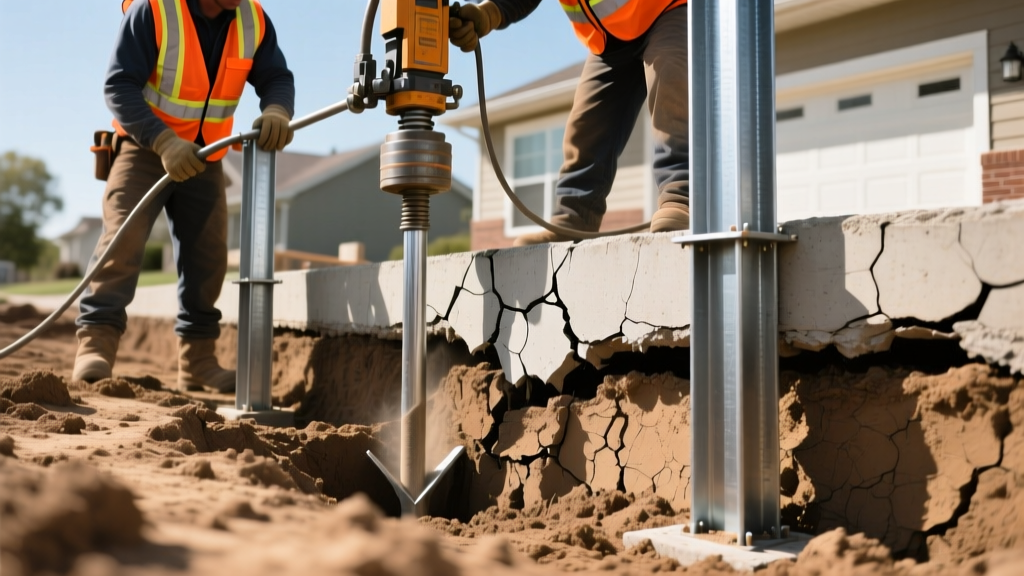
In regions like the Dallas-Fort Worth metroplex, the load-bearing strata or bedrock can be 40 to 60 feet below the surface. Contractors must use high-capacity hydraulic rams (exceeding 50,000 PSI) to drive 2-7/8" outside diameter (OD) galvanized push piers to refusal. Because of the depth and heavy equipment required, the cost to repair foundation settlement in these zones typically ranges from $25,000 to $55,000 for a standard 2,500 sq. ft. home perimeter.
The Northeast & Midwest: Frost Heave and Glacial Till
In regions with severe winter climates, the primary enemy is the frost line. If original footings were poured above the local frost depth (which can be 48 to 60 inches in states like Minnesota or Maine), the freezing and thawing of soil moisture causes cyclical frost heave. Over time, this snaps shallow concrete footings and causes severe stair-step cracking in masonry.
Repairing settlement here rarely requires driving piers 50 feet into the earth. Instead, contractors utilize spot-underpinning, excavating to below the frost line, and pouring new concrete piers. This is often paired with exterior French drains to manage hydrostatic pressure. Total project costs for regional frost-heave settlement repair generally fall between $12,000 and $28,000, heavily weighted toward excavation labor and landscaping restoration rather than deep steel materials.
Coastal & Southeast: High Water Tables and Sand Scour
Florida, the Gulf Coast, and the Eastern Seaboard feature loose, poorly graded sands and high water tables. Settlement in these areas is rarely caused by clay expansion; instead, it is driven by soil scour (water washing away fine sand particles beneath the footing) and hydrostatic uplift.
Push piers are ineffective in loose sand because there is no bedrock to achieve "refusal" against. Instead, structural engineers specify helical piers. These act like giant screws, utilizing steel helix plates to achieve torque-to-capacity verification in dense sand layers. According to guidelines published by the U.S. Department of Housing and Urban Development (HUD) regarding residential foundation systems in challenging soils, helical piles provide immediate load transfer without relying on end-bearing bedrock. Expect coastal settlement repairs to cost $18,000 to $35,000, utilizing 15 to 25 square-shaft helical piers equipped with cap plates.
Repair Method Matrix: Matching the Fix to the Soil
Choosing the wrong repair method for your regional soil type will result in catastrophic failure and wasted capital. Use this decision framework to verify your contractor's proposal:
- IF Soil = Expansive Clay AND Depth to Bedrock > 30 ft: Mandate Push Piers (Friction and End-Bearing). Reject helical piers, as the clay's friction will yield false torque readings.
- IF Soil = Loose Sand / High Water Table: Mandate Helical Piers with square shafts and multi-helix lead sections. Reject push piers, as they will punch endlessly through sand without hitting refusal.
- IF Failure = Interior Slab Sinking (No Structural Footing Damage): Mandate Polyurethane Foam Jacking. Reject mudjacking, as the heavy slurry will add thousands of pounds of dead weight to already compromised subsoil.
- IF Failure = Lateral Bowing from Settlement Shift: Mandate Carbon Fiber Straps (Kevlar-reinforced, minimum 60,000 PSI tensile strength) paired with deep underpinning to arrest vertical movement first.
Permitting, Engineering, and Hidden Regional Fees
The quoted cost to repair foundation settlement rarely includes the mandatory soft costs required by local municipalities. In 2026, building departments in high-risk soil zones have tightened regulations significantly.
- Geotechnical Soil Boring Report ($1,200 - $2,500): Required in states like Colorado and Texas before a permit is issued. An engineer must drill core samples to verify the exact depth to bedrock.
- Structural Engineering Stamp ($800 - $1,500): A licensed P.E. (Professional Engineer) must design the pier spacing layout (typically spaced 6 to 8 linear feet apart) and specify the required load capacity per pier.
- Permitting & Inspections ($400 - $900): Varies by county. Coastal counties in Florida often require additional environmental reviews if excavation impacts protected water tables.
- Landscaping & Hardscape Restoration ($2,000 - $8,000+): Heavy machinery required for push pier installation will destroy concrete walkways, HVAC lines, and root systems. Always budget a 15% contingency for exterior restoration.
"The most common financial mistake homeowners make is accepting a 'free inspection' from a repair company without an independent structural engineer's report. In expansive clay regions, an independent P.E. will often specify 30% fewer piers than a commission-based contractor, saving the homeowner thousands while maintaining structural integrity."
Frequently Asked Questions
Does homeowner's insurance cover foundation settlement?
In 95% of cases, no. Standard HO-3 policies exclude earth movement, expansive soil, and frost heave. Settlement is classified as a maintenance and geological issue. The only exception is if the settlement was the direct, immediate result of a covered peril, such as a sudden, accidental plumbing leak beneath the slab that washed out the subsoil.
How long does a regional underpinning project take?
For a standard 20-pier installation, expect 4 to 7 days of active heavy excavation and driving. However, in the Northeast, winter ground freezing can halt exterior excavation entirely from December through March, pushing project timelines into the spring.
Are DIY foundation repair kits viable for structural settlement?
No. Epoxy injection kits and DIY drainage solutions only address cosmetic drywall cracks or minor surface water. True structural settlement involves loads exceeding 40,000 lbs per linear foot of wall. Attempting to arrest this with retail products will result in continued structural failure and void any future professional repair warranties.
Written by
Sarah WhitfieldSarah Whitfield is a chartered quantity surveyor (MRICS) and construction cost analyst with 15 years of experience in material pricing, procurement strategy, and project budgeting. She earned her degree in Construction Management from the University of Reading (UK) and has worked on projects ranging from $2M custom homes to $180M mixed-use developments across North America and Europe. Sarah currently leads cost estimating for BuildMat Insight, maintaining a proprietary database of 4,000+ material price points updated quarterly. She is a frequent contributor to RSMeans cost data panels and has presented at the International Cost Engineering Council (ICEC) congress. Based in Denver, CO, Sarah is an avid trail runner and volunteer mentor for Women in Construction.
More from Sarah Whitfield
View all
Wood & Lumber
What Are the Different Types of Wood? A Builder's Guide
Compare structural softwoods, finish hardwoods, and engineered lumber. Analyze Janka ratings, MOE values, and 2026 pricing for construction.
Aug 4, 2026

Walls & Panels
Steel Framing vs Wood Framing: Corrosion and Moisture Defense
Compare steel framing vs wood framing for moisture resistance. Learn about galvanized coatings, condensation risks, and corrosion protection strategies.
Jul 21, 2026

Stone & Masonry
How to Cut Stone Veneer: Wet Saw vs Grinder Comparison
Compare the best tools for cutting stone veneer. We review wet saws, angle grinders, and chop saws to help you achieve clean, chip-free cuts.
Jul 21, 2026