Foundation Building Materials San Diego: 2026 Cost Breakdown
Analyze 2026 costs for foundation building materials in San Diego. Compare concrete, rebar, and waterproofing prices for local slab and raised builds.

The San Diego Soil & Climate Factor
Calculating the cost of foundation building materials in San Diego requires more than just multiplying cubic yards by a national average. San Diego County presents a bifurcated geological and climatic challenge that directly dictates material selection and final pricing. Coastal zones like La Jolla, Point Loma, and Coronado expose structural concrete to salt-laden air and sulfate-rich soils, necessitating specialized cementitious mixes and non-corrosive reinforcement. Conversely, East County suburbs such as Santee, El Cajon, and Lakeside are notorious for highly expansive bentonite clays that swell significantly during rare but intense atmospheric river events, requiring deepened grade beams and stiffened slab designs.
Furthermore, local logistics heavily influence material delivery costs. Navigating ready-mix trucks through narrow, historic alleys in North Park or up steep, winding grades in Mount Helix incurs substantial surcharges. This 2026 cost analysis breaks down the exact pricing for concrete, reinforcement, vapor barriers, and insulation required to meet both structural demands and the stringent California Building Standards Commission Title 24 energy codes.
2026 Material Cost Matrix: Concrete & Aggregates
Ready-mix concrete prices in San Diego have stabilized in 2026 after the volatile supply chain disruptions of the early 2020s, but they remain at a premium compared to the national average due to local aggregate scarcity and strict environmental kiln regulations. The American Concrete Institute (ACI) recommends specific mix designs based on soil sulfate concentrations.
| Concrete Mix Type | PSI / Spec | 2026 SD Cost (per CY) | Primary Application |
|---|---|---|---|
| Standard Residential | 3,000 PSI | $165 - $175 | Flatwork, non-structural sidewalks, inland minor footings |
| Structural Foundation | 4,000 PSI | $180 - $190 | Standard slab-on-grade, interior raised floor piers |
| Sulfate Resistant | 4,000 PSI (Type V) | $195 - $215 | Coastal foundations, soils with high sulfate content |
| High-Early Strength | 5,000 PSI (Type III) | $220 - $245 | Tilt-up panels, fast-track commercial, winter pours |
| Flowable Fill (CLSM) | 150 PSI | $140 - $155 | Trench backfill, abandoned pipe abandonment |
Note: Prices reflect base material costs. Add $15-$25 per cubic yard for fiber reinforcement (macro-synthetic fibers like Fibermesh) which is now standard practice in San Diego to mitigate plastic shrinkage cracking during hot Santa Ana wind events.
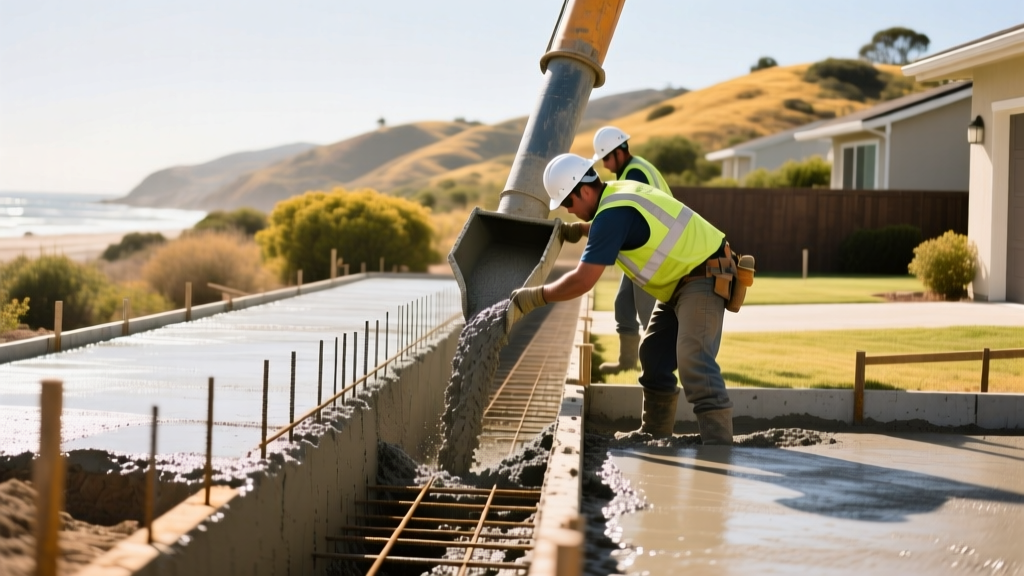
Reinforcement Strategies: Steel vs. GFRP in Coastal Zones
Rebar selection is where San Diego foundation costs diverge sharply from inland markets. The marine layer accelerates the oxidation of traditional black steel, leading to spalling concrete within 15 to 20 years if cover depths are not perfectly maintained. Builders in 2026 are increasingly shifting toward advanced composites for coastal projects.
Option A: Epoxy-Coated Steel (ASTM A775)
- Material Cost: $1.35 - $1.60 per linear foot (for #4 bar).
- Pros: Widely available at local suppliers like White Cap and Builders Wholesale; familiar to all local ironworkers; excellent structural yield strength (60,000 PSI).
- Cons: The epoxy coating is easily scratched during tying and transport. Any micro-abrasion becomes a focal point for localized galvanic corrosion.
Option B: Glass Fiber Reinforced Polymer (GFRP)
- Material Cost: $2.75 - $3.20 per linear foot (for #4 equivalent).
- Pros: 100% immune to chloride and sulfate corrosion; one-quarter the weight of steel, drastically reducing labor fatigue and crane time; non-magnetic and non-conductive.
- Cons: Lower shear strength than steel; cannot be bent on-site (must be ordered with factory-fabricated 90-degree hooks); requires specific tie-wire techniques to avoid damaging the glass matrix.
Title 24 Compliance: Insulation & Vapor Retarders
California's Title 24 Energy Code mandates strict thermal breaks for slab-on-grade foundations to prevent heat loss through the concrete mass. In San Diego's Climate Zone 7 (coastal) and Zone 10 (inland valleys), the requirements dictate specific R-values for slab edge insulation.
Slab Edge Insulation Requirements
For heated slabs or residential builds with radiant floor heating, you must install R-10 insulation extending 24 inches down the exterior edge of the foundation. In 2026, 2-inch extruded polystyrene (XPS) rigid foam boards, such as Owens Corning FOAMULAR, are the standard.
- XPS R-10 (2-inch thick): $1.85 - $2.10 per square foot.
- EPS R-10 (2.5-inch thick): $1.40 - $1.65 per square foot (more vulnerable to moisture absorption during the curing process).
Vapor Retarders: Beyond Generic Poly
The days of laying down cheap 6-mil clear polyethylene are over. The California Building Code now requires a minimum 10-mil vapor retarder under all interior concrete slabs to prevent moisture migration that destroys modern, low-VOC floor finishes.
"Upgrading from a generic 10-mil poly to a 15-mil engineered barrier like Stego Wrap adds roughly $0.30 per square foot to the material budget. However, it prevents catastrophic moisture-related flooring failures and reduces the need for expensive secondary topical moisture mitigation systems, which can cost $4 to $6 per square foot post-pour."
Logistics & Hidden Surcharges in San Diego County
Material unit costs only tell half the story. The physical delivery and placement of foundation materials in San Diego introduce several unavoidable line items that must be factored into your 2026 budget.
- Concrete Pump Trucks: Due to steep topography and limited street parking, direct chute pouring is rarely possible. Boom pump rentals average $165 to $210 per hour, with a mandatory 4-hour minimum and a $150 mobilization fee.
- Short Load Fees: If your foundation requires less than a full 8-cubic-yard truckload (common for ADU foundations or room additions), ready-mix suppliers will levy a short load fee ranging from $75 to $120 per missing yard.
- Rebar Fabrication & Delivery: Ordering pre-cut and bent rebar from local yards like Pacific Steel or Metals Depot saves hours of on-site labor but incurs a $150-$250 delivery fee for flatbed drop-offs, plus a 15% fabrication markup.
- Formwork Lumber: While not a permanent material, the cost of 2x12 Douglas Fir for forming footings has settled at $14.50 to $16.00 per linear board foot in 2026. Factor in a 20% waste allowance for curved or stepped footings.
Decision Framework: Choosing Your Material Stack
To optimize your foundation budget without compromising structural integrity or code compliance, apply this decision framework based on your specific San Diego micro-climate and soil conditions.
Scenario 1: Coastal Build (e.g., Ocean Beach, Del Mar)
- Concrete: 4,000 PSI with Type V (Sulfate Resistant) cement.
- Reinforcement: GFRP rebar for all exterior grade beams and slab edges to eliminate salt-spray corrosion.
- Vapor Barrier: 15-mil Stego Wrap with sealed seams.
- Cost Premium: Expect a 12-18% higher material cost compared to inland builds, offset by a 50+ year maintenance-free lifecycle.
Scenario 2: Inland Expansive Soil (e.g., Scripps Ranch, Eastlake)
- Concrete: Standard 4,000 PSI mix with macro-synthetic fibers.
- Reinforcement: Standard black steel (#4 and #5) paired with post-tensioning cables stressed to 33,000 lbs to compress the slab and resist clay heave.
- Sub-grade Prep: Budget heavily for 12-18 inches of imported select fill and mechanical compaction to 95% Proctor density.
- Cost Premium: Earthwork and imported fill will consume 30% of the foundation budget, but material costs remain at baseline averages.
By aligning your material specifications with San Diego's unique geological zones and 2026 supply chain realities, you can prevent costly change orders and ensure your foundation system meets both the physical demands of the environment and the regulatory demands of the state.
Written by
David NakamuraDavid Nakamura is a licensed architect (AIA) and construction technology writer focused on sustainable building methods, mass timber engineering, and high-performance building envelopes. He holds a Master of Architecture from the University of Washington and is a certified Passive House Consultant (CPHC). David spent eight years at the Seattle firm Mithun, where he led the design of three LEED Platinum projects, before founding his own practice specializing in net-zero residential design. He serves on the editorial advisory board of GreenBuilder Magazine and has authored peer-reviewed papers on cross-laminated timber (CLT) connections for the Journal of Structural Engineering. In his spare time, David teaches woodworking at Pratt Fine Arts Center and kayaks the Puget Sound.
More from David Nakamura
View all
Construction Cost
Labor Cost to Build a Deck Per Sq Ft: 2026 Installation Guide
Discover the exact labor cost to build a deck per sq ft in 2026. This installation guide breaks down contractor rates, complexity factors, and hidden fees.
Aug 4, 2026

Construction Cost
How Much Does It Cost to Build a 3 Bedroom House? Financing Guide
Learn exactly how much it costs to build a 3 bedroom house and explore 2026 financing options, construction loan types, and budget frameworks for your build.
Aug 4, 2026

Construction Cost
Cost to Build a Tennis Court: 2026 Guide
How much does it cost to build a tennis court in 2026? Breakdowns for asphalt, concrete, and synthetic surfaces plus fencing and lighting.
Jul 30, 2026