Foundation Repair Cost in Texas: 2026 Method Comparison
Compare 2026 foundation repair costs in Texas. Analyze steel piers, helical piers, pressed pilings, and polyjacking for expansive clay soils.

The Texas Soil Factor: Why Repair Costs Vary
Calculating the foundation repair cost in Texas requires an understanding of the state's unique geology. Unlike regions with stable, rocky substrates, much of Texas—particularly the I-35 corridor from San Antonio through Austin to Dallas-Fort Worth, and the Houston clay basin—sits atop high-plasticity expansive soils. These soils, rich in smectite and montmorillonite clay minerals, possess a Plasticity Index (PI) frequently exceeding 35. When hydrated, they can swell up to 30% in volume; during the severe summer droughts characteristic of the region, they shrink and pull away from the slab, causing differential settlement.
Because the soil mechanics vary drastically from the sandy loam of East Texas to the caliche rock of West Texas, contractors cannot apply a one-size-fits-all pricing model. The foundation repair cost in Texas is ultimately dictated by the depth required to reach stable load-bearing strata or sufficient skin friction, the weight of the structure, and the accessibility of the site.
2026 Foundation Repair Cost Comparison Matrix
The following matrix breaks down the primary structural underpinning and leveling methods utilized by licensed Texas foundation repair contractors in 2026. Costs reflect current material, labor, and equipment mobilization rates.
| Repair Method | 2026 Cost Estimate | Target Soil / Depth | Best Application |
|---|---|---|---|
| Concrete Pressed Pilings | $650 - $950 per pier | Clay / 15-25 ft (Friction) | Standard slab-on-grade homes |
| Steel Push Piers | $1,900 - $2,600 per pier | Mixed / 30-60+ ft (Bedrock) | Heavy masonry, severe settlement |
| Helical Piers | $2,300 - $3,200 per pier | Sandy Loam / Variable | Lighter loads, tension, new builds |
| Polyurethane Foam (Polyjacking) | $16 - $28 per sq. ft. | Surface voids / 2-6 inches | Slab voids, driveways, minor dips |
| Cement Slurry (Mudjacking) | $9 - $14 per sq. ft. | Surface voids / 2-8 inches | Exterior flatwork, pool decks |
Deep Dive: Piering Systems Compared
When a Texas home experiences differential settlement exceeding the American Concrete Institute (ACI) tolerance guidelines for slab-on-ground foundations (typically a deflection ratio of L/600), structural underpinning is required. Here is how the three primary piering systems compare in the Texas market.
Concrete Pressed Pilings (The Texas Standard)
Pressed concrete pilings dominate the Texas market, accounting for roughly 70% of residential slab repairs. This method involves using a hydraulic ram to press 6-inch diameter cylindrical concrete segments into the ground, relying on the friction of the dense clay to hold the pier in place.
- Pros: Highly cost-effective; utilizes the natural friction of Texas expansive clay; minimal landscaping disruption compared to drilled bell-bottom piers.
- Cons: Rarely reaches true bedrock; susceptible to upward drag (skin friction) if the clay swells significantly after installation; requires a steel cable tensioning system to prevent segment separation.
- Expert Insight: Always insist on a "friction reduction" cap or a steel sleeve on the top 3-4 segments of the piling. This prevents the swelling surface clay from gripping the concrete and lifting the pier, which can cause secondary heaving damage to your slab.
Steel Push Piers vs. Helical Piers
For homes in areas with highly variable soil profiles, such as the Hill Country where caliche rock shelves are unpredictable, or for heavier two-story masonry homes, engineers specify steel piers.
Steel Push Piers utilize the weight of the structure itself to drive hollow steel tubes deep into the earth until they refuse on load-bearing bedrock (end-bearing). They are the gold standard for arresting severe, ongoing settlement, but the mobilization of heavy hydraulic equipment drives the foundation repair cost in Texas higher for this method.
Helical Piers, which feature steel shafts with helical bearing plates, are mechanically torqued into the ground. They are ideal for lighter structures (sunrooms, porches) or in areas where the house cannot provide the reaction force needed to push steel piers. According to structural guidelines referenced by the Texas Department of Insurance (TDI), helical piers must be installed to a specific torque-to-capacity ratio to ensure they can support the design load without further settling.
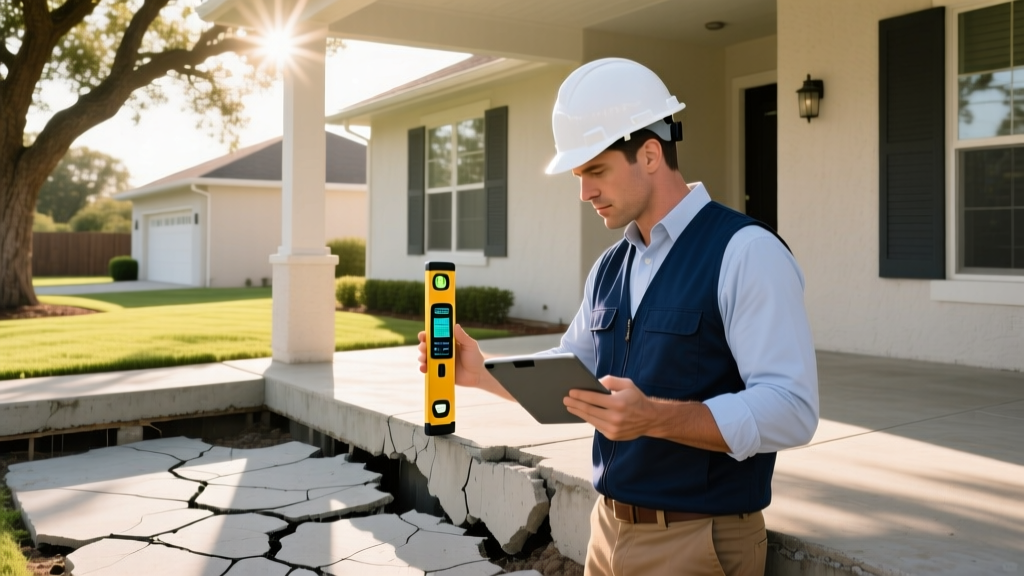
Slabjacking: Mudjacking vs. Polyurethane Foam
Not all foundation issues require deep underpinning. If a slab has settled uniformly or if exterior flatwork (driveways, patios) has dropped due to soil washout from poor drainage, slabjacking is the appropriate remedy. However, the material used drastically alters the long-term outcome in Texas.
Traditional mudjacking pumps a slurry of topsoil, sand, and cement beneath the slab. In Texas, introducing hundreds of gallons of water-based slurry directly onto expansive clay can trigger localized swelling. Polyurethane foam, which expands using a chemical reaction and introduces zero moisture to the subgrade, is vastly superior for interior slab leveling in high-plasticity soil zones.
While polyurethane foam (polyjacking) costs roughly 60% more per square foot than traditional mudjacking, its lightweight nature (2-4 lbs per cubic foot vs. 100+ lbs for mud) prevents further subgrade consolidation. Furthermore, polyjacking requires injection holes of only 5/8-inch in diameter, preserving the aesthetic integrity of interior tile or hardwood floors.
Hidden Costs and Permitting in Texas Municipalities
When budgeting for foundation repair, homeowners frequently overlook secondary costs that can inflate the final invoice by 15% to 30%. Understanding these variables is crucial for accurate financial planning.
- Municipal Permits and Engineering Reports: Cities like Austin, Plano, and Houston have strict permitting requirements for structural underpinning. You will typically need a Pre-Repair and Post-Repair evaluation from an independent, licensed Professional Engineer (P.E.). Expect to pay $600 to $1,200 for these third-party engineering reports, which are separate from the contractor's fees.
- Plumbing Isolation and Testing: Because foundation movement frequently shears cast-iron or PVC sewer lines, most reputable Texas contractors require a hydrostatic plumbing test before lifting the slab. If a leak is found, the water must be shut off and the line repaired to prevent washing out the newly compacted soil. Budget $400 to $800 for the test, and significantly more if trenching or tunneling is required to access the break.
- Drainage Correction: Lifting a house without fixing the water flow is a temporary fix. Installing French drains, surface swales, or extending downspouts to comply with local FEMA flood and drainage guidelines is often mandatory to validate the contractor's lifetime warranty. Drainage remediation typically adds $2,500 to $6,000 to the total project cost.
Decision Framework: Matching the Repair to the Damage
Use this diagnostic framework to determine which repair method aligns with your specific structural symptoms before calling a contractor.
- Symptom: Diagonal drywall cracks originating from door frames, doors sticking at the top hinge, and exterior brick frieze cracks.
Diagnosis: Differential settlement affecting the structural perimeter.
Action: Perimeter underpinning using pressed concrete pilings or steel push piers. - Symptom: A distinct slope in the center of the living room, but perimeter walls and windows are perfectly plumb and undamaged.
Diagnosis: Interior slab drop due to subgrade void or plumbing leak.
Action: Interior tunneling and polyurethane foam injection (polyjacking). - Symptom: Driveway or pool deck pulling away from the house foundation, creating a trip hazard.
Diagnosis: Surface erosion and lack of expansion joints.
Action: Exterior mudjacking or polyjacking, followed by sealing the expansion joint with polyurethane caulk.
Expert FAQ on Texas Foundation Economics
Does a lifetime warranty on foundation repair actually transfer to a new buyer?
In Texas, a "lifetime warranty" is only as strong as the company issuing it. If the repair company goes out of business, the warranty is void. When evaluating the foundation repair cost in Texas, prioritize companies that offer a third-party backed warranty (such as the Foundation Performance Association guidelines) or purchase a warranty insurance policy that survives the transfer of the property deed.
Is it cheaper to demolish and rebuild a severely damaged pier-and-beam foundation?
For historic pier-and-beam homes in cities like San Antonio or Galveston, the cost of jacking, replacing rotted wooden girders, and installing new concrete footings often exceeds $40,000. However, complete demolition and replacement of the substructure usually requires bringing the entire home up to modern 2026 building codes, which can easily push costs past $120,000. Targeted repair using helical piers to stabilize existing concrete footings remains the most economically viable path.
Will my homeowner's insurance cover foundation repair in Texas?
Standard Texas homeowner's insurance policies (HO-A and HO-B) explicitly exclude foundation damage caused by earth movement, expansive soil, or drought. Coverage is generally only triggered if the settlement is the direct, proximate result of a sudden, covered peril—such as a sudden burst pipe beneath the slab that washes away the subgrade. Always consult your policy's specific exclusions regarding "earth movement" and "water seepage."
Written by
Marcus ChenMarcus Chen is a licensed structural engineer (PE) and building materials analyst with over 12 years of experience across residential, commercial, and industrial construction. He holds a Master of Science in Civil Engineering from UC Berkeley and spent six years at Thornton Tomasetti before transitioning to independent consulting and technical writing. Marcus specializes in material selection for seismic-prone regions, concrete reinforcement strategies, and lifecycle cost analysis. His work has been cited by the American Concrete Institute (ACI) and the Structural Engineers Association of California (SEAOC). When he is not on a job site or at his desk, you will find him hiking the Sierra Nevada or restoring a 1920s craftsman bungalow in Oakland, CA.
More from Marcus Chen
View all
Construction Cost
How Much Did the Eiffel Tower Cost to Build?
How much did the Eiffel Tower cost to build in 1889? We adjust for inflation and compare its budget to modern skyscraper construction.
Aug 4, 2026

Fire Resistance
What Is a Fire Resistant Material? Testing & Certification Guide
Discover what is a fire resistant material through ASTM and UL testing. Learn how fire ratings, certifications, and assemblies work in construction.
Aug 4, 2026

Construction Cost
How Much Did the Burj Khalifa Cost to Build?
How much did the Burj Khalifa cost to build? We break down the $1.5B project and extract 5 money-saving strategies for your next build.
Jul 30, 2026