Vertical Foundation Crack Repair Cost & Methods Guide (2026)
Discover the true vertical foundation crack repair cost in 2026. Compare epoxy vs. polyurethane injection pricing, DIY kits, and structural fixes.

The Economics of Vertical Crack Repair
Vertical foundation cracks are the most common defect found in poured concrete foundations, typically resulting from concrete shrinkage during the curing process or minor differential settlement. While they rarely indicate immediate structural failure, they are primary conduits for water intrusion, soil gases, and radon. Understanding the vertical foundation crack repair cost requires separating cosmetic sealing from structural welding and hydrostatic water management.
2026 National Cost Snapshot
- Average Professional Repair: $250 to $450 per standard 8-foot crack.
- Cost Per Linear Foot (Pro): $35 to $70 depending on resin type.
- DIY Injection Kit Cost: $130 to $300 per kit (covers 1 to 2 cracks).
- Minimum Service Call Fee: $150 to $250 for professional mobilization.
Diagnosing the Crack: Structural vs. Hydrostatic
Before calculating repair costs, you must categorize the crack's behavior. The International Association of Certified Home Inspectors (InterNACHI) notes that vertical cracks wider than 1/4 inch, or those exhibiting lateral displacement (shearing), require structural evaluation rather than simple injection.
The 'Dime and Quarter' Diagnostic Rule
- Hairline to Dime-Width (Up to 1/16 inch): Typically shrinkage cracks. Low structural risk, high water intrusion risk. Best treated with polyurethane injection.
- Dime to Quarter-Width (1/16 to 1 inch): May indicate ongoing settlement. Requires monitoring. If dry, structural epoxy is appropriate. If wet, polyurethane is mandatory.
- Quarter-Width and Beyond (>1 inch): High structural concern. Injection alone is insufficient; requires carbon fiber staples, steel I-beams, or helical pier underpinning before sealing.
Material Showdown: Epoxy vs. Polyurethane Injection Costs
The two dominant methods for vertical foundation crack repair are epoxy and polyurethane injection. They serve fundamentally different engineering purposes, which directly impacts the vertical foundation crack repair cost.
| Method | Primary Function | Avg Cost (Pro) | Material Cost (DIY) |
|---|---|---|---|
| Polyurethane Injection | Waterproofing, hydrostatic leak sealing, radon mitigation | $35 - $55 / linear ft | $150 - $250 / kit |
| Epoxy Injection | Structural welding, restoring tensile strength to dry concrete | $45 - $70 / linear ft | $120 - $200 / kit |
| Routing & Sealing | Cosmetic surface patching, minor dampness control | $10 - $15 / linear ft | $30 - $60 / tube |
Never use rigid structural epoxy on a crack that is actively weeping water or subject to hydrostatic pressure. Epoxy requires a perfectly dry substrate to bond. If moisture is present, the epoxy will fail to adhere, and trapped hydrostatic pressure will eventually blow out the patch, leading to catastrophic water intrusion and wasted material costs.
Professional Service Pricing Breakdown
When hiring a licensed foundation repair contractor, the vertical foundation crack repair cost is rarely just the price of the resin. Professional quotes encompass mobilization, surface preparation, and warranty backing.
What You Are Paying For in a Pro Contract
- Diagnostic Assessment ($100 - $200): Often waived if you proceed with the repair. Includes moisture meter testing and crack width gauging.
- Surface Routing and Port Installation ($75 - $125): Grinding the crack into a V-groove and epoxying injection ports every 6 to 8 inches along the vertical axis.
- High-Pressure Injection ($150 - $250): Using a 2-part, high-pressure pump (up to 3,500 PSI for epoxy, 400 PSI for polyurethane) to force resin completely through the 8-to-10-inch wall thickness.
- Port Removal and Finishing ($50 - $100): Grinding off cured ports and smoothing the surface for waterproofing membrane application.
DIY Injection Kits: Are They Worth the Savings?
For homeowners with standard 8-foot poured concrete walls, DIY low-pressure injection kits offer massive savings. However, they rely on gravity and low-pressure expansion rather than high-pressure mechanical pumps, meaning they are best suited for cracks 1/16 inch or wider.
Top Commercial-Grade Kits for DIY Injection
- Emecole Metro 10-Part Polyurethane Kit (~$185): The industry standard for DIY leak sealing. Includes 2 dual-cartridges of hydrophobic polyurethane, 15 surface ports, and a standard caulk gun. Covers one standard 8-foot crack up to 1/8 inch wide.
- RadonSeal Concrete Foundation Crack Repair Kit (~$160): Specifically formulated to expand and seal against soil gases. According to the Environmental Protection Agency (EPA), sealing foundation penetrations is a critical first step in radon mitigation. This kit uses a closed-cell foam that blocks gas migration.
- Sika Sikadur-52 DIY Epoxy Kit (~$140): A high-modulus, 100% solids structural epoxy. Ideal for dry, dormant shrinkage cracks where restoring the concrete's original tensile strength is the goal. Requires meticulous surface drying before application.
Hidden Variables That Spike Repair Quotes
Contractors base initial estimates on visible interior conditions. Several hidden variables can rapidly inflate the final vertical foundation crack repair cost once work begins.
Cost Escalation Triggers
- Finished Basements: Removing and replacing drywall, insulation, and framing to access the crack adds $300 to $800 to the labor cost.
- Exterior Membrane Damage: If the exterior waterproofing membrane has failed, interior injection is only a band-aid. Exterior excavation and membrane replacement cost $100 to $150 per linear foot.
- Multiple Crack Intersections: Y-shaped cracks or horizontal step-cracks intersecting a vertical line require additional injection ports and significantly more resin volume, increasing material costs by 30% to 50%.
- Sump Pump Integration: If the crack is located below the water table and the existing sump pump is undersized, contractors may mandate a pump upgrade ($800 - $1,500) to handle the redirected water volume.
The Professional Injection Sequence
Understanding the professional methodology helps you evaluate contractor bids and ensures the work meets International Concrete Repair Institute (ICRI) guidelines.
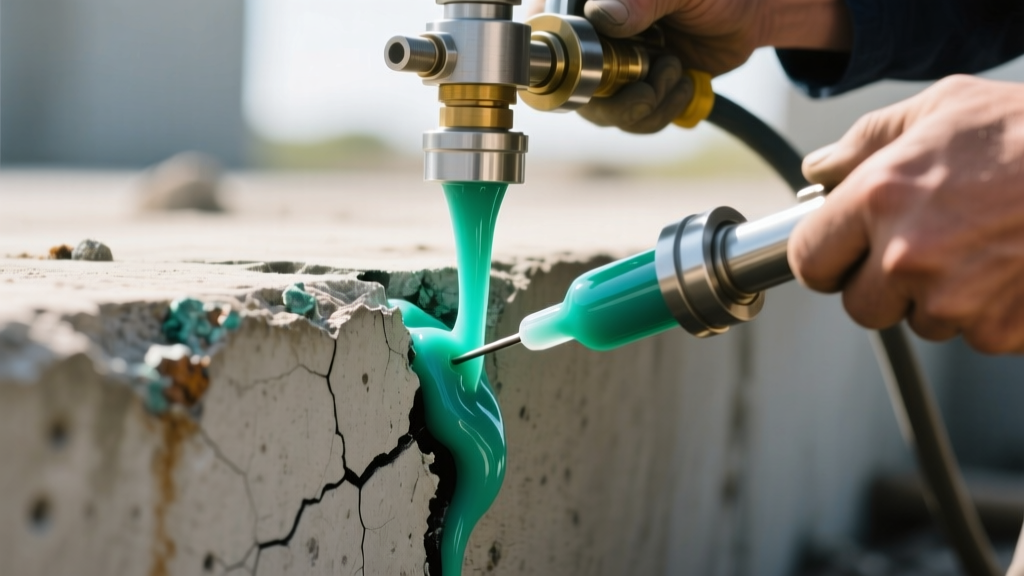
- V-Groove Routing: The technician uses a diamond-blade angle grinder to widen the surface of the crack to 1/2 inch deep and 1/2 inch wide. This creates a reservoir for the surface seal.
- Port Adhesion: Plastic injection ports are aligned over the crack and secured using a fast-setting, high-strength surface epoxy paste.
- Surface Sealing: The entire crack between the ports is coated with the same epoxy paste to create an airtight, watertight containment vessel. This prevents the injected resin from blowing out into the basement.
- Bottom-Up Injection: Resin is injected into the lowest port. Once resin extrudes from the port directly above it, the lower port is capped, and the gun is moved to the next port. This ensures the crack is filled completely from the footing to the top, eliminating air pockets.
- Curing and Snap-Off: Polyurethane cures in 15 to 30 minutes; epoxy requires 12 to 24 hours. After curing, the plastic ports are snapped off flush with the wall.
Frequently Asked Questions
Does homeowners insurance cover vertical foundation crack repair?
Standard homeowners insurance policies explicitly exclude foundation settling, shrinkage, and earth movement. Insurance will only cover the repair if the crack was directly caused by a sudden, covered peril, such as a vehicle striking the foundation or a localized plumbing explosion. Routine vertical crack sealing is strictly an out-of-pocket maintenance expense.
How long does a polyurethane injection last?
High-quality, hydrophobic polyurethane resins are chemically inert once cured and do not degrade in the presence of water or soil acids. When injected correctly through the entire wall thickness, the repair is considered permanent and will outlast the remaining lifespan of the concrete structure itself. Most reputable contractors offer 10-year to lifetime transferable warranties on polyurethane injections.
Can I just use hydraulic cement to plug the crack?
Hydraulic cement (like WaterPlug) is a rigid, crystalline patching compound. While it stops active water flow temporarily, it lacks flexibility. As the foundation undergoes microscopic thermal expansion and contraction, the rigid hydraulic cement will crack away from the concrete substrate within 6 to 12 months, allowing water to bypass the plug. It is only suitable as a temporary emergency measure before performing a proper polyurethane injection.
Written by
James ThorntonJames Thornton is a construction industry veteran with 25 years of hands-on experience in wood framing, lumber grading, and residential building codes. He started as a framing carpenter in rural Oregon, earned his ICC Residential Building Inspector certification, and eventually became a senior plan reviewer for the City of Portland Bureau of Development Services. James holds a B.S. in Wood Science & Technology from Oregon State University and is a certified lumber grader through the West Coast Lumber Inspection Bureau (WCLIB). He has inspected over 3,000 residential construction sites and authored the city's internal guide on advanced framing techniques (2x6 at 24" O.C.). James lives in Bend, OR, where he builds custom timber-frame cabins and competes in lumberjack sports.
More from James Thornton
View all
Insulation
Best Home Insulation Materials: Complete 2026 Guide
Compare top home insulation materials for 2026. Find R-values, installed costs per square foot, and best uses for fiberglass, spray foam, and mineral wool.
Aug 4, 2026

Sustainable Building
Certify Your Green Building Material for LEED and WELL
Step-by-step guide to certifying a green building material for LEED v5 and WELL v2. Master EPDs, HPDs, and VOC limits for 2026 project specifications.
Aug 4, 2026

Stone & Masonry
Veneer Stacked Stone Panels: Interior Design & Style Showcase
Discover how veneer stacked stone panels transform interiors. Explore modern design profiles, material pairings, and technical installation specs.
Aug 4, 2026