How Much Does It Cost to Build a Basement Foundation by Region (2026)
Discover how much it costs to build a basement foundation across US regions in 2026. Get precise pricing, soil factors, and frost line requirements.

National Averages vs. Regional Basement Foundation Costs
When homeowners and builders ask how much does it cost to build a basement foundation, national averages only tell a fraction of the story. In 2026, the national average for a full, 2,000-square-foot poured concrete basement foundation ranges from $40,000 to $75,000 ($20 to $37.50 per square foot). However, regional geology, frost line depths, and local building codes create massive price disparities. A basement in the rocky soils of New England can easily cost double what a similarly sized basement costs in the deep, loamy soils of the Midwest.
According to the NAHB Construction Cost Survey, foundation work typically accounts for 10% to 15% of total construction costs, but this spikes in regions requiring extensive excavation or specialized waterproofing. Below is the 2026 regional cost breakdown for a standard 2,000 sq. ft. full basement.
| Region | Cost Per Sq. Ft. | Total Cost (2,000 Sq. Ft.) | Primary Cost Driver |
|---|---|---|---|
| Northeast | $45 - $65 | $90,000 - $130,000 | Bedrock excavation, deep frost lines |
| Midwest | $25 - $40 | $50,000 - $80,000 | Expansive clay, freeze-thaw concrete |
| Southeast | $40 - $60 | $80,000 - $120,000 | High water tables, hydrostatic pressure |
| West / Mountain | $35 - $55 | $70,000 - $110,000 | Seismic engineering, sloped topography |
The Three Regional Drivers of Basement Pricing
To accurately budget for a basement foundation, you must evaluate the subsurface conditions and climate mandates specific to your build site. The HUD Foundation Design Guide outlines three primary environmental factors that dictate structural requirements and, consequently, cost.
1. Frost Line Depth and Footing Dimensions
Building codes require foundation footings to extend below the local frost line to prevent frost heave, which can crack and shift the foundation. In Atlanta, the frost line is roughly 12 inches deep, requiring minimal over-excavation. In Minneapolis, the frost line drops to 60 inches. Deeper footings require more cubic yards of concrete, extended forming labor, and larger excavation volumes. Expect to pay an additional $4 to $8 per linear foot of footing for every 12 inches of depth required beyond the standard 24-inch baseline.
2. Soil Bearing Capacity and Expansive Clays
Soil type dictates the width of your footings and the need for soil remediation. The Midwest and parts of Texas feature highly expansive clays that swell when wet and shrink when dry. Building on these soils often requires over-excavating 2 to 4 feet and replacing the native clay with engineered, non-expansive fill (like crushed limestone or gravel) to create a stable bearing pad. This soil replacement adds $3,000 to $7,000 to the foundation budget.
3. Hydrostatic Pressure and Water Table Management
Basements act as dams against groundwater. In regions with high water tables, such as the Southeast and coastal areas, hydrostatic pressure can push water through microscopic pores in the concrete or cause catastrophic wall bowing. These regions mandate exterior waterproofing membranes (like 60-mil EPDM or peel-and-stick bituminous sheets like Tremco Paraseal), exterior rigid insulation protection boards, and perforated perimeter French drains tied to dual sump pumps. This comprehensive waterproofing system adds $8 to $12 per square foot of below-grade wall area.
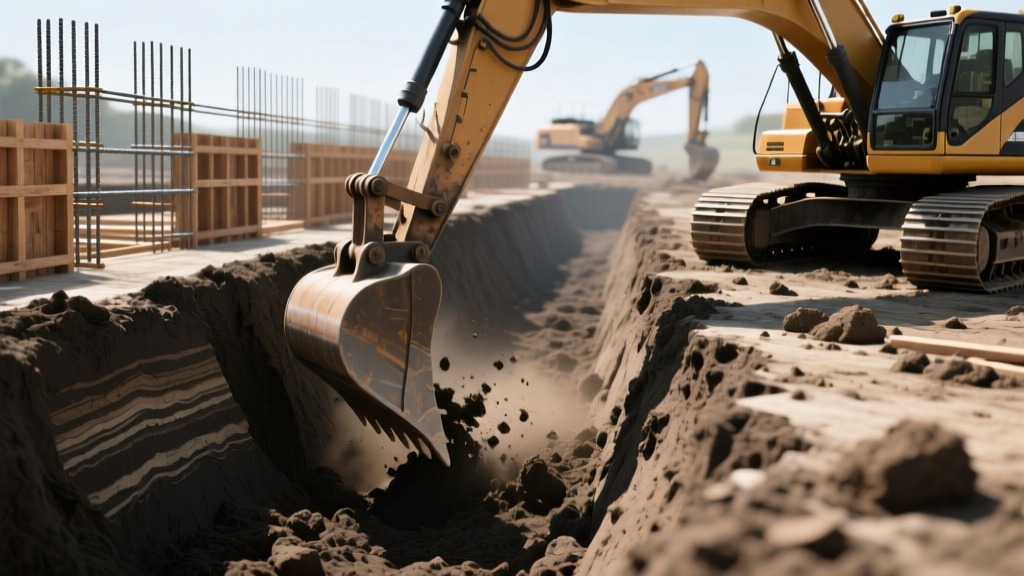
If your site sits on shallow bedrock or ledge, standard excavation is impossible. Blasting and removing rock costs between $15 and $30 per cubic yard. Hitting a massive granite shelf can add $15,000 to $40,000 to your excavation budget. Always invest in a geotechnical soil boring report ($1,500 - $3,000) before purchasing land in rocky regions.
2026 Regional Cost Profiles & Structural Requirements
Northeast & New England
The Northeast features some of the highest foundation costs in the country due to a combination of deep frost lines (48+ inches), high labor rates, and prevalent bedrock. Poured concrete walls are standard, typically specified at 4,000 PSI with air-entrainment to survive brutal freeze-thaw cycles. Because basements here are frequently used as conditioned living space, builders increasingly use Insulated Concrete Forms (ICFs) like Fox Blocks or Nudura. While ICFs add $4 to $6 per square foot of wall area upfront, they eliminate the need for separate interior framing and insulation, yielding a net-zero cost premium while drastically reducing heating loads.
Midwest & Great Plains
The Midwest offers the most favorable economics for basement construction. Deep, easily excavated loam and clay soils keep earthwork costs low. However, the severe temperature swings require strict attention to concrete curing and reinforcement. Standard practice in 2026 includes using #4 or #5 rebar placed horizontally at 16 inches on-center, combined with vertical dowels tying the wall to the footing. Radon mitigation is also a mandatory consideration here; installing a passive sub-slab depressurization system (with an active fan upgrade ready) during the pour costs only $800 to $1,200, compared to $2,500+ for a post-construction retrofit.
Southeast & Gulf Coast
Basements are rare in the deep South due to the high water table and sandy soils, but they are common in hilly areas like Atlanta or the Texas Hill Country. The primary expense here is water management. Excavators must frequently employ dewatering systems—running trash pumps continuously during the footing pour to prevent the concrete from washing out. Furthermore, local codes often require advanced termite barriers, such as Termimesh stainless steel mesh or physical sand barriers, integrated directly into the foundation penetrations and joints.
West Coast & Mountain Regions
In seismic zones (California, Pacific Northwest), basement foundations must act as rigid shear walls to resist lateral earth and earthquake forces. Engineers specify dense rebar schedules (e.g., #5 rebar at 12 inches O.C. both ways) and heavy-duty Simpson Strong-Tie hold-downs anchored deep into the footings to create a continuous load path. In mountainous regions like Colorado or Utah, sloped lots require stepped footings and retaining wall engineering for the downhill side of the basement, which can increase concrete volume by 30% to 50%.
Ready-mix concrete prices in 2026 average $140 to $165 per cubic yard delivered. However, many regional batch plants enforce strict 'short load' fees for orders under 5 yards, and 'wait time' penalties if your crew cannot unload the truck within 90 minutes. Always order 10% overage and have a secondary pour site (like a patio pad or extra driveway thickness) planned for leftover material.
Hidden Regional Costs to Budget For
Beyond the raw materials and excavation, regional site conditions trigger secondary costs that frequently blow up foundation budgets. Factor these into your preliminary estimates:
- Geotechnical Engineering Report: $1,500 – $3,500. Mandatory in regions with expansive soils, high water tables, or seismic risks to determine bearing capacity and recommend footing widths.
- Shoring and Trench Boxes: $2,000 – $5,000. OSHA requires protective shoring for trenches deeper than 5 feet. In sandy coastal soils, trench boxes are required even for shallower footing excavations to prevent cave-ins.
- Interior French Drain & Sump System: $3,500 – $6,000. Essential in the Midwest and Northeast to manage interior hydrostatic pressure and protect finished basement spaces.
- Backfill Material Import: $1,500 – $4,000. Native clay cannot be used to backfill against basement walls due to expansion and poor drainage. You must import washed #57 gravel or clean crushed stone.
- Crane Services for Precast Walls: $2,500 – $4,500. If utilizing precast concrete basement walls (like Superior Walls) to speed up construction in cold climates, a mobile crane is required for setting the panels.
Decision Framework: Is a Basement Viable in Your Region?
Before committing to a basement foundation, run your site through this structural viability checklist based on regional data from the PNNL Building Science Guidelines and local geological surveys:
- Check the Seasonal High Water Table (SHWT): If the SHWT is within 4 feet of the surface, a full basement will require continuous, high-capacity pumping and exterior tanking. Consider a crawlspace or slab-on-grade instead.
- Identify Bedrock Depth: If test pits reveal solid ledge within 3 feet of grade, the blasting costs will likely exceed the value of the finished basement space.
- Evaluate the Frost Line vs. Usable Depth: In extreme northern climates, you must dig 6+ feet just to get the footing below the frost line. Since you are already excavating that deep, adding the remaining 2-3 feet to create a full 8-foot or 9-foot basement wall yields a high return on investment compared to a shallow crawlspace.
- Assess Topography: On slopes greater than 10%, a 'walk-out' or 'look-out' basement becomes structurally complex, requiring engineered retaining walls on the uphill side. The premium for the natural light and separate entrance usually justifies the 20% to 30% cost increase.
Understanding how much does it cost to build a basement foundation requires looking past the square-footage metrics and analyzing the dirt, water, and climate specific to your zip code. By budgeting for regional soil remediation, precise frost-line footings, and localized waterproofing mandates, you can prevent mid-construction change orders and ensure a structurally sound below-grade space.
Written by
Sarah WhitfieldSarah Whitfield is a chartered quantity surveyor (MRICS) and construction cost analyst with 15 years of experience in material pricing, procurement strategy, and project budgeting. She earned her degree in Construction Management from the University of Reading (UK) and has worked on projects ranging from $2M custom homes to $180M mixed-use developments across North America and Europe. Sarah currently leads cost estimating for BuildMat Insight, maintaining a proprietary database of 4,000+ material price points updated quarterly. She is a frequent contributor to RSMeans cost data panels and has presented at the International Cost Engineering Council (ICEC) congress. Based in Denver, CO, Sarah is an avid trail runner and volunteer mentor for Women in Construction.
More from Sarah Whitfield
View all
Wood & Lumber
What Are the Different Types of Wood? A Builder's Guide
Compare structural softwoods, finish hardwoods, and engineered lumber. Analyze Janka ratings, MOE values, and 2026 pricing for construction.
Aug 4, 2026

Walls & Panels
Steel Framing vs Wood Framing: Corrosion and Moisture Defense
Compare steel framing vs wood framing for moisture resistance. Learn about galvanized coatings, condensation risks, and corrosion protection strategies.
Jul 21, 2026

Stone & Masonry
How to Cut Stone Veneer: Wet Saw vs Grinder Comparison
Compare the best tools for cutting stone veneer. We review wet saws, angle grinders, and chop saws to help you achieve clean, chip-free cuts.
Jul 21, 2026