Wet Basement Fixes: WaterGuard vs. Hydraway Interior Drainage
Compare WaterGuard and Hydraway interior drainage systems to fix a wet basement. Explore costs, clog-resistance specs, and installation frameworks.
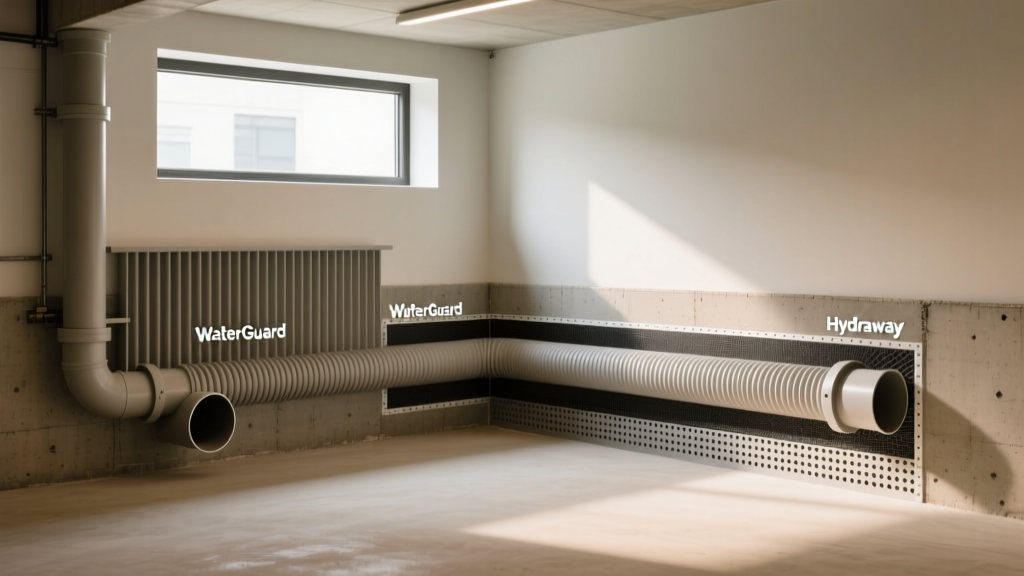
The Engineering Reality of a Wet Basement
A wet basement is rarely a surface-level issue; it is a symptom of hydrostatic pressure. When the water table rises, saturated soil exerts up to 2,000 lbs of lateral force per square foot against foundation walls. This pressure forces groundwater through cold joints, floor cracks, and porous concrete. While exterior excavation and membrane application is the theoretical ideal, it costs upwards of $25,000 and requires destroying landscaping. Consequently, interior perimeter drainage has become the industry standard for managing hydrostatic relief.
The interior drainage market is dominated by two distinct engineering philosophies: the rigid PVC flange systems pioneered by Basement Systems (WaterGuard), and the geosynthetic core systems manufactured by Hydrotech International (Hydraway). Choosing between them requires understanding soil composition, iron ochre presence, and slab thickness.
Brand Deep-Dive: Basement Systems WaterGuard
WaterGuard is a patented, high-density polyethylene (HDPE) and PVC drainage channel designed specifically to address the most common failure point in traditional French drains: silt and mud infiltration.
Design and Footing Placement
Traditional interior drains are buried in gravel next to the footing, where they inevitably clog with fine clay and silt. WaterGuard solves this by resting on top of the concrete footing, positioned directly beneath the basement slab. It features a proprietary 3/8-inch wall flange that extends upward to intercept water migrating down the foundation wall before it reaches the floor.
Iron Ochre and Cleanout Architecture
In regions with high iron content in the soil, iron bacteria oxidize to form a thick, gelatinous sludge known as iron ochre. This sludge destroys standard perforated pipes. WaterGuard integrates threaded cleanout ports every 15 to 20 linear feet, allowing contractors to flush the system with high-pressure water without breaking the concrete floor.
Brand Deep-Dive: Hydraway Drainage Systems
Hydraway abandons the "pipe and gravel" paradigm entirely, utilizing a geocomposite core wrapped in a thermally bonded geotextile filter fabric. It is engineered for high-flow environments and tight spatial constraints.
Geosynthetic Core Mechanics
The Hydraway 300 and 1000 series feature a 1.25-inch thick geonet core. According to geosynthetic flow testing, this core provides 70% more void space for water entry compared to traditional washed gravel. Water enters the geotextile fabric and is immediately channeled through the geonet core into the integrated 4-inch discharge pipe.
Clog Resistance and Filter Fabric
The primary vulnerability of any interior drain is the filter medium. Hydraway uses a non-woven, thermally bonded geotextile fabric rather than mechanical needle-punched fabrics. This prevents the fabric from stretching or tearing during the installation of the concrete floor overlay, maintaining a strict soil-separation barrier that keeps fine clays out of the discharge pipe.
Head-to-Head Comparison Matrix
| Specification | WaterGuard (Basement Systems) | Hydraway 300/1000 (Hydrotech) |
|---|---|---|
| Core Material | Rigid PVC / HDPE Channel | Geocomposite Geonet Core |
| Wall Interception | 3/8" Molded Flange | Requires separate wall membrane tie-in |
| Footing Placement | On top of footing | Adjacent to or on footing (profile dependent) |
| Iron Ochre Mitigation | Excellent (Integrated cleanout ports) | Moderate (Requires external cleanout access) |
| Flow Rate Capacity | High (Large open channel) | Very High (Geonet void space) |
| Avg. Material Cost | $35 - $45 per linear foot | $28 - $38 per linear foot |
Cost Breakdown and Project ROI
Pricing for interior drainage is heavily dependent on linear footage, concrete demolition requirements, and sump pump specifications. Below is a realistic cost framework for a standard 120-linear-foot rectangular basement in 2026.
- WaterGuard System (120 ft): $7,200 - $8,400 (Includes demolition, channel, cleanouts, and floor restoration).
- Hydraway System (120 ft): $6,000 - $7,500 (Lower material cost, but similar labor for concrete demolition).
- Sump Pump Integration: Both systems require a high-capacity sump basin. Pairing with a primary Zoeller M53 1/3 HP pump ($350) and a Wayne CDU980E battery backup system ($850) adds roughly $1,200 to the total project cost.
Decision Framework: Selecting the Right System
Do not default to the cheapest bid. Base your selection on the specific failure mode of your foundation, as outlined by EPA moisture control guidelines and structural engineering best practices.
Choose WaterGuard When:
- You have active wall leaks: The integrated 3/8-inch flange is superior for catching water migrating down poured concrete or block walls before it pools on the floor.
- Soil tests indicate high iron content: The accessible, threaded cleanout ports are non-negotiable for flushing iron ochre sludge every 18 to 24 months.
- The footing is unusually wide or irregular: WaterGuard's rigid structure bridges minor footing inconsistencies better than flexible geocomposites.
Choose Hydraway When:
- Floor slab thickness is minimal: If your basement slab is less than 3 inches thick, excavating a deep trench for rigid PVC risks undermining the structural integrity of the floor. Hydraway's lower profile requires less aggressive trenching.
- Water volume is exceptionally high: The geonet core's rapid water-entry rate is ideal for properties situated at the base of a hill or in areas with a seasonally high water table where sudden hydrostatic spikes occur.
- Radon mitigation is a priority: The geotextile wrapping provides an excellent secondary seal when integrated with a sub-slab depressurization radon system.
Critical Installation Gotchas
The best drainage channel will fail if the installation ignores secondary water management. Ensure your contractor adheres to the following specifications:
- The Vapor Barrier Mandate: Interior drainage only manages liquid water. You must pair the drain with a Class I vapor barrier (like a 20-mil polyethylene liner) mechanically fastened to the walls and tucked into the drainage flange. This stops water vapor transmission, which is responsible for 90% of basement mold growth and humidity issues.
- Pitching the Floor: When pouring the new concrete over the drainage channel, the floor must be pitched at a minimum of 1/4-inch per foot toward the drain. Flat floors will allow water to pool in the center of the room before reaching the perimeter.
- Sump Basin Seal: The sump basin lid must be hermetically sealed with a mechanical gasket and bolted down. An unsealed basin will allow radon gas and soil moisture to evaporate directly into the living space, negating the benefits of the perimeter drain.