Best Materials for Metal Roof Repair and Maintenance
Discover the best materials for metal roof repair, including butyl tapes, polyurethane sealants, and zinc primers to fix leaks, rust, and loose fasteners.

Diagnosing Metal Roof Degradation: Why Leaks Occur
Metal roofing systems routinely achieve 40- to 60-year lifespans, but they are not immune to environmental stress. The primary catalyst for metal roof failure is thermal cycling. A 100-foot run of steel roofing can expand and contract up to 1.5 inches between winter nights and summer afternoons. This constant movement causes fastener back-out, seam separation, and the eventual tearing of sealant beads. When selecting materials for metal roof repair, you must prioritize products with high elongation properties and UV stability to accommodate this continuous thermal movement.
The Core Arsenal: Repair Materials for Metal Roof Systems
Effective maintenance requires matching the specific failure mode with the correct chemical and mechanical repair material. Below is the technical breakdown of the industry-standard materials for metal roof remediation.
1. Replacement Fasteners and Washers
Fastener back-out and washer degradation account for roughly 70% of all metal roof leaks in exposed-fastener systems. When replacing failed screws, do not reuse the existing holes without upsizing.
- Screw Specification: Use #12 diameter (oversized from the original #10) x 1.5-inch length hex-washer-head screws with a Type 17 drilling point. The Type 17 point acts as a self-tapping auger, clearing debris from the hole without requiring pre-drilling.
- Washer Material: Demand EPDM (Ethylene Propylene Diene Monomer) washers with a minimum thickness of 0.060 inches. Avoid neoprene washers, which dry-rot and crack under UV exposure within 5 to 7 years. EPDM maintains elasticity for up to 25 years.
- Torque Control: Fasteners must be driven to exactly 15 to 20 inch-pounds of torque. Overdriving compresses and cuts the EPDM washer, creating an immediate leak path. Use a cordless drill with an adjustable clutch set to slip just as the washer makes full contact and bulges slightly past the metal edge.
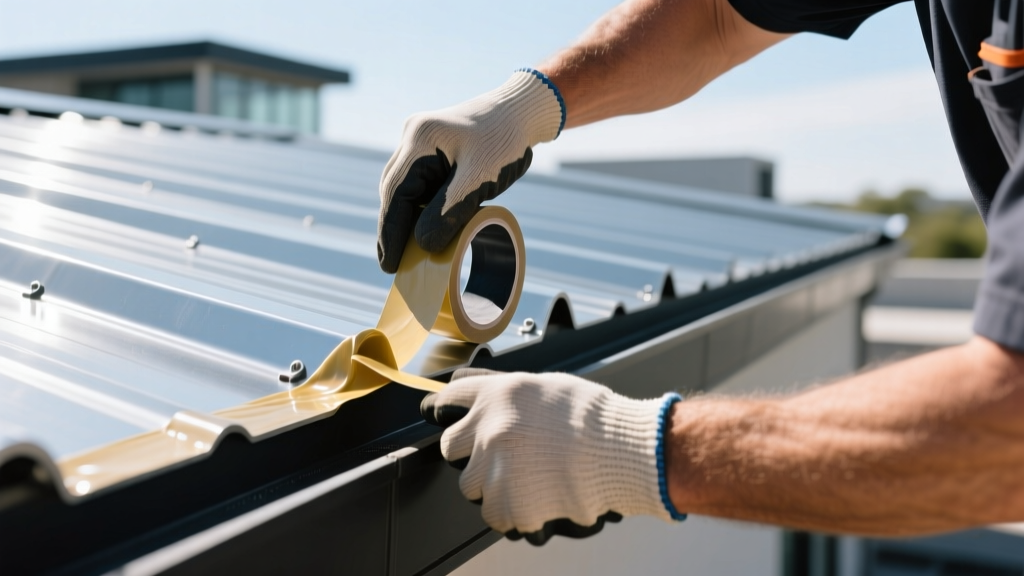
2. Sealants and Tapes for Seams and Flashings
Sealant selection depends entirely on whether the joint is concealed (under a lap) or exposed to direct sunlight and weather.
| Sealant Type | Best Application | Movement Capability | UV Resistance |
|---|---|---|---|
| Butyl Tape (100% Solids) | Concealed lap seams, ridge caps | Non-curing, infinite | Poor (Must be concealed) |
| Polyurethane (e.g., Geocel 2300) | Exposed flashings, penetrations, transitions | ±25% joint movement | Moderate (Paintable) |
| High-Modulus Silicone | Glass-to-metal, specific HVAC curbs | ±50% joint movement | Excellent (Cannot be painted) |
For exposed lap seams and flashing transitions, a high-quality polyurethane sealant like Geocel 2300 Architectural Grade or Titebond WeatherMaster is the standard. These materials adhere aggressively to Kynar 500 and SMP (Silicone Modified Polyester) painted finishes without requiring a primer, and they can be top-coated to match the roof color.
3. Rust Remediation and Touch-Up Coatings
Surface scratching during installation or debris accumulation in valleys leads to localized oxidation. Addressing rust requires a strict three-step chemical protocol to prevent the corrosion from creeping beneath the factory paint.
- Mechanical Prep (SSPC-SP3): Use a wire cup brush on an angle grinder to remove all loose scale and red rust down to bare, shiny metal. Follow the Sheet Metal and Air Conditioning Contractors' National Association (SMACNA) guidelines for surface preparation, ensuring no feathered edges remain.
- Solvent Wipe: Wipe the abraded area with xylene or a dedicated metal prep solvent to remove grinding oils and microscopic dust.
- Zinc-Rich Primer: Apply a cold galvanizing compound containing a minimum of 90% zinc dust in the dry film (e.g., Rust-Oleum Cold Galvanizing Compound). The zinc acts as a sacrificial anode, corroding preferentially to protect the underlying steel substrate.
- PVDF Topcoat: Finish with a Kynar 500/Hylar 5000-based PVDF (polyvinylidene fluoride) touch-up paint. PVDF resins resist UV degradation and chalk far better than standard acrylic or polyester touch-up paints.
Galvanic Corrosion Compatibility Matrix
One of the most common maintenance errors is introducing dissimilar metals during a repair. When two dissimilar metals are in contact in the presence of an electrolyte (rainwater), galvanic corrosion occurs, rapidly destroying the less noble metal. Consult this matrix before selecting materials for metal roof repairs, as recommended by the Metal Construction Association.
| Base Roof Metal | Safe Contact Metals | Destructive Contact Metals (Avoid) |
|---|---|---|
| Galvanized Steel | Zinc, Aluminum, Stainless Steel | Copper, Uncoated Steel |
| Galvalume® | Zinc, Aluminum, Stainless Steel | Copper, Lead |
| Aluminum | Zinc, Galvalume, Stainless Steel | Copper, Galvanized Steel (without isolation) |
| Copper | Stainless Steel, Lead | Steel, Aluminum, Zinc, Galvalume |
Step-by-Step Fastener and Seam Repair Protocol
When executing repairs on an aging exposed-fastener metal roof, follow this sequence to ensure long-term adhesion and watertight integrity.
- Clean the Substrate: Wash the repair area with a mild, non-abrasive detergent (like Simple Green) and a soft-bristle brush. Rinse thoroughly. According to the National Roofing Contractors Association (NRCA), sealants will fail if applied over chalked paint, dirt, or biological growth.
- Remove Failed Fasteners: Back out loose screws. Do not simply drive them deeper, as the threads in the purlin are already stripped.
- Upsize and Replace: Drive the new #12 x 1.5-inch EPDM washer screws into the existing holes. Stop driving the moment the washer squeezes out uniformly around the metal washer head.
- Apply Seam Sealant: For horizontal lap seams that have separated, use a putty knife to pack polyurethane sealant into the joint. Tool the sealant with a wet finger or spatula to create a slight concave profile, which sheds water more effectively than a convex bead.
- Re-engage Laps: If the seam has pulled apart, use a hand seamer or locking pliers with padded jaws to gently bend the metal back into engagement before the sealant skins over (usually within 10 to 15 minutes for polyurethanes).
When Repair Materials Are Not Enough
While high-quality materials for metal roof repair can extend a system's life by decades, localized maintenance cannot fix systemic failures. If you observe oil-canning (severe rippling of the panels), widespread fastener back-out affecting more than 30% of the roof, or delamination of the factory paint coating (chalking beyond a Hunter Delta E of 5), the substrate or structural attachments have failed. In these scenarios, applying sealants and new screws is a temporary bandage; a full panel replacement or a metal-over-metal retrofit system is the only viable engineering solution.
Written by
Marcus ChenMarcus Chen is a licensed structural engineer (PE) and building materials analyst with over 12 years of experience across residential, commercial, and industrial construction. He holds a Master of Science in Civil Engineering from UC Berkeley and spent six years at Thornton Tomasetti before transitioning to independent consulting and technical writing. Marcus specializes in material selection for seismic-prone regions, concrete reinforcement strategies, and lifecycle cost analysis. His work has been cited by the American Concrete Institute (ACI) and the Structural Engineers Association of California (SEAOC). When he is not on a job site or at his desk, you will find him hiking the Sierra Nevada or restoring a 1920s craftsman bungalow in Oakland, CA.
More from Marcus Chen
View all
Construction Cost
How Much Did the Eiffel Tower Cost to Build?
How much did the Eiffel Tower cost to build in 1889? We adjust for inflation and compare its budget to modern skyscraper construction.
Aug 4, 2026

Fire Resistance
What Is a Fire Resistant Material? Testing & Certification Guide
Discover what is a fire resistant material through ASTM and UL testing. Learn how fire ratings, certifications, and assemblies work in construction.
Aug 4, 2026

Construction Cost
How Much Did the Burj Khalifa Cost to Build?
How much did the Burj Khalifa cost to build? We break down the $1.5B project and extract 5 money-saving strategies for your next build.
Jul 30, 2026