Synthetic Roof Underlayment Taxonomy: Woven vs. Non-Woven Selection
Compare woven and non-woven synthetic roof underlayment. Learn permeability ratings, UV limits, and selection criteria for asphalt, metal, and tile roofs.
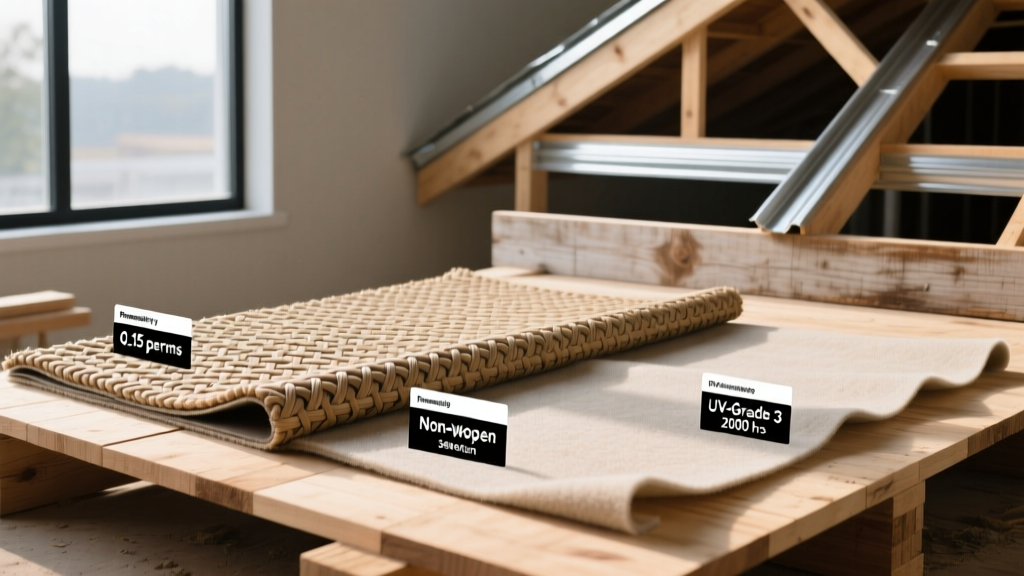
The Core Taxonomy: Woven vs. Non-Woven Synthetics
Synthetic roof underlayment is not a monolithic product category. The market is fundamentally divided into two distinct manufacturing processes: woven polypropylene and non-woven spunbound polyolefin/polyester. Understanding the material science behind these two types is the first step in specifying the correct water-resistive barrier (WRB) for your roof assembly.
Woven Polypropylene (The Scrim-Based Approach)
Woven synthetics are manufactured by extruding polypropylene into tapes, weaving them into a grid (scrim), and then coating both sides with polyethylene or polypropylene film. This creates a highly durable, tear-resistant sheet. However, the coating process inherently limits the material's vapor permeability. Most standard woven underlayments rate between 1 and 10 perms, functioning as a Class II or Class III vapor retarder rather than a breathable membrane.
Non-Woven Spunbound (The Micro-Porous Approach)
Non-woven synthetics are created by extruding continuous polyolefin or polyester filaments and bonding them thermally or chemically into a randomized, felt-like matrix. This micro-porous structure allows liquid water to be blocked while permitting water vapor to escape. Premium non-woven underlayments frequently achieve permeability ratings of 20 to 50+ perms, classifying them as highly breathable Class I vapor barriers (when considering the entire assembly) or unrestricted WRBs. This breathability is critical for unvented roof assemblies or homes with closed-cell spray foam insulation applied directly to the roof deck.
Material Science Note: The Building America Solution Center emphasizes that in cold climates or highly air-conditioned homes in hot-humid zones, the vapor permeability of the underlayment must be coordinated with the interior vapor retarder to prevent interstitial condensation within the OSB or plywood decking.
Performance Matrix: Comparing Top-Tier Synthetics
When selecting a product, contractors must look beyond the marketing claims and evaluate the technical data sheets. Below is a comparison of three industry-standard synthetic underlayments representing different material constructions and performance tiers.
| Product / Brand | Material Type | Weight (lbs/sq) | Permeability (Perms) | Max UV Exposure | Approx. Cost (per square) |
|---|---|---|---|---|---|
| Epilay Protec 120 | Non-Woven Polyolefin | 2.2 lbs | 22 Perms | 12 Months | $28 - $34 |
| Titanium UDL30 | Woven PP / Coated | 2.4 lbs | 8 Perms | 6 Months | $22 - $28 |
| DuPont Tyvek Protec 160 | Non-Woven Spunbound | 3.1 lbs | 50+ Perms | 9 Months | $38 - $45 |
| Standard #15 Felt | Asphalt-Saturated Organic | 8.0 lbs | 5-15 Perms (Variable) | 30 Days | $12 - $16 |
Note: Pricing reflects 2026 wholesale distributor averages for full-pallet purchases. One 'square' equals 100 square feet of coverage.
Climate and Pitch Selection Framework
The National Roofing Contractors Association (NRCA) recommends matching the underlayment's physical properties to the specific environmental and structural demands of the project. Use the following decision framework to specify the correct material:
- Low-Slope Roofs (2:12 to 4:12 pitch): Water drains slowly, increasing the risk of capillary action and wind-driven rain intrusion. Specify a heavy-weight non-woven (3.0+ lbs per square) or a self-adhering ice and water shield (ASTM D1970) for the entire deck. Standard woven synthetics are not recommended here due to seam vulnerability.
- Steep-Slope Roofs (5:12 to 12:12 pitch): Rapid water shedding allows for standard synthetic use. Woven products perform exceptionally well here due to their high tensile strength and lower cost, provided the primary roofing is installed within the UV exposure window.
- High-Wind / HVHZ Regions (e.g., Florida Coast): Building codes in High-Velocity Hurricane Zones often mandate non-woven synthetics with specific cap-nail fastening patterns (e.g., 12-inch on-center grid). Non-woven materials seal tighter around the fastener shaft, reducing the risk of water tracking down the nail shank during pressure-equalization events.
Fastener Pull-Through and Sealant Integration
A frequently overlooked failure mode in synthetic underlayment installation is fastener compatibility. The physical structure of the material dictates how it interacts with roofing nails and cap staples.
The Woven 'Fishmouth' and Tear Risk
Because woven underlayments rely on a grid of extruded tapes, a standard roofing nail driven through the material can split the polypropylene yarns. Under high wind uplift, this micro-tear can propagate, leading to fastener pull-through. Furthermore, woven materials are highly susceptible to 'fishmouths' (wrinkles that prevent flat adhesion to the deck). To mitigate this, manufacturers like Epilay and Titanium mandate the use of 1-inch or 2-inch plastic cap nails, which distribute the holding force over a wider area and seal the puncture.
Non-Woven Sealing Dynamics
Non-woven mats do not have a directional grain or woven yarns to split. When a nail penetrates a spunbound polyolefin membrane, the randomized fibers compress tightly around the nail shank. While cap nails are still the best practice for high-wind warranties, non-woven synthetics can safely be installed with standard galvanized roofing nails in moderate-wind zones without sacrificing water resistance at the puncture site.
Compatibility Rules: Matching Underlayment to the Primary Roof
The primary roofing material generates specific thermal and UV conditions that the underlayment must withstand.
- Metal Roofing (Standing Seam & Exposed Fastener): Metal roofs conduct extreme heat, often pushing deck temperatures past 160°F (71°C) in summer. You must select a synthetic with a high thermal rating (minimum 240°F / 115°C). Additionally, non-woven synthetics with high-friction, slip-resistant top coatings are mandatory for installer safety on steep metal pitches.
- Clay and Concrete Tile: Tile installations are slow. The underlayment may be exposed to direct sunlight for weeks or months before the battens and tiles are laid. Specify a woven or non-woven product with a minimum 6-to-12-month UV rating. Standard 30-day UV underlayments will degrade, chalk, and lose their hydrophobic properties if left exposed too long.
- Asphalt Shingles: Asphalt shingles provide immediate UV protection but trap heat. Any standard ASTM D226-equivalent synthetic is acceptable, though non-woven is preferred in unvented cathedral ceiling assemblies to allow the deck to dry outward.
Installation Gotchas and Edge Cases
Even the most expensive synthetic underlayment will fail if installation protocols are ignored. Pay attention to these critical edge cases:
- Seam Taping Requirements: Synthetic underlayments do not self-seal at the overlaps like asphalt-saturated felt does when heated by the sun. Horizontal and vertical seams must be sealed. Use butyl-based tape for low-temperature applications (below 40°F) and acrylic-based tape for standard conditions. Never use standard duct tape or asphalt-based flashing cements, which will degrade the polyolefin coating.
- The 'Wet Deck' Slip Hazard: While many synthetics advertise 'slip-resistant' surfaces, this testing is done on dry or lightly dewed surfaces. When covered in a layer of wet sawdust, mud, or morning frost, the polypropylene surface becomes exceptionally slick. Always utilize fall arrest systems and roof brackets, regardless of the underlayment's traction marketing.
- Reverse Lap Errors: Water must flow over the overlaps, not into them. Ensure a minimum 2-inch side lap and a 4-inch head lap. In valleys, the underlayment must be run vertically up the valley center, with horizontal field sheets lapping over the valley material, not under it.
Frequently Asked Questions
Can I install synthetic underlayment directly over rigid foam insulation?
No. Synthetic underlayments require a solid, continuous nailable substrate like OSB, plywood, or spaced wood sheathing. If you are using rigid foam above the deck, the underlayment must be installed between the structural deck and the foam, or you must use a specialized structural underlayment rated for direct-to-foam application with specific fastener lengths that penetrate through the foam into the structural deck.
Does synthetic underlayment replace ice and water shield?
No. Synthetic underlayment is a water-resistive barrier (WRB) designed to shed bulk water. It is not a self-adhering, waterproofing membrane. Building codes still require an ice and water protector (ASTM D1970) in valleys, at eaves, around penetrations, and at roof-to-wall transitions, regardless of the synthetic underlayment used in the field.
How long can synthetic underlayment be left exposed to the sun?
UV resistance varies strictly by manufacturer and product line. Standard economy synthetics are rated for 30 to 90 days. Premium products (like Epilay Protectite or Titanium UDL50) can be rated for 6 to 12 months. Always check the specific product's technical data sheet, as exceeding the UV limit voids the manufacturer's warranty and causes the material to become brittle and lose its hydrophobicity.