Car Roof Material Guide: Carports and Vehicle Canopies
Explore the best car roof material options for carports, RV covers, and vehicle canopies, including polycarbonate, Galvalume, and TPO membranes.

The Engineering Divide: Automotive vs. Architectural Vehicle Shelters
When architects, builders, and property owners search for a 'car roof material,' they are rarely looking for stamped boron steel or panoramic tempered glass used in automotive manufacturing. Instead, the search intent targets architectural vehicle shelters: carports, RV covers, boat canopies, and enclosed auto garages. While the material science of automotive roofs (high-strength steel alloys, lightweight carbon fiber) influences modern canopy design, structural vehicle shelters must comply with entirely different physical demands. Architectural car roofs must withstand ASCE 7-22 wind uplift calculations, localized snow drift loads, and severe hail impact (UL 2218 Class 4), all while spanning open bays without the structural support of a unibody vehicle frame.
Selecting the correct car roof material for a vehicle shelter requires balancing light transmission, thermal expansion, galvanic compatibility, and coastal corrosion resistance. This guide breaks down the exact material specifications, gauge thicknesses, and engineering protocols required for durable carport and canopy construction in 2026.
Car Roof Material Comparison Matrix
| Material Profile | Standard Thickness / Gauge | Est. Cost per Sq. Ft. (2026) | Hail Impact Rating | Primary Use Case |
|---|---|---|---|---|
| Multi-Wall Polycarbonate | 8mm (Twin) to 16mm (Triple) | $2.50 - $4.80 | Class 3 / Class 4 | Residential canopies, solar-integrated carports |
| Galvalume Steel (Corrugated) | 29-Gauge (0.36mm) / 26-Gauge (0.48mm) | $1.80 - $3.20 | Class 4 (26-Gauge) | Standard open-air carports, agricultural RV covers |
| Architectural Aluminum | 0.032' or 0.040' Sheet | $4.50 - $7.00 | Class 3 | Coastal carports, salt-spray environments |
| TPO Membrane (Reinforced) | 60-mil to 80-mil | $3.50 - $5.50 | Class 4 (with cover board) | Flat-roof enclosed auto garages, commercial RV storage |
Multi-Wall Polycarbonate: The Transparent Canopy Standard
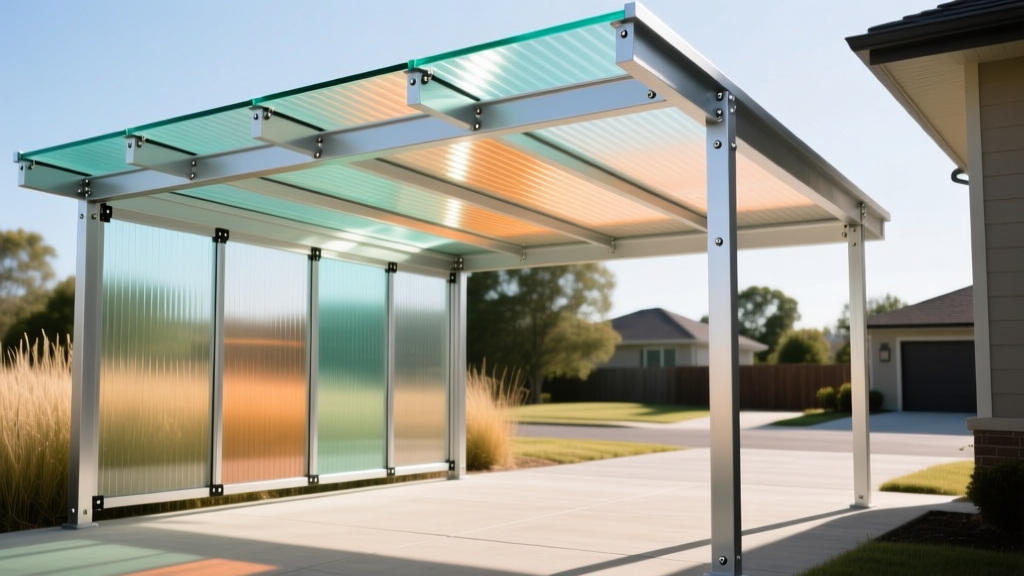
For residential carports and commercial walkways where natural light penetration is desired, multi-wall polycarbonate is the dominant car roof material. Unlike the single-layer corrugated fiberglass of the 1990s—which suffered from severe UV degradation and yellowing—modern polycarbonate panels (such as Palram Suntuf or Polygal) feature a co-extruded UV-resistant cap layer that blocks 99.9% of harmful UV radiation while allowing visible light transmission.
Critical Installation Specifications
- Orientation: The UV-protected layer must face the sun. Installing the panel upside down will result in catastrophic embrittlement and yellowing within 24 to 36 months.
- Thermal Expansion: Polycarbonate expands and contracts at a rate of 0.065 mm/m°C. A 20-foot panel will expand nearly a quarter-inch between winter and summer. Fastener holes must be drilled 1/8-inch oversized to prevent panel buckling and stress fractures.
- Purlin Spacing: For 8mm twin-wall panels, purlins should be spaced at 24 inches on center (O.C.) to handle standard 20 PSF snow loads. For 16mm triple-wall panels, spacing can be increased to 48 inches O.C.
Galvalume vs. Architectural Aluminum: Metal Carport Roofing
Metal remains the most prevalent car roof material for open-air shelters due to its high strength-to-weight ratio and non-combustible nature. However, the choice between steel and aluminum hinges entirely on the geographic location of the structure.
Galvalume Steel (AZ50 vs. AZ55 Coatings)
Standard steel carports utilize Galvalume sheets, which are coated with an aluminum-zinc alloy to prevent rust. For architectural applications, specify an AZ55 coating (0.55 ounces of aluminum-zinc per square foot) rather than the cheaper AZ50. The AZ55 coating provides superior edge creep protection, which is vital because carport roofs feature exposed, cut edges that are highly susceptible to moisture ingress. According to the Metal Construction Association, AZ55 Galvalume can achieve a 40-year bare panel warranty in non-coastal environments.
Architectural Aluminum for Coastal Zones
Within 1,500 feet of a saltwater coastline, Galvalume steel will suffer from rapid galvanic corrosion and edge delamination. In these zones, 0.032-inch or 0.040-inch architectural aluminum is the mandatory car roof material. To ensure color retention against intense UV and salt spray, specify panels finished with an AAMA 2604 fluorocarbon (PVDF) coating system, which resists chalking and fading far better than standard polyester (PE) or silicone-modified polyester (SMP) paints.
Never fasten aluminum roof panels directly to steel purlins or steel structural frames. The dissimilar metals, combined with rainwater acting as an electrolyte, will trigger severe galvanic corrosion, destroying the aluminum panel at the fastener point within a single season. Always use a dielectric slip sheet (such as 30lb felt or specialized rubberized membrane tape) between the aluminum panel and the steel substructure.
Flat Membrane Systems for Enclosed RV and Auto Garages
When constructing fully enclosed vehicle storage, RV garages, or commercial auto dealerships with low-slope roofs (less than 2:12 pitch), metal panels are inappropriate due to their reliance on gravity for water shedding. Here, Thermoplastic Polyolefin (TPO) or Ethylene Propylene Diene Monomer (EPDM) membranes become the specified car roof material.
For vehicle shelters, a 60-mil reinforced TPO membrane is the industry baseline. TPO is highly reflective, reducing the internal ambient temperature of the garage by up to 15°F compared to black EPDM, which is critical for protecting vehicle interiors and RV battery systems from extreme heat. As noted by the U.S. Department of Energy, cool roof membranes significantly reduce cooling loads in commercial structures. Seams must be heat-welded at 1,000°F to create a monolithic, hydrostatic barrier capable of holding standing water without leaking.
Engineering Wind Uplift on Open Structures
Carports and open canopies present unique aerodynamic challenges. Under the ASCE 7-22 standard, these structures are classified as 'open buildings.' Wind does not merely push against the roof; it flows underneath the canopy, creating a complex pressure differential that generates massive uplift forces on the leeward side. The FEMA Building Science division frequently highlights carport failures in post-hurricane assessments due to inadequate uplift engineering.
Fastening and Structural Anchoring
- Fastener Type: Standard lap screws are insufficient for structural attachment to purlins. Use #12 or #14 structural hex-washer head screws with a minimum 1-inch embedment into the steel substructure.
- Washer Composition: Specify EPDM (Ethylene Propylene Diene Monomer) washers, not standard neoprene. EPDM withstands continuous UV exposure and temperature extremes (-40°F to 250°F) without dry-rotting or cracking.
- Perimeter Reinforcement: The outer 8 feet of a carport roof (the perimeter zone) experience the highest uplift coefficients. Fastener patterns in this zone must be doubled (e.g., moving from 12-inch O.C. to 6-inch O.C. on the ribs).
Procurement and Specification Checklist
To ensure your vehicle shelter withstands environmental stressors and avoids premature material failure, verify the following specifications with your supplier before procurement:
- UV Co-extrusion Verification: If using polycarbonate, request the manufacturer's technical data sheet confirming the UV layer is co-extruded, not merely applied as a post-production coating.
- Coating Weight Certification: For steel carports, require mill certificates proving an AZ55 Galvalume coating weight.
- Resin Purity (TPO): Ensure the TPO membrane is manufactured without plasticizers (which migrate and cause brittleness over time) and features a polyester scrim reinforcement for puncture resistance against hail.
- Thermal Breaks: If attaching a metal car roof directly to a conditioned auto garage, specify thermal spacer blocks to prevent condensation dripping onto vehicle finishes.
Selecting the correct car roof material is an exercise in environmental adaptation. By matching the specific gauge, coating, and polymer profile to the localized wind, snow, and salt-spray conditions of the build site, contractors can deliver vehicle shelters that provide decades of structural reliability and aesthetic permanence.
Written by
James ThorntonJames Thornton is a construction industry veteran with 25 years of hands-on experience in wood framing, lumber grading, and residential building codes. He started as a framing carpenter in rural Oregon, earned his ICC Residential Building Inspector certification, and eventually became a senior plan reviewer for the City of Portland Bureau of Development Services. James holds a B.S. in Wood Science & Technology from Oregon State University and is a certified lumber grader through the West Coast Lumber Inspection Bureau (WCLIB). He has inspected over 3,000 residential construction sites and authored the city's internal guide on advanced framing techniques (2x6 at 24" O.C.). James lives in Bend, OR, where he builds custom timber-frame cabins and competes in lumberjack sports.
More from James Thornton
View all
Insulation
Best Home Insulation Materials: Complete 2026 Guide
Compare top home insulation materials for 2026. Find R-values, installed costs per square foot, and best uses for fiberglass, spray foam, and mineral wool.
Aug 4, 2026

Sustainable Building
Certify Your Green Building Material for LEED and WELL
Step-by-step guide to certifying a green building material for LEED v5 and WELL v2. Master EPDs, HPDs, and VOC limits for 2026 project specifications.
Aug 4, 2026

Stone & Masonry
Veneer Stacked Stone Panels: Interior Design & Style Showcase
Discover how veneer stacked stone panels transform interiors. Explore modern design profiles, material pairings, and technical installation specs.
Aug 4, 2026