Choosing the Best Roof Underlayment Materials: A Complete Guide
Compare synthetic, felt, and rubberized asphalt roof underlayment materials. Learn costs, lifespans, and best applications for your roofing project.

The roof covering is only the first line of defense against weather. Beneath the shingles, tiles, or metal panels lies the critical secondary water barrier: the underlayment. Selecting the correct roof underlayment materials dictates the longevity of the roof deck, the validity of manufacturer warranties, and the system's resilience against ice dams and wind-driven rain. This guide dissects the technical specifications, failure modes, and 2026 market costs of the three primary underlayment categories.
Core Roof Underlayment Materials Compared
Roofing underlayment is measured in 'squares' (100 square feet). The table below outlines current market averages for material costs, physical properties, and UV exposure limits before the primary roof covering must be installed.
| Material Type | Cost per Square | Weight per Roll | Tear Resistance | Max UV Exposure |
|---|---|---|---|---|
| Asphalt Felt (#15) | $15 - $22 | 12 - 15 lbs | Low | 30 Days |
| Asphalt Felt (#30) | $25 - $35 | 20 - 25 lbs | Medium | 30 Days |
| Synthetic (Standard) | $20 - $30 | 4 - 6 lbs | High | 90 Days |
| Synthetic (Premium) | $35 - $55 | 6 - 8 lbs | Maximum | 180 Days |
| Rubberized Asphalt | $85 - $145 | 25 - 35 lbs | Self-Sealing | 60 Days |
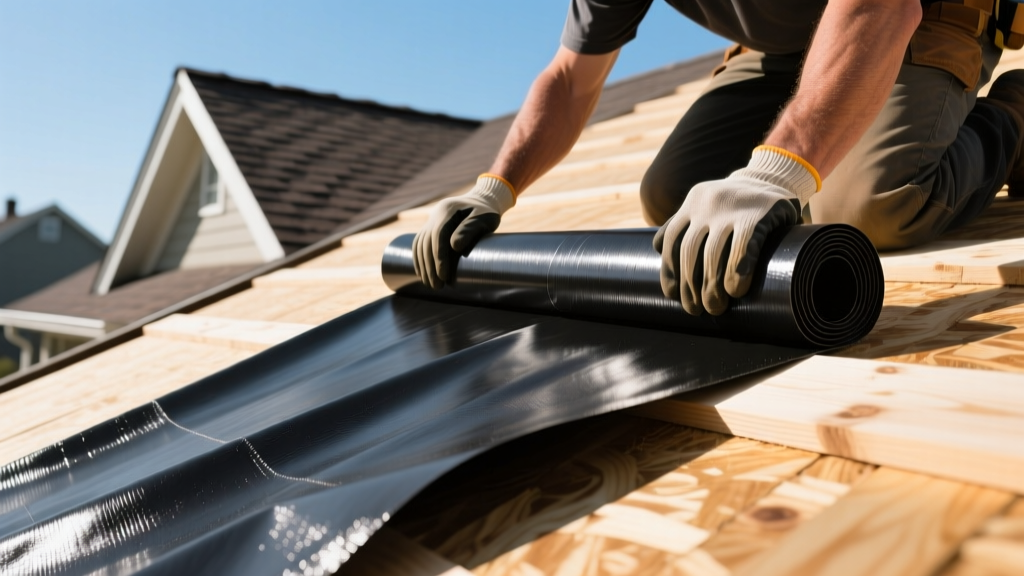
Asphalt-Saturated Felt (Tar Paper)
Historically the default choice, asphalt-saturated felt is manufactured using an organic (cellulose) or fiberglass mat saturated with asphalt. While #15 felt was once the standard, most modern building codes and shingle manufacturers now require a minimum of #30 felt if organic mat products are used, due to its superior tensile strength.
Failure Modes and Edge Cases
The primary vulnerability of organic felt is moisture absorption. If installed on a damp deck or exposed to morning dew before shingling, the felt absorbs water and expands. Once trapped beneath the shingles, it dries and shrinks, causing 'telegraphing'—visible horizontal wrinkles that distort the appearance of the roof covering. Furthermore, felt degrades rapidly under UV exposure; leaving it exposed for more than 30 days causes the asphalt to dry out, leading to micro-tearing and loss of water resistance.
When using felt on steep slopes (8:12 or greater), staples are highly discouraged. Staples tear easily through the organic mat under wind uplift. Always use plastic cap nails with a minimum 1-inch diameter cap to secure felt in high-wind zones.
Synthetic Underlayment (Polypropylene and Polyethylene)
Synthetic underlayments, woven or non-woven from polyolefin polymers, have captured the majority of the residential roofing market. Products like Owens Corning DeckArmor and GAF FeltBuster offer distinct advantages over traditional felt, primarily centered on dimensional stability and weight.
Why Synthetics Dominate Modern Roofing
Because synthetics are hydrophobic, they do not absorb moisture, eliminating the wrinkling and telegraphing issues inherent to organic felt. They also feature engineered slip-resistant top coatings, a critical safety feature for roofers working on steep pitches.
Premium synthetics tested under ASTM D5469 (Standard Specification for Polymeric Roof Underlayment) routinely demonstrate tear strengths exceeding 30 lbf (pounds-force) in both machine and cross directions, compared to the 6 lbf minimum required for standard #15 felt under ASTM D226.
Rubberized Asphalt (Peel-and-Stick)
Rubberized asphalt underlayment, often referred to as ice and water shield, consists of a polymer-modified (SBS) asphalt coating backed by a cross-laminated or polyethylene film. Unlike felt and synthetic, which rely on mechanical fasteners, rubberized asphalt is self-adhering and self-sealing around nail penetrations.
Pros and Cons of Self-Adhered Membranes
- Pro: Completely impermeable to liquid water; seals around fasteners preventing capillary action.
- Pro: Essential for mitigating ice dam water backup in cold climates.
- Con: High material cost (up to 5x the price of standard synthetic).
- Con: Can adhere too aggressively to wooden decks, making future tear-offs difficult and damaging to the OSB/plywood sheathing.
- Con: Requires a completely dry, dust-free deck for proper adhesion; will fail to bond to damp or frosty wood.
Decision Framework: Matching Underlayment to Your Roof
Do not use a single underlayment for the entire roof if the geometry or climate demands a hybrid approach. Use this framework to specify materials for your project:
- Scenario A: Standard Asphalt Shingle Roof (Temperate Climate, 4:12+ Pitch)
Use a high-quality synthetic underlayment (e.g., Tyvek Protec 120) for the entire deck. It provides the best balance of cost, slip resistance, and tear strength. - Scenario B: Cold Climate with Ice Dam History
Install a rubberized asphalt membrane (e.g., Grace Ice & Water Shield) from the eaves edge extending at least 24 inches past the interior warm wall line. Cover the remainder of the roof field with synthetic underlayment. - Scenario C: Metal Roofing Systems
Standard asphalt-based underlayments can soften and adhere to the underside of metal panels when deck temperatures exceed 180°F in the summer. Specify a high-temp synthetic or a specialized non-adhering metal roof underlayment (like SharkSkin Ultra) that features a slip layer to accommodate thermal expansion and contraction of the metal. - Scenario D: Low-Slope Applications (2:12 to 4:12 Pitch)
Asphalt shingles on low slopes require a double layer of underlayment per the International Residential Code (IRC), or a continuous peel-and-stick membrane covering 100% of the deck to prevent wind-driven water intrusion.
Installation Edge Cases and Code Compliance
Proper material selection is useless without code-compliant installation. The International Residential Code (IRC) Chapter 9 mandates specific underlayment applications based on roof slope and climate zone.
High-Wind and HVHZ Requirements
In High-Velocity Hurricane Zones (HVHZ), standard underlayment attachment is insufficient. The National Roofing Contractors Association (NRCA) recommends securing synthetic underlayments in these zones using corrosion-resistant plastic cap nails spaced a maximum of 12 inches apart in the field and 6 inches at the overlaps, rather than relying on the manufacturer's standard 24-inch spacing.
Valleys and Penetrations
Regardless of the field underlayment chosen, all open valleys, roof-to-wall intersections, and penetrations (chimneys, skylights, plumbing vents) must be flashed with a minimum 36-inch wide strip of rubberized asphalt membrane before the primary underlayment and metal flashing are installed.
Frequently Asked Questions
Can I mix different brands of underlayment on the same roof?
Yes, but only if they are the same material type. You can use one brand of synthetic on the main field and a different brand of rubberized asphalt in the valleys. However, mixing felt and synthetic on the same roof plane is not recommended due to differing expansion rates and fastener requirements.
Does synthetic underlayment void my shingle warranty?
No. Major manufacturers like Owens Corning and GAF explicitly approve the use of ASTM-compliant synthetic underlayments. In fact, using the manufacturer's proprietary synthetic underlayment often qualifies the roof for enhanced, extended warranty tiers.
How long can synthetic underlayment be left exposed?
While premium synthetics boast UV resistance of up to 180 days, this only applies to the material's structural integrity, not its slip resistance. Dust, pollen, and UV exposure will degrade the slip-resistant coating within a few weeks. Always cover exposed underlayment as soon as the roofing material schedule allows.
Written by
Elena RodriguezElena Rodriguez is a civil engineer and technical writer specializing in concrete technology, masonry systems, and ASTM/ACI compliance. She earned her B.S. in Civil Engineering from Texas A&M University and spent a decade at a materials testing laboratory, performing over 2,000 concrete compressive strength tests and masonry prism evaluations. Elena is an ACI-certified Field Testing Technician (Grade I) and a member of ASTM Committee C12 on Natural Building Stone. She currently consults on forensic engineering cases involving concrete failures and moisture intrusion. Based in San Antonio, TX, Elena is a proud member of the Society of Women Engineers (SWE) and coaches her daughter's FIRST Robotics team.
More from Elena Rodriguez
View all
Walls & Panels
Cost Analysis: Light Gauge Steel Framing Advantages and Disadvantages
Evaluate light gauge steel framing advantages and disadvantages through a strict cost analysis lens, comparing material, labor, and lifecycle expenses.
Aug 4, 2026

Walls & Panels
Gypsum Board Types: Exact Specifications, Thickness & Dimensions
Compare standard, Type X, and moisture-resistant gypsum board types. Get exact specifications, thicknesses, dimensions, and ASTM standards for your project.
Aug 4, 2026

Fire Resistance
Best Fire-Resistant Outdoor Decking Materials: 2026 Buyer Guide
Discover the best fire-resistant outdoor decking materials for 2026. Compare Class A PVC, aluminum, and hardwood options for WUI compliance and safety.
Aug 4, 2026